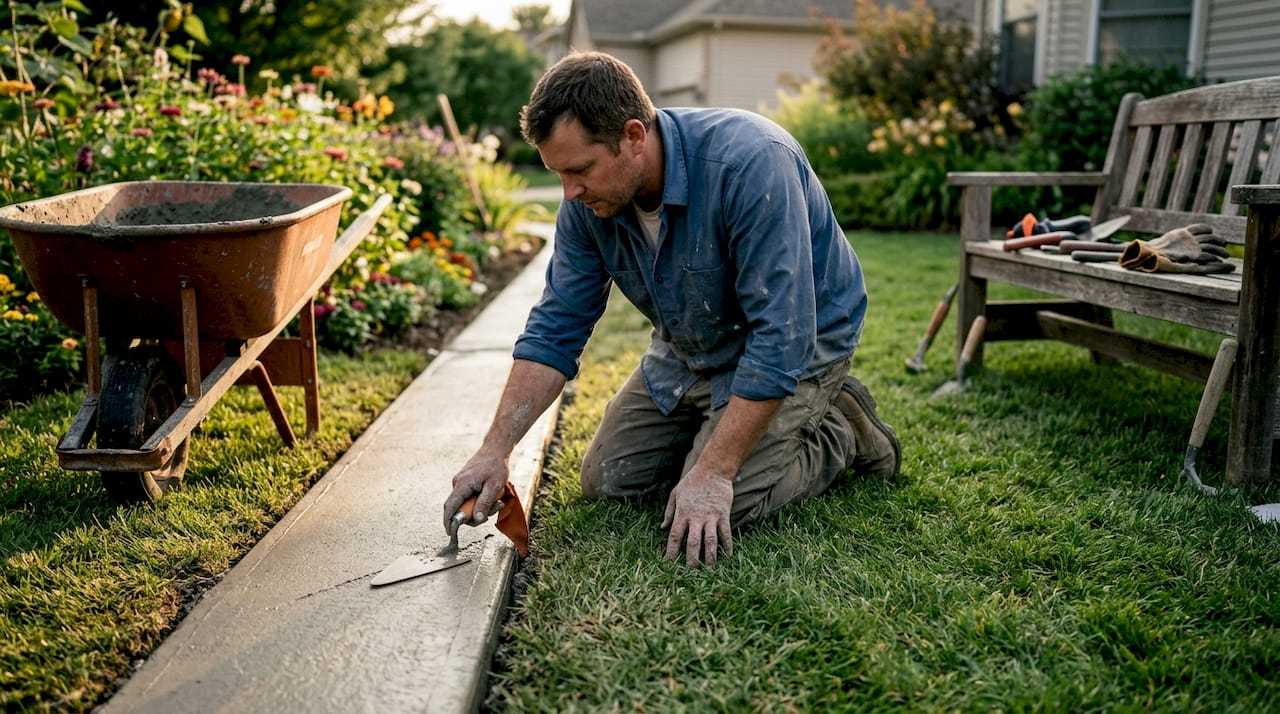
A concrete border detail is a permanent concrete edging that forms a crisp, defined boundary around landscaping features, keeping materials like mulch, gravel, and soil exactly where they belong. Known in the industry as concrete landscape curbing, this type of edging is installed on-site using specialized equipment and is designed to last for years without shifting or separating. Property owners and landscapers choose it over plastic or metal alternatives because it holds its shape, resists root intrusion, and adds a finished, professional look to any outdoor space. VW Concreting has completed over 145 projects across Melbourne, and concrete border details appear in a significant share of them.
What is a concrete border detail and how is it formed?
A concrete border detail is a continuous or sectional concrete edging poured directly on-site to create a permanent boundary between landscaping zones. The industry term for the most common method is extruded or poured-in-place concrete edging. This approach uses specialized machinery to push wet concrete through a mold, forming a continuous concrete ribbon that follows the exact layout of your yard, including curves, corners, and irregular shapes.
The result is a single solid structure with no joints or gaps. That matters because joints are where sectional edging fails. Pre-made concrete sections, the kind you buy at a hardware store and press into the ground, develop gaps over time as soil shifts. Weeds push through those gaps. Mulch migrates. The border loses its clean line within a season or two.
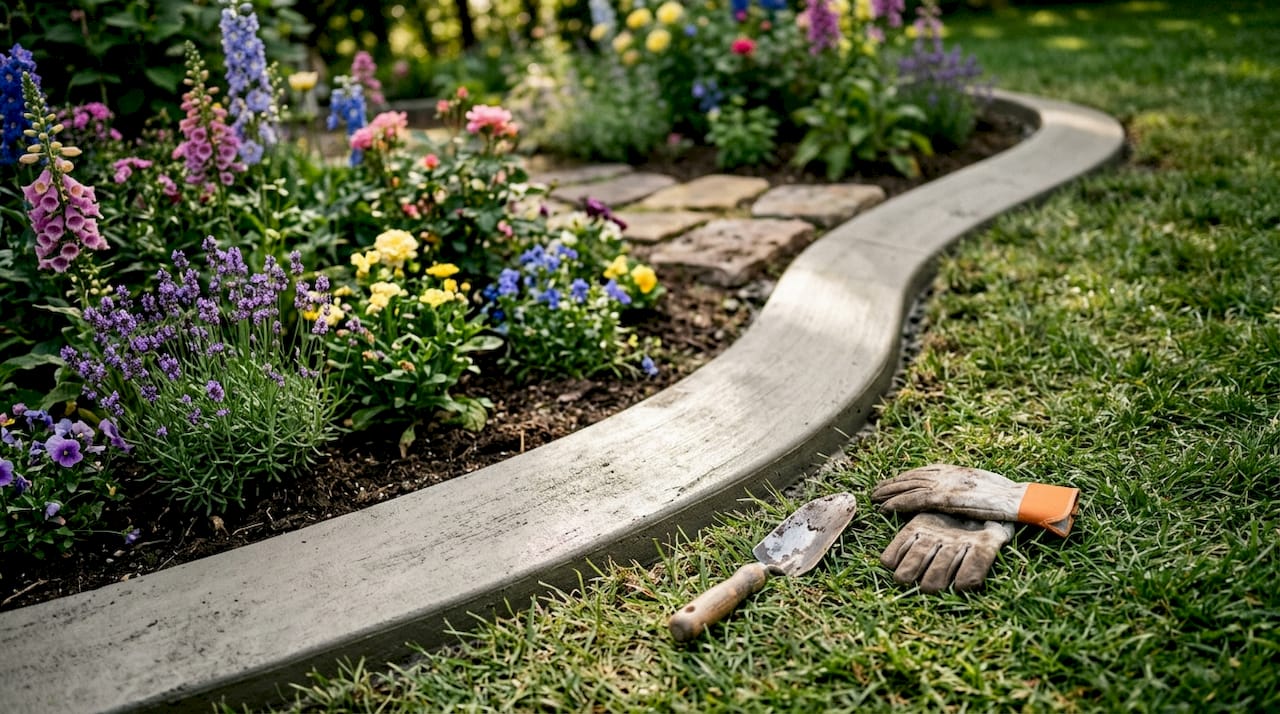
Extruded systems avoid that problem entirely. Because the concrete is formed on-site in one continuous pour, extruded systems adapt precisely to the contours of your landscape. Stamps and textures are pressed into the surface while the concrete is still wet, so decorative finishes are built into the structure rather than applied afterward.
Common profile options include:
- Mower edge: A flat, low-profile border that lets a mower wheel ride along the top, eliminating hand trimming
- Slant edge: A sloped face that directs water away from planting beds
- Rounded or dome profile: A classic look suited to formal garden beds and driveways
- Stamped or textured finish: Patterns pressed into wet concrete to mimic stone, brick, or cobble
Pro Tip: Machine-extruded borders produce a more consistent cross-section than hand-formed pours. If your installer is forming the border by hand without a mold or machine guide, the finished height and width will vary, which affects both appearance and durability.
What is the functional purpose of concrete border details?
Concrete border details serve one primary function: material separation and containment. They keep decorative materials like mulch, bark, and gravel inside planting beds and off pathways or lawns. That sounds simple, but the practical impact on maintenance is significant. Without a solid border, mulch spreads across a lawn after every rain, gravel migrates onto driveways, and planting beds lose their defined shape within months.
Beyond containment, concrete borders act as a durable root barrier. The depth of the edging in the ground, typically 4–6 inches, physically blocks shallow root systems from crossing into lawn areas or pathways. This is particularly useful around aggressive ground covers, ornamental grasses, and shrubs that spread laterally.
Concrete border details are appropriate for:
- Defining flower beds and planting zones along lawns
- Separating gravel paths from turf or garden beds
- Edging driveways and walkways for a clean finish
- Creating boundaries between lawn and mulched tree surrounds
- Framing decorative garden features like water features or raised beds
Concrete border details are not appropriate for:
- Solving drainage or erosion problems. The edging does not redirect water flow in any meaningful way.
- Replacing retaining walls or structural support elements
- Areas with severe slope changes where water pooling is likely against the edge
The role of concrete edging in a landscape project is functional first and decorative second. Choosing it for the wrong reason, such as trying to fix a drainage issue, leads to premature failure.
How to install concrete border details: key steps and best practices
Installation quality determines whether a concrete border lasts five years or twenty-five. The visible curb is only one part of the system. The compacted base and drainage path underneath are equally important, and neglecting either causes failure even when the surface looks fine at first.
Here is how a professional installation proceeds:
- Mark the layout. Use spray paint, string lines, or garden hose to define the exact path of the border before any digging starts. Curves should be smooth and intentional, not improvised.
- Dig the trench. A trench 4–6 inches deep is standard for most residential applications. Width depends on the profile selected, but 4–6 inches is typical for a mower edge or slant profile.
- Compact the base. Loose soil under the border causes settling and cracking. Compact the trench base firmly. In areas with poor drainage or sandy soil, add a thin gravel layer before pouring.
- Check water flow. Before pouring, confirm that water flow patterns do not direct runoff against the back of the border. Water pooling against the edge undermines the base over time and causes the border to shift or crack.
- Pour or extrude the concrete. Machine extrusion produces the most consistent result. Hand forming is possible for short straight runs but requires careful attention to profile consistency.
- Stamp and finish. Apply any texture or color while the concrete is still workable. Integral color mixed into the concrete lasts longer than surface-applied stains.
- Cure properly. Keep the border moist for at least 24–48 hours after pouring. Avoid foot traffic for 48 hours and heavy loads for at least a week.
Pro Tip: Check for tree roots before digging. Cutting through a major root during trench work can destabilize a mature tree and create a trip hazard as the root decays and the border shifts above it.
The entire border system must be treated as a unit. A perfectly poured curb on a poorly compacted base will fail. A well-compacted base with ignored drainage will also fail. All three elements need attention.
What are the benefits and limitations of concrete border details?
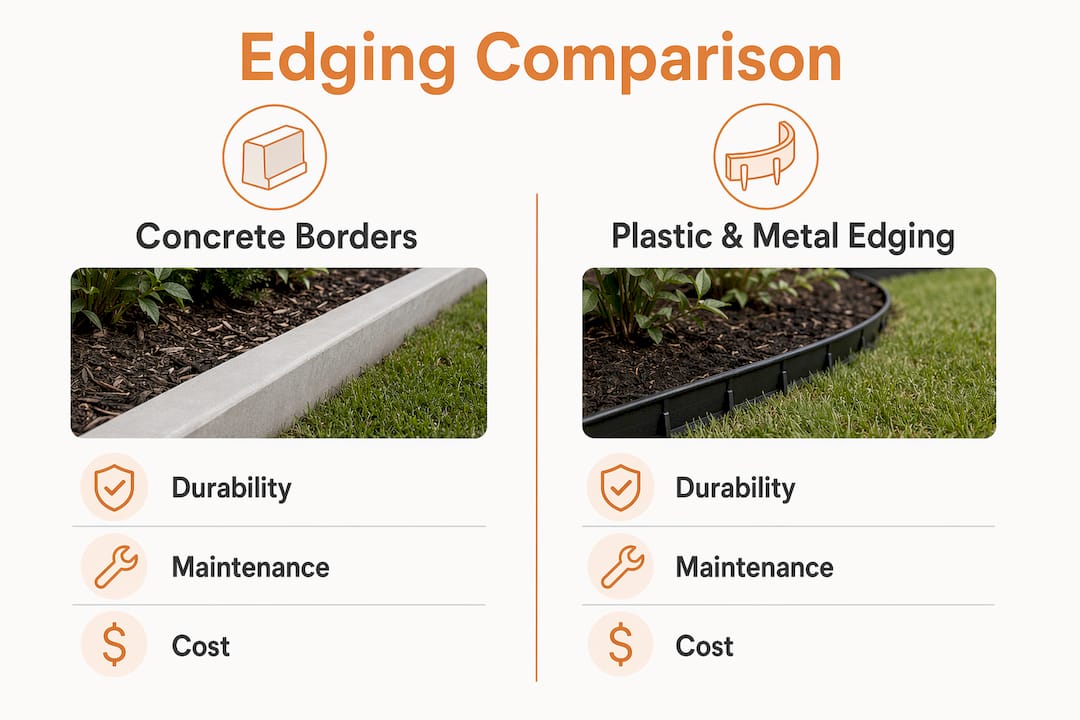
Concrete border details outperform plastic and metal edging on almost every practical measure. The table below compares the key factors across edging categories.
| Factor | Concrete border details | Plastic or metal edging |
|---|---|---|
| Lifespan | Decades with proper installation | 3–10 years before warping or corrosion |
| Maintenance | Minimal once cured | Requires periodic re-staking and replacement |
| Customization | Colors, textures, and profiles available | Limited to standard shapes and colors |
| Root barrier effectiveness | High due to depth and weight | Low to moderate |
| Weed resistance | High with continuous pour | Low at joints and edges |
| Removal | Difficult and labor-intensive | Easy |
| Upfront cost | Higher | Lower |
The continuous pour method eliminates the joints that allow weeds to establish and sections to shift. That single structural advantage accounts for most of the maintenance difference between concrete and sectional alternatives.
The main limitation is permanence. Concrete borders are difficult and expensive to remove if you change your landscape design. They also require professional installation to perform correctly, which adds to upfront cost. Property owners who plan to redesign their yard within a few years may prefer a less permanent edging option.
Pro Tip: Choose an integral color that complements your home’s exterior rather than matching your garden plants. Plants change seasonally. Your concrete border will be there for decades.
For color and texture options that hold up in Melbourne’s climate, the finish selection matters as much as the profile. Exposed aggregate and stamped finishes add visual interest without requiring ongoing maintenance.
Key Takeaways
A concrete border detail is the most durable and low-maintenance edging option available, but it requires professional installation, proper base preparation, and drainage planning to perform as intended.
| Point | Details |
|---|---|
| Definition and purpose | A concrete border detail is a permanent on-site edging that separates landscape materials and defines boundaries. |
| Extruded method is superior | Continuous poured-in-place borders eliminate joints, reducing weed intrusion and shifting over time. |
| Installation is a system | The trench depth, compacted base, and drainage path are as critical as the visible concrete curb. |
| Know the limitations | Concrete borders are permanent and difficult to remove; they do not solve drainage or erosion problems. |
| Customization adds value | Integral colors, stamped textures, and profile choices let borders complement any landscape design. |
Why I think most property owners underestimate what goes into a good border
After years of working on landscaping and concreting projects across Melbourne, the pattern I see most often is this: property owners focus entirely on how the border looks and almost nothing on what sits underneath it. They approve the profile, pick a color, and assume the rest is straightforward. It rarely is.
The base preparation is where most failed borders start going wrong. Soil that has not been compacted properly will settle unevenly within the first wet season. The border cracks, tilts, or develops a wavy line that no amount of cleaning will fix. I have seen borders installed by well-meaning DIYers that looked perfect on day one and were visibly failing by month six.
The other mistake I see regularly is ignoring water. A border installed across a natural drainage path will have water pushing against its back face every time it rains. Over time, that pressure undermines the base. The landscaping and concreting integration that produces lasting results always starts with a site assessment, not a product selection.
My honest advice: treat the border as infrastructure, not decoration. The decorative finish is the last decision you make, not the first. Get the site conditions right, get the base right, and the border will look good and stay that way for decades.
— Vic
Professional concrete border installation in Melbourne
VW Concreting brings over two decades of experience to every concrete border project, from simple garden bed edging to full-property landscaping borders with custom finishes.
Whether you need a mower edge along a lawn, a stamped border around a driveway, or a complete landscaping border system for a new build, the VW Concreting team handles every stage from site assessment to final cure. Every project includes proper base preparation, drainage review, and finish selection suited to your property. With over 145 completed projects across Melbourne, VW Concreting delivers borders that hold their line and their look for the long term. Contact the team for a quote on your next concrete border project.
FAQ
What is a concrete border detail in landscaping?
A concrete border detail is a permanent on-site concrete edging that creates a defined boundary between landscaping zones, keeping materials like mulch and gravel contained. It is also called concrete landscape curbing and is typically formed using specialized extrusion equipment.
How deep should a concrete border be installed?
A standard concrete border trench is 4–6 inches deep, with the base compacted before pouring. Proper depth provides stability and acts as an effective root barrier.
Can I install concrete edging myself?
Short straight runs can be hand-formed, but curved or large-scale borders require specialized machinery and professional experience to achieve a consistent profile and durable result. Poor base preparation is the most common cause of DIY border failure.
How long does a concrete border last?
A properly installed concrete border lasts for decades with minimal maintenance. Longevity depends on correct base compaction, drainage management, and professional installation technique.
Is concrete edging better than plastic or metal edging?
Concrete edging outlasts plastic and metal alternatives in lifespan, root barrier effectiveness, and weed resistance. The higher upfront cost is offset by significantly lower maintenance and replacement costs over time.
Leave A Comment