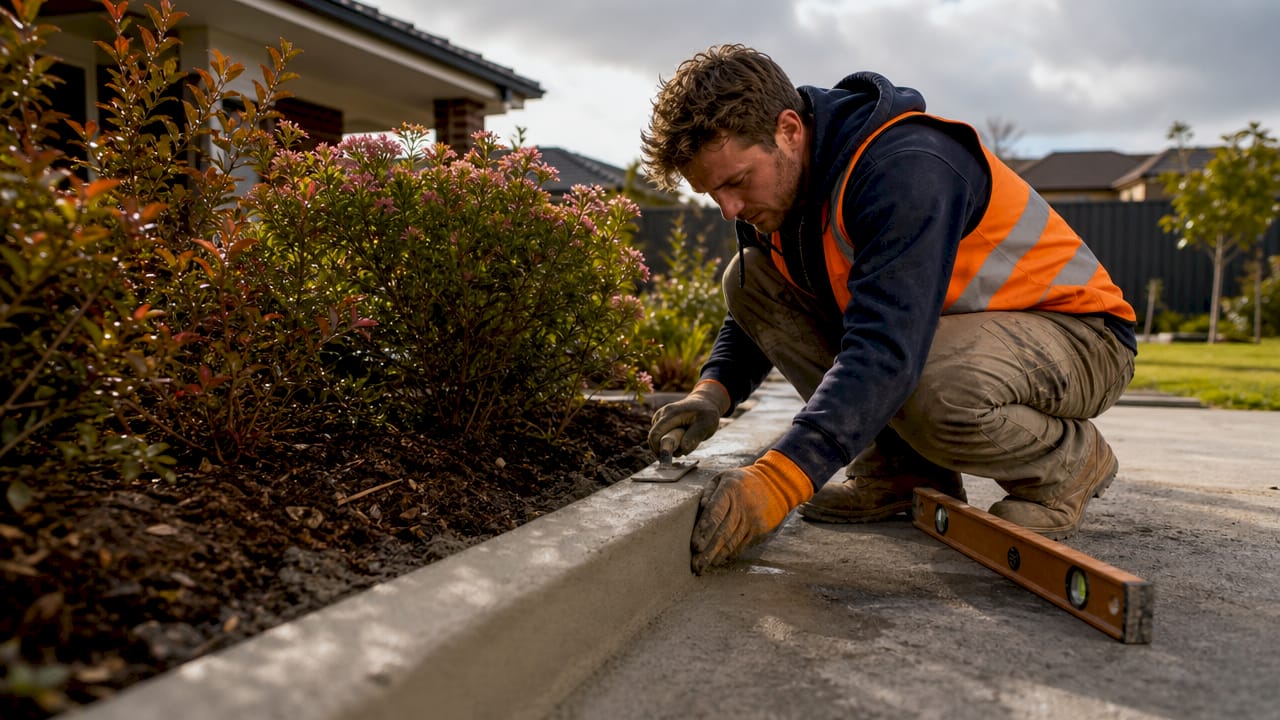
A concrete kerbing system is a continuous raised or flush concrete border installed along driveways, garden beds, pathways, and roads to define boundaries, control water runoff, and protect adjacent surfaces. The industry standard term is “concrete curbing” in American usage, though “kerbing” is the recognized term in Australian and British construction practice. Both terms describe the same structural element. VW Concreting, a Melbourne-based contractor with over 145 projects completed since 2001, installs concrete kerbing as part of full landscaping and outdoor construction packages. Vertical concrete kerbs reduce pedestrian accidents by up to 45% and manage roughly 50% of urban stormwater runoff. Those two numbers alone explain why kerbing appears in nearly every serious landscaping and property development project.
What is a concrete kerbing system and why does it matter?
A concrete kerbing system is a formed concrete edge that separates two surfaces, typically turf and pavement, garden bed and driveway, or road and footpath. It performs three jobs at once: it defines a boundary, it restrains lateral movement of pavement materials, and it channels water away from structures. Without kerbing, pavement edges spread outward over time, soil erodes into paved areas, and water pools where it causes the most damage.
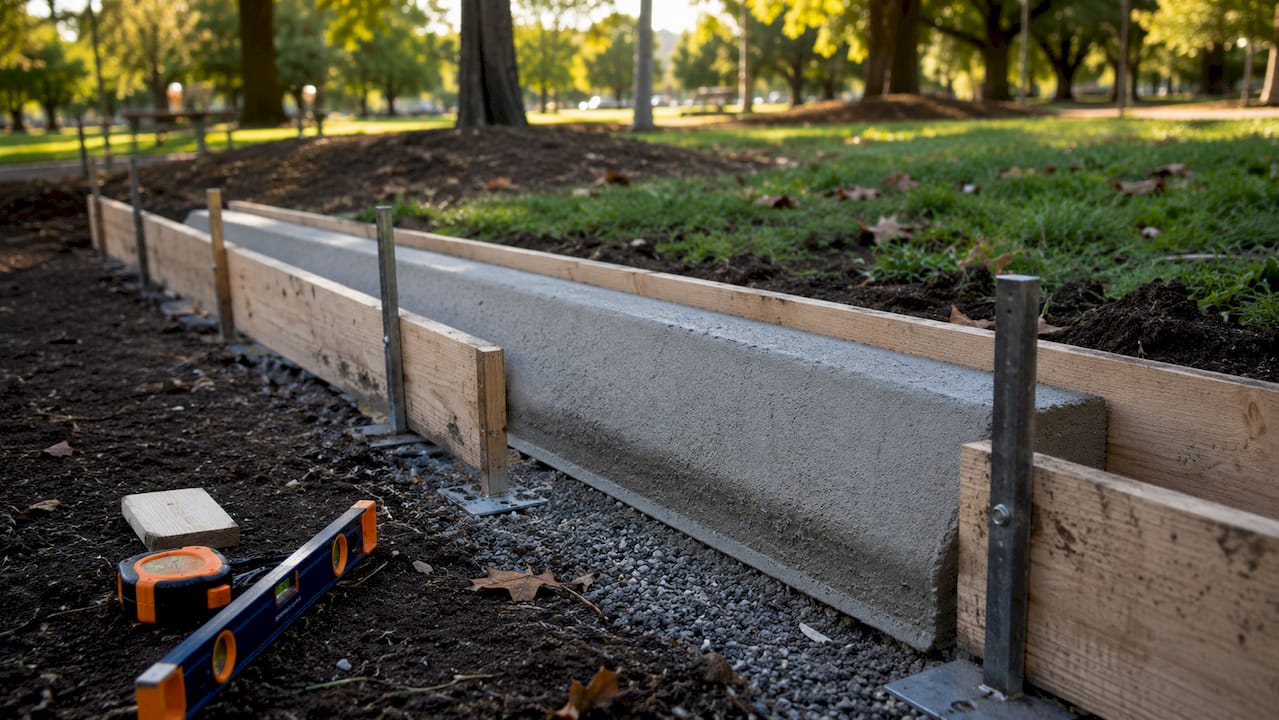
Properly installed concrete kerbing prevents lateral spreading of pavement and protects garden edges from erosion. That structural role is often underestimated by homeowners who think of kerbing as purely decorative. The reality is that missing or failed kerbs compromise the entire pavement structure around them.
Concrete kerbing also acts as a continuous barrier against turf roots, stopping grass from creeping into garden beds and reducing the time you spend weeding and trimming. That maintenance benefit compounds over years, making concrete a smarter long-term choice than plastic or timber edging.
What are the different types of concrete kerbing?
Concrete kerbing comes in five main forms. Each suits a different application, budget, and aesthetic goal.
| Style | Best Use | Key Feature |
|---|---|---|
| Poured-in-place curbing | Garden beds, driveways | Custom shapes, seamless finish |
| Precast border stones | Pathways, formal gardens | Consistent sizing, easy replacement |
| Extruded curbing | Long runs, commercial sites | Machine-formed, fast installation |
| Stamped decorative borders | Feature gardens, patios | Patterns mimic stone or brick |
| Flush mow strips | Lawn edges | Mower wheels run on the surface |
| Exposed aggregate edging | Decorative residential | Textured finish, visual contrast |
Poured-in-place curbing is formed on-site using timber or steel formwork. It suits curved garden beds and irregular shapes where precast units would require too many cuts. The finish is seamless and can be colored or stamped.
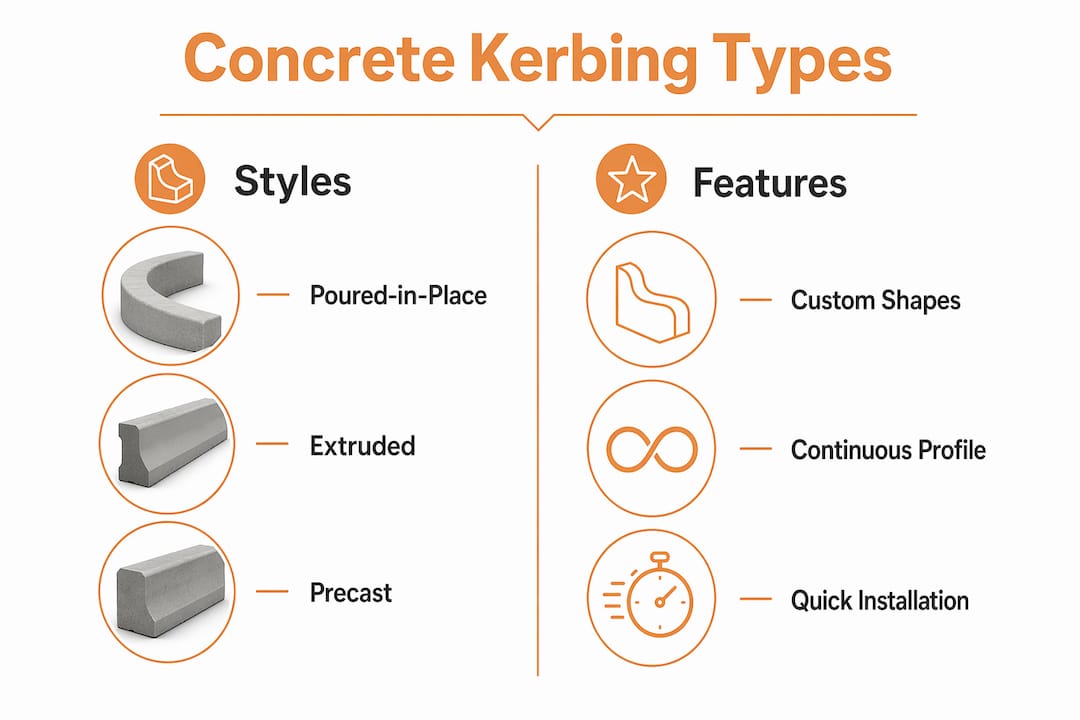
Extruded curbing is produced by a curbing machine that extrudes a continuous concrete profile directly onto a prepared base. This method works best on long straight or gently curved runs, such as commercial parking lots or residential driveways. It is fast and cost-effective at scale.
Flush mow strips are the most practical choice for lawn edges. Flush mow strips save 15–30 minutes of trimming time per mowing session because mower wheels roll along the concrete surface instead of requiring a separate string trimmer pass. Over a full mowing season, that time saving is significant.
Matching kerbing style to existing hardscape materials improves visual cohesion and adds perceived property value. A brushed concrete mow strip pairs naturally with a brushed concrete driveway, while an exposed aggregate border complements an exposed aggregate driveway.
How is a concrete kerbing system installed?
Installation quality determines how long a kerbing system lasts. A poorly prepared base causes cracking and settlement within a few years. The process follows a clear sequence whether you hire a professional or tackle it yourself.
- Mark the layout. Use spray paint or string lines to define the kerb alignment. Curves require flexible formwork or a curbing machine.
- Excavate and compact the base. Remove 4–6 inches of soil along the marked line. Compact the subgrade firmly. A loose base is the leading cause of kerb failure.
- Set formwork or position precast units. For poured-in-place kerbing, set timber or steel forms to the correct height and alignment. For precast units, bed each piece on a mortar layer.
- Mix and place concrete. Use a concrete mix suited to outdoor exposure. For extruded kerbing, load the curbing machine and run it along the prepared base in a single continuous pass.
- Finish and cure. Trowel or stamp the surface as required. Cover with curing compound or plastic sheeting for at least 24 hours to prevent surface cracking.
- Backfill and compact. Once the concrete reaches sufficient strength (typically 48–72 hours), backfill both sides and compact firmly to prevent edge movement.
Professional installation covers site prep, base compaction, concrete placement, alignment, and backfill as a complete sequence. Skipping any step creates weak points that show up within the first winter.
Pro Tip: Calculate your net kerb volume first by measuring length, width, and height of the kerb profile, then apply a waste factor of 5–10% before ordering concrete. Over-ordering on a small job wastes money; under-ordering forces a second batch that may not match the first pour.
DIY installation is feasible for short straight runs using precast units or simple poured-in-place borders. For curved layouts, long runs, or projects requiring extruded profiles, a curbing machine and experienced operator produce a far better result. VW Concreting uses professional-grade equipment on every kerbing job, which is why the finish holds up over decades rather than seasons.
How does concrete kerbing compare to alternatives in cost and durability?
Concrete kerbing costs more upfront than plastic or timber edging. It pays back that premium many times over in lifespan and reduced maintenance.
Installed costs for concrete landscape edging range from $3 to $15 per linear foot, depending on style, site complexity, and finish. A simple flush mow strip sits at the lower end. A stamped decorative border with color additives sits at the higher end.
| Material | Typical lifespan | Maintenance needs | Relative cost |
|---|---|---|---|
| Concrete kerbing | 20+ years | Minimal | Medium to high upfront |
| Plastic edging | 2–5 years | Moderate (warps, fades) | Low upfront |
| Timber edging | 5–10 years | High (rots, splinters) | Low to medium |
| Steel edging | 10–15 years | Low to moderate (rusts) | Medium |
A concrete mow strip lasts at least 20 years, outperforming every common alternative. Plastic edging warps in summer heat and becomes brittle in cold. Timber rots at soil contact points. Steel eventually rusts through at the base.
Concrete does have one vulnerability: freeze-thaw cycles. In climates with hard winters, water enters micro-cracks, freezes, and expands, widening the crack over time. The fix is straightforward. Use an air-entrained concrete mix, seal the surface every few years, and install control joints at regular intervals to give the slab a place to move without cracking randomly. Melbourne’s climate is mild enough that freeze-thaw is rarely a concern, but property developers working in cooler regions should specify the right mix from the start.
Pro Tip: Concrete kerbing acts as a permanent turf barrier that plastic and timber simply cannot match. If you spend more than 20 minutes per month re-edging a garden bed, the concrete option pays for itself in saved labor within two to three years.
What practical roles does concrete kerbing serve in landscaping and property development?
Concrete kerbing does more than look clean. It performs structural, safety, and environmental functions that improve a property’s long-term value and usability.
- Pavement restraint. Kerbing locks the edge of a driveway or path in place, preventing the base material from spreading laterally under vehicle loads. Without it, driveway edges crumble and the surface cracks from the outside in.
- Pedestrian safety. Raised kerbs create a clear physical separation between vehicle zones and pedestrian zones. The 45% reduction in pedestrian accidents associated with vertical kerbs reflects how effectively a simple raised edge guides both drivers and walkers.
- Stormwater management. Kerb and gutter systems channel runoff away from buildings and garden beds, directing it toward drains. This protects foundations and prevents soil saturation in garden areas.
- Erosion control. Garden bed edging holds topsoil in place during heavy rain. Without a solid border, mulch and soil wash onto paved surfaces and into drains.
- Visual definition. A clean kerb line gives a property a finished, intentional look. It separates lawn from garden, driveway from turf, and path from planting in a way that no amount of mulch or gravel can replicate.
For property developers, concrete kerbing is a cost-effective way to add perceived quality to a project. Buyers and tenants notice clean edges. They signal that the rest of the construction is equally well-considered. Pairing kerbing with landscaping that integrates concreting creates a cohesive outdoor space that holds its value. You can also explore paver stone options to complement kerbing in feature areas and entry courts.
Key Takeaways
A concrete kerbing system is the most durable, low-maintenance boundary solution available for landscaping and property development, outperforming plastic, timber, and steel alternatives on every long-term metric.
| Point | Details |
|---|---|
| Definition and function | Concrete kerbing defines boundaries, restrains pavement edges, and manages stormwater runoff. |
| Style selection matters | Match kerbing style to existing hardscape for visual cohesion and maximum property value. |
| Installation sequence is critical | Base compaction and correct curing prevent the cracking and settlement that ruin cheap jobs. |
| 20+ year lifespan | Concrete outlasts plastic (2–5 years), timber (5–10 years), and steel (10–15 years) by a wide margin. |
| Cost range | Installed costs run $3–$15 per linear foot, with long-term savings from reduced maintenance. |
Why I think most people underestimate concrete kerbing
Most homeowners treat kerbing as an afterthought. They plan the garden, choose the plants, lay the pavers, and then ask what to put around the edges. That order of thinking is backwards. Kerbing is a structural element. It should be planned at the same time as the driveway or garden layout, not added as a finishing touch.
The most common mistake I see is a poorly compacted base. The concrete looks fine on day one. Six months later, one section has settled 20 millimeters and cracked through. The fix costs more than getting it right the first time. Compaction is not glamorous work, but it is the single biggest predictor of how long a kerbing installation lasts.
The second mistake is choosing style without thinking about the rest of the property. A stamped decorative border looks out of place next to a plain brushed driveway. A flush mow strip looks unfinished next to a formal garden with raised beds. The concrete edging role in landscaping is as much visual as structural. Getting both right at once is what separates a good job from a great one.
For large projects, professional installation is not just more convenient. It produces a measurably better result. Curbing machines extrude a consistent profile that hand-formed work rarely matches. The alignment is tighter, the finish is cleaner, and the base preparation is done with equipment that actually achieves the required compaction. I have seen too many DIY kerbing jobs that looked acceptable at completion and were crumbling within two years. The upfront cost of professional work is the cheaper option when you account for the full project lifespan.
— Vic
Concrete kerbing services in Melbourne
VW Concreting has delivered comprehensive concreting and landscaping projects across Melbourne since 2001, with over 145 completed jobs ranging from residential driveways to full property development packages. Concrete kerbing is one of the most requested elements in those projects because it ties every outdoor surface together.
Whether you need a simple flush mow strip around a lawn edge or a full kerb and gutter system for a new development, VW Concreting brings the equipment, experience, and materials to do it properly. Professional installation means correct base preparation, the right concrete mix, and a finish that lasts decades. Contact VW Concreting to get a quote for your kerbing project or to discuss how kerbing fits into your broader landscaping services in Melbourne.
FAQ
What is the difference between a kerb and a curb?
Kerb and curb refer to the same concrete edge structure. “Curb” is the American English spelling; “kerb” is used in Australian, British, and New Zealand construction practice.
How long does concrete kerbing last?
Concrete kerbing lasts at least 20 years when properly installed, significantly longer than plastic (2–5 years), timber (5–10 years), or steel edging (10–15 years).
Can I install concrete kerbing myself?
Short straight runs using precast units are DIY-feasible. Curved layouts, long runs, or extruded profiles require a curbing machine and experienced operator for a quality result.
How much does concrete kerbing cost per linear foot?
Installed costs range from $3 to $15 per linear foot, depending on the style, site complexity, and surface finish selected.
Does concrete kerbing help with drainage?
Yes. Concrete kerb and gutter systems manage a significant portion of stormwater runoff by channeling water away from buildings, garden beds, and paved surfaces toward drains.
Leave A Comment