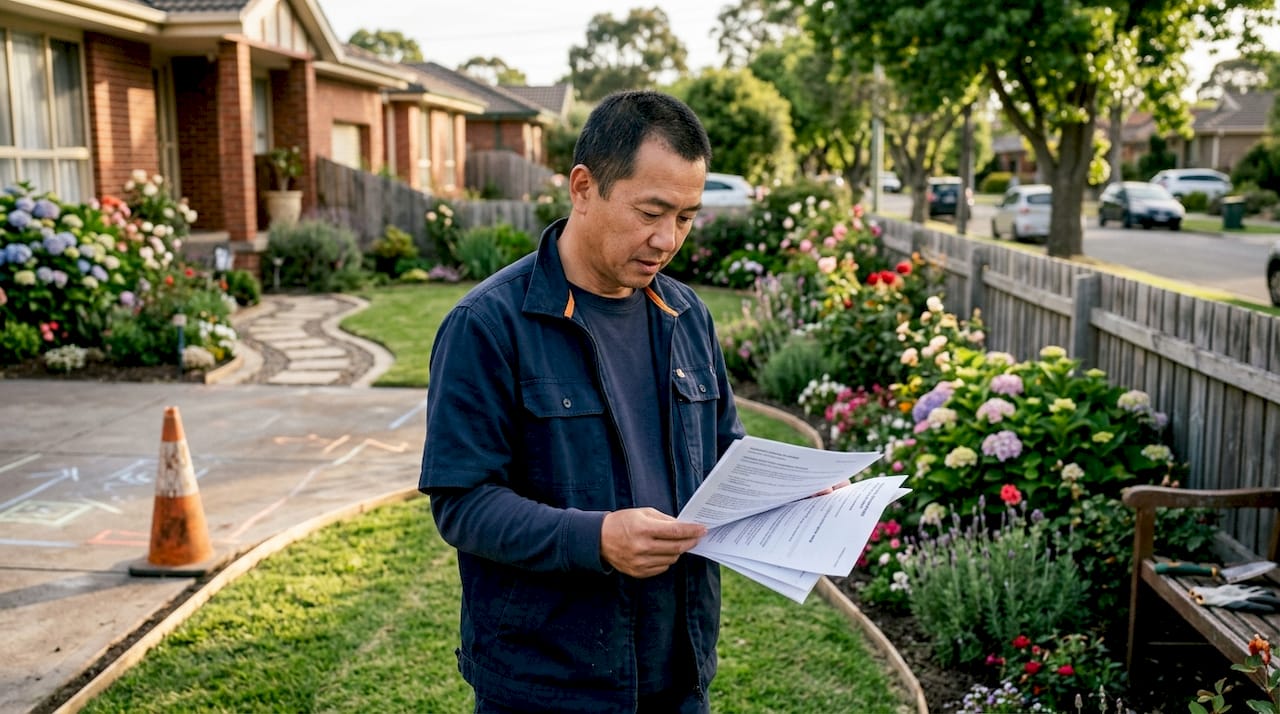
A crossover permit is a mandatory council approval for constructing or modifying the section of your driveway that connects your property to the public road. That strip of ground covering the footpath, nature strip, and kerb sits within the public road reserve, not your private land. Melbourne councils control all work in that zone to protect underground services, pedestrian safety, and road infrastructure. Understanding why driveways need crossover permits saves you from costly mistakes, project delays, and legal exposure before a single shovel hits the ground.
Why driveways need crossover permits: the legal foundation
A crossover is defined as the paved connection between a private property boundary and the public road carriageway. Because it crosses public land, it falls under council jurisdiction, not private property rules. Transport for Victoria and local councils share responsibility for managing this space, and no work can proceed without their formal approval.
The legal basis is clear. Vehicle crossing permits are legal contracts committing the permit holder to council engineering standards. They exist to prevent public hazards like footpath subsidence, flooding, and damage to buried utilities. Homeowners routinely underestimate how binding these conditions are, which is why skipping the permit creates serious long-term liability.
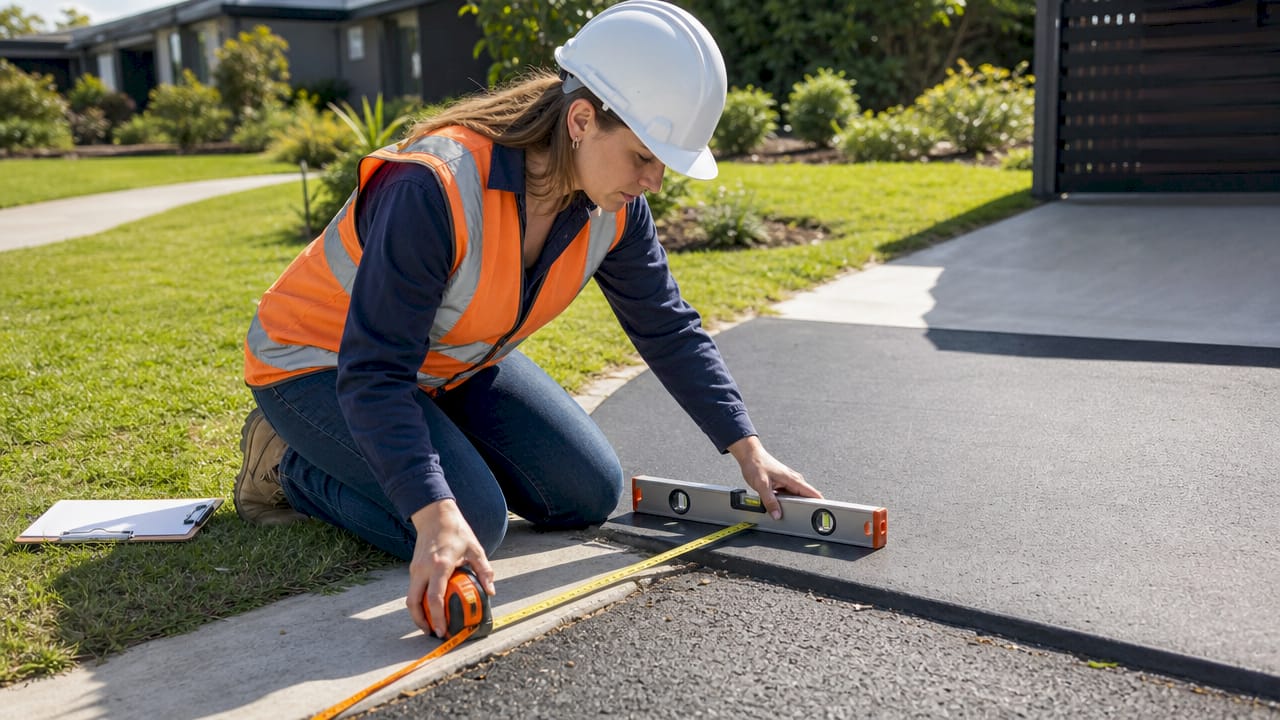
Local councils treat crossovers as critical interfaces between private property and public transport corridors. A poorly designed crossover can redirect stormwater onto neighboring properties, undermine kerb stability, or create a trip hazard on the footpath. The permit process exists precisely to catch those problems before concrete is poured.
Building or development approvals for your private property do not replace the need for a separate crossover permit. The crossover permit requires distinct insurance documentation and a qualified contract holder. Many homeowners assume their planning permit covers everything. It does not.
What regulations and standards govern crossover permits in Melbourne?
Melbourne councils apply specific engineering standards to every crossover application. These standards address drainage design, kerb and channel modifications, footpath reinstatement, and vehicle safety. The goal is to make sure your driveway does not compromise the public assets surrounding it.
Key requirements include:
- Drainage compliance: The crossover must not redirect stormwater onto the road or neighboring properties. Council engineers review drainage grades before approving any design.
- Forward exit design: Vehicles must be able to exit the property facing forward on arterial roads. This prevents drivers from reversing blind into traffic.
- Kerb and channel work: Any modification to the existing kerb requires council-approved materials and construction methods.
- Australian Standards compliance: Concrete thickness, reinforcement, and surface finish must meet relevant Australian Standards for trafficable surfaces. You can read more about what this means for concrete trafficability in practice.
- Work hour restrictions: Most councils restrict construction to standard business hours to minimize disruption to neighboring residents.
Pro Tip: Ask your council for the specific crossover design standards document before engaging a contractor. Some councils publish detailed technical drawings online that show exactly what kerb profiles and drainage grades they require.
Permits also include mandatory inspection hold points. Formwork inspections must occur after steel laying but before concrete is poured. Missing that inspection means the council can require you to demolish and redo the work at your own cost.
Who can apply for a crossover permit and what documents are needed?
Not every contractor can hold a crossover permit. Only qualified contractors with a minimum of $10 million in public liability insurance can officially apply for and hold a crossover permit in Melbourne. This rule protects the public from uninsured work on shared infrastructure. As a homeowner, you cannot apply directly. Your contractor applies on your behalf.
The documentation required for a successful application includes:
- Detailed site plan: Shows the property boundary, nature strip width, location of existing trees, underground services, and the proposed crossover dimensions.
- Proof of public liability insurance: Minimum $10 million coverage. The policy must be current at the time of application and throughout the works.
- Engineering drawings: Required for non-standard crossovers, arterial road access, or properties under Heritage Overlay.
- Contractor license details: Council must verify the contractor is qualified to work within the road reserve.
- Tree impact assessment: If any nature strip tree is affected, a separate arborist report or council tree assessment may be required.
Pro Tip: Confirm with your contractor that their public liability insurance is current before they submit the application. An expired policy is one of the most common reasons applications are rejected outright.
Poor infrastructure planning is the leading cause of permit rejections in Melbourne councils. Submitting incomplete site plans or missing insurance documents adds weeks to your timeline. Getting the paperwork right the first time is the fastest path to approval.
How much do crossover permits cost and what timelines apply?
Permit fees vary by road type and council. Brimbank Council, for example, charges $100 for local roads and up to $726.20 for arterial roads as of april 2026. Arterial roads carry higher fees because they require more complex engineering review and traffic management considerations.
| Cost item | Details |
|---|---|
| Local road application fee | $100 (Brimbank Council, 2026) |
| Arterial road application fee | Up to $726.20 (Brimbank Council, 2026) |
| Tree removal (nature strip) | Varies by council tree policy; paid separately |
| Tree replacement fee | Council-mandated; applied during permit approval |
| Pre-pour inspection | Booked at least 24 hours in advance; no additional fee in most cases |
All application fees are non-refundable, even if the permit is refused. Budget for tree-related costs separately. If your proposed crossover affects a nature strip tree, you pay for removal through an authorized contractor and a separate tree replacement fee set by council policy.
Approved permits are valid for three months. That window starts from the date of approval, not the date you plan to start work. Schedule your contractor before applying so you can begin promptly after approval.
What are the benefits and risks of crossover permit compliance?
Compliance with crossover permit regulations protects you on multiple fronts. The permit safeguards public infrastructure including stormwater systems, underground services, and public footpaths. It also protects you from personal liability if something goes wrong after construction.
The practical benefits are significant:
- Driveway durability: Permitted work must meet engineering standards, which means your concrete driveway is built to last. Unpermitted work often cuts corners on reinforcement and drainage, leading to cracking and subsidence within a few years.
- Property value protection: A driveway built without a permit creates a disclosure problem when you sell. Buyers and conveyancers check council records. Unpermitted work can delay settlement or reduce your sale price.
- Legal protection: The permit functions as a legal assurance that works meet engineering standards, reducing liability risks for both councils and homeowners.
- Avoiding reinstatement costs: Councils can order unauthorized crossovers to be removed and the road reserve reinstated at the homeowner’s expense.
“Permits frequently include strict conditions like work hour restrictions, drainage standards, and mandatory inspection hold points to avoid long-term public liability issues. Missing inspections or failing conditions can cause delays, rework, or forfeiture of security bonds.”
Skipping the permit process is never worth the short-term convenience. The financial and legal consequences of unauthorized work far outweigh the cost and effort of applying correctly.
What steps should Melbourne homeowners take to get a crossover permit?
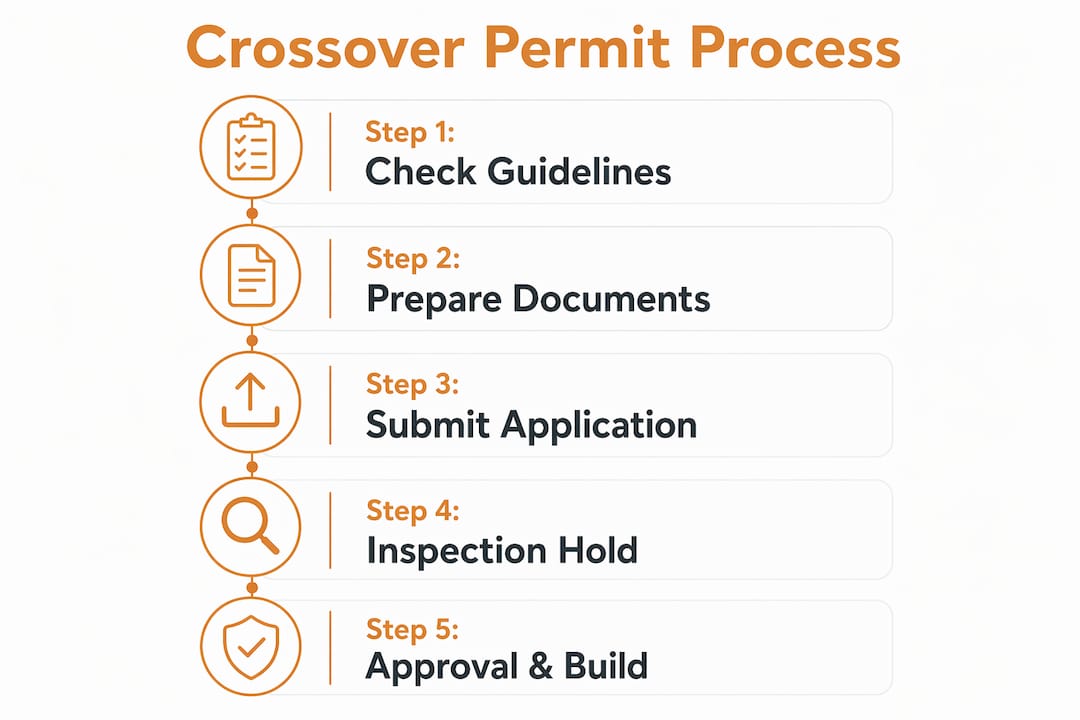
A clear process makes the difference between a smooth project and a stalled one. Follow these steps to navigate the crossover permit process efficiently.
- Consult your council early. Contact the planning or engineering department before engaging a contractor. Properties under Heritage Overlay or on arterial roads may need additional approvals. Early consultation is especially critical in these cases, as poor planning is the top cause of application rejection.
- Hire a qualified, insured contractor. Confirm they hold current public liability insurance of at least $10 million and have experience with council crossover applications in Melbourne.
- Prepare all documents before submitting. Gather your site plan, insurance certificate, engineering drawings, and any tree impact assessments. Incomplete applications are rejected without refund.
- Submit the application and pay the fee. Allow time for council review. Arterial road applications take longer due to additional engineering checks.
- Book the pre-pour inspection. Schedule at least 24 hours in advance. The inspector must approve formwork and steel placement before any concrete is poured. Understanding control joints in driveways is useful preparation for this stage.
- Complete works within the permit validity window. Approved permits are valid for three months. Coordinate your contractor’s schedule to finish within that period.
- Manage tree impacts proactively. If a nature strip tree is in the crossover path, arrange the council-approved removal and pay the replacement fee before works begin.
Key Takeaways
A crossover permit is a legal requirement for any driveway work within the public road reserve, and skipping it exposes Melbourne homeowners to reinstatement orders, fines, and property sale complications.
| Point | Details |
|---|---|
| Permit is legally required | The crossover sits in the public road reserve, so council approval is mandatory before any work begins. |
| Only insured contractors can apply | Contractors must hold at least $10 million public liability insurance to be eligible permit holders. |
| Fees vary by road type | Local road permits start at $100; arterial road permits can reach $726.20 at Brimbank Council as of 2026. |
| Permits expire in three months | Approved permits are valid for three months, so coordinate your contractor’s schedule before applying. |
| Non-compliance carries real costs | Unauthorized work can trigger council reinstatement orders, bond forfeiture, and property sale delays. |
What I’ve learned from watching crossover projects go wrong
Most crossover permit problems I’ve seen come down to one mistake: homeowners assume their building permit covers the crossover. It never does. The crossover permit is a separate legal instrument with its own insurance requirements, qualified contractor rules, and inspection hold points. Treating it as an afterthought is how projects stall for weeks.
The second most common mistake is underestimating tree impacts. A single nature strip tree in the wrong spot can add significant cost and time to a project. I’ve seen homeowners get blindsided by council tree replacement fees because nobody flagged the issue during the planning stage. Ask your contractor to walk the site with you and identify every tree within two meters of the proposed crossover before you submit anything.
One thing that genuinely speeds up the process is calling the council engineering department directly, not just submitting the online form and waiting. Council engineers are usually willing to give informal guidance on drainage grades and kerb profiles before you pay for detailed drawings. That conversation can save you a full round of revisions.
The permit is not bureaucratic friction. It is the mechanism that makes your driveway legally sound, structurally durable, and protected against future liability. Projects that go through the process properly almost always finish faster than those that try to shortcut it.
— Vic
VW Concreting: crossover permit expertise for Melbourne homeowners
Navigating Melbourne’s crossover permit requirements takes experience, the right insurance, and a contractor who knows how to prepare documentation that councils approve the first time.
VW Concreting has completed over 145 projects across Melbourne since 2001, including crossover replacements that meet council engineering standards from application through to final inspection. The team handles site plans, insurance documentation, pre-pour inspection scheduling, and tree impact coordination so you don’t have to manage the process alone. Whether you’re installing a new driveway or upgrading an existing one, see the full range of driveway and slab projects to understand what a compliant, well-built crossover looks like in practice.
FAQ
What is a crossover permit in Melbourne?
A crossover permit is a mandatory council approval for any work on the section of driveway that crosses the public road reserve, including the footpath, nature strip, and kerb. It is a legal contract committing the permit holder to council engineering standards.
Can a homeowner apply for a crossover permit directly?
No. Only qualified contractors with at least $10 million in public liability insurance can officially apply for and hold a crossover permit in Melbourne. Your contractor submits the application on your behalf.
How long does a crossover permit last?
Approved crossover permits are valid for three months from the date of approval. All construction must be completed within that window or a new application is required.
What happens if you build a crossover without a permit?
Councils can order the unauthorized work to be removed and the road reserve reinstated at the homeowner’s expense. Unpermitted driveways also create legal complications when selling the property.
Do I need a separate permit if I already have a building permit?
Yes. A building permit for private property does not cover crossover works. The crossover permit requires separate insurance documentation and a qualified contractor, making it a distinct approval process.
Leave A Comment