What is decorative concrete, and how does it differ from regular concrete?
Decorative concrete is standard concrete enhanced with aesthetic finishes, including coloring, texturing, staining, or overlays, while retaining full structural integrity. Think of it as the same workhorse material you’d find under any driveway or warehouse floor, but finished to look like slate, brick, natural stone, or polished marble. The American Concrete Institute’s ACI 310R governs the techniques and standards that define this category, covering everything from integral pigments and chemical stains to surface embossing and polishing.
What separates decorative concrete from plain structural concrete isn’t the mix, it’s the intention. Regular concrete prioritizes compressive strength and load-bearing capacity. Decorative concrete demands both: the same structural performance plus a controlled, repeatable aesthetic result. Mix design precision matters far more here, since minor variances that a structural pour tolerates can ruin a polished or stained finish.
Common applications include:
- Residential driveways and patios
- Interior floors in homes, restaurants, and retail spaces
- Pool surrounds and outdoor entertainment areas
- Commercial lobbies and walkways
Table of Contents
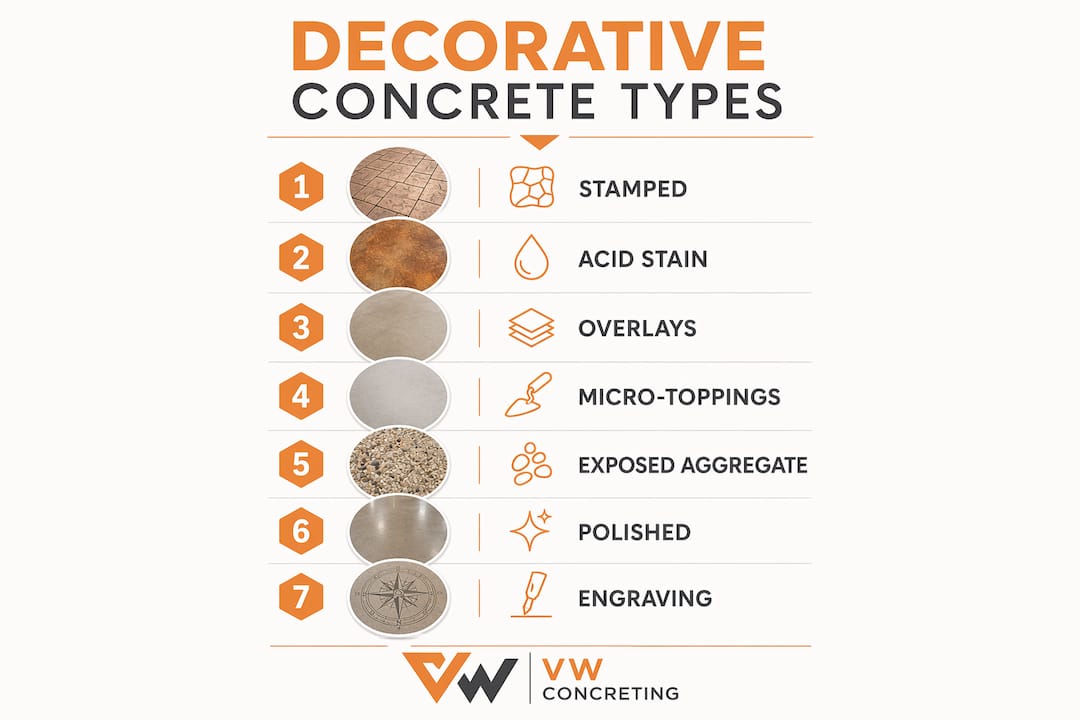
- 1. Stamped concrete mimics stone, brick, and tile
- 2. Acid staining creates permanent, variegated color
- 3. Overlays restore and redesign existing slabs
- 4. Micro-toppings deliver ultra-thin, modern finishes
- 5. Exposed aggregate reveals the stone within the mix
- 6. Polished concrete suits high-traffic commercial floors
- 7. Engraving and stenciling add pattern to existing surfaces
- Why decorative concrete is worth the investment
- How decorative concrete is made and applied
- How decorative concrete compares to other flooring materials
- VW Concreting brings decorative concrete expertise to your project
- Key Takeaways
1. Stamped concrete mimics stone, brick, and tile
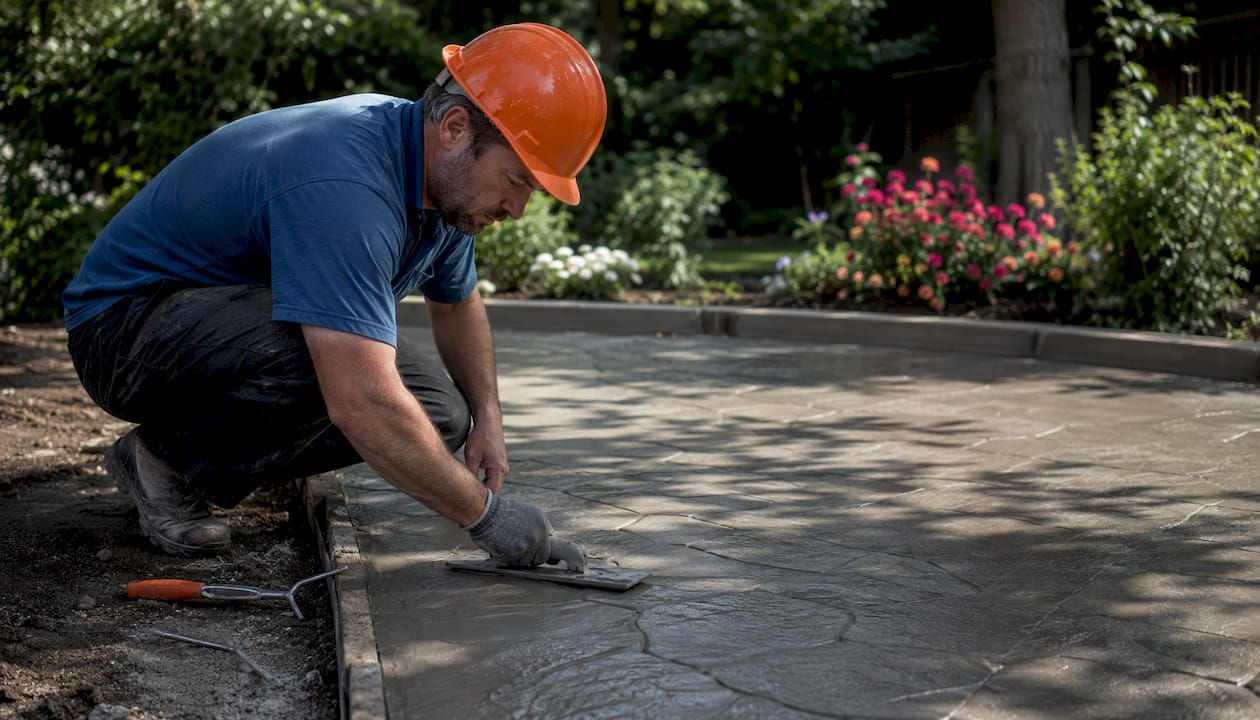
Stamped concrete is poured, then imprinted with rubber mats or rollers while still in its plastic state. The timing is everything. Stamps applied too early sink unevenly; applied too late, they leave shallow, undefined impressions. When done right, the result convincingly replicates slate, cobblestone, flagstone, or wood plank at a fraction of the material cost.
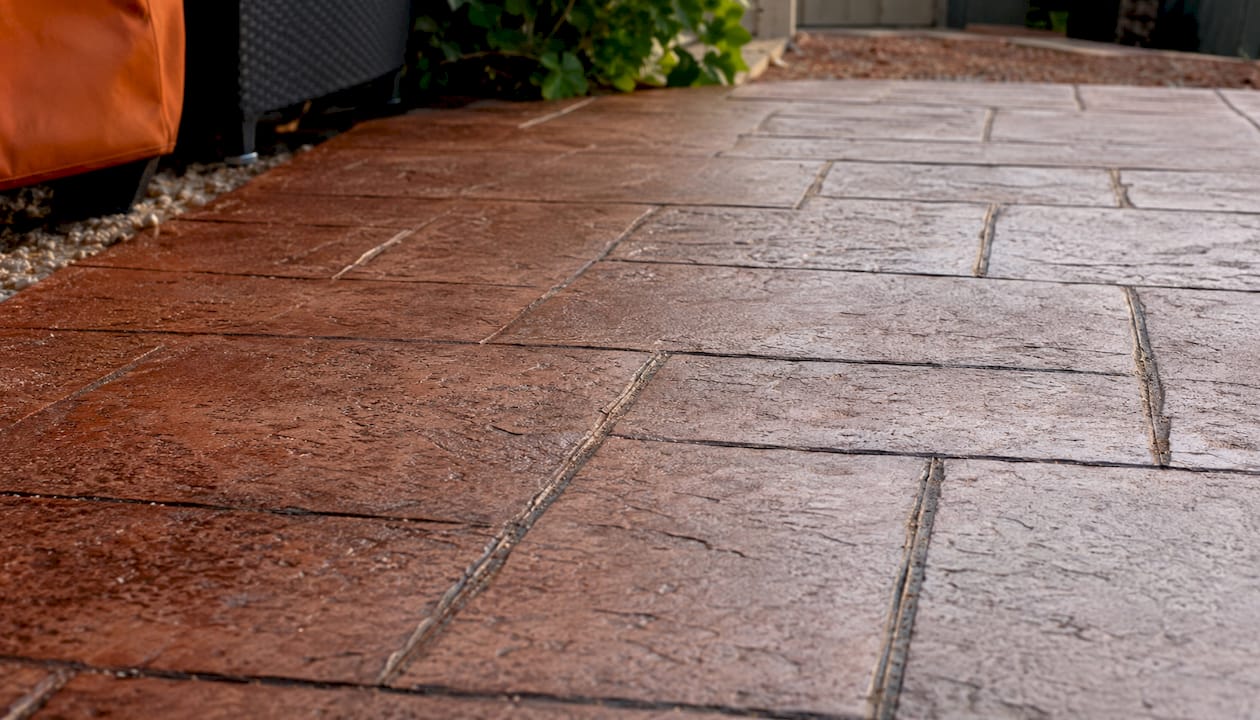
It’s the most popular decorative finish for driveways and patios precisely because it combines texture and color in one pour. A release agent, typically a contrasting powder or liquid, prevents the stamp from sticking and adds a secondary tone that deepens the stone-like effect.
2. Acid staining creates permanent, variegated color
Acid staining doesn’t coat the surface. It reacts chemically with the calcium hydroxide in cured concrete, producing translucent, mottled tones in earthy browns, tans, and blue-greens. No two acid-stained floors look identical, which is part of the appeal.
The color is permanent and won’t peel or chip, but the palette is limited to what the chemical reaction produces. For a broader color range, water-based concrete dyes offer more predictable, vivid results without the chemical reaction, though they require a sealer to lock in the pigment.
3. Overlays restore and redesign existing slabs
A decorative overlay is a polymer-modified cementitious layer bonded over an existing, structurally sound slab. Thickness typically runs 1/4 to 3/4 inch depending on the stamp pattern or texture being applied. This makes overlays the go-to solution when a homeowner wants a new look without tearing out the old concrete.
Minor cracks up to 1/4 inch can be repaired before overlay application; anything larger needs a structural assessment first. The overlay can then be stamped, stained, or textured to match virtually any design direction.
Pro Tip: Before committing to an overlay, check whether the existing slab has moisture vapor issues. Trapped moisture is the leading cause of overlay delamination, and no amount of surface prep fixes a slab that’s wicking water from below.
4. Micro-toppings deliver ultra-thin, modern finishes
Micro-toppings are cement-based coatings applied at 1/16 to 1/8 inch thick, producing a smooth, seamless surface that reads more like polished plaster than concrete. They’re common in contemporary interiors: think minimalist kitchens, bathroom floors, and commercial showrooms where the goal is a continuous, grout-free surface.
Because they’re so thin, micro-toppings amplify any imperfection in the substrate. The base slab must be flat, clean, and crack-free before application.
5. Exposed aggregate reveals the stone within the mix
Exposed aggregate finishes are achieved by seeding decorative stones, pebbles, or glass into the surface, then washing away the top layer of cement paste before it fully hardens. What remains is a textured, slip-resistant surface with the aggregate visible and proud of the surrounding matrix.
This finish is particularly practical around pools and on sloped driveways, where grip matters as much as appearance. The aggregate itself, whether river pebbles, crushed granite, or recycled glass, drives the aesthetic.
6. Polished concrete suits high-traffic commercial floors
Polished concrete is ground progressively with diamond-tooled equipment, moving through finer and finer grits until the surface reaches the desired sheen. A chemical densifier is applied mid-process, reacting with the concrete to harden and tighten the surface. The result requires no topical sealer and carries the lowest total cost of ownership of any decorative finish over its lifespan.
It’s the standard choice for warehouses, retail floors, and airport terminals because it handles foot traffic and forklift loads without degrading.
7. Engraving and stenciling add pattern to existing surfaces
Engraving uses rotary cutting tools to score patterns, logos, or faux-grout lines directly into hardened concrete. Stenciling lays a template over the surface, then applies color or texture within the cutout areas. Both techniques work on existing slabs without adding material thickness, making them practical for spaces with tight clearance requirements.
Why decorative concrete is worth the investment
The case for decorative concrete comes down to three things: longevity, versatility, and property value.
Structurally, a well-poured concrete slab can last 20 or more years. The aesthetic layer on top requires more attention, but color and sealer typically need refreshing every 3–5 years depending on UV exposure and climate. In freeze-thaw regions, that interval shortens. In mild climates, a quality sealer can stretch further.
Key benefits include:
- Property value: Decorative concrete can boost property value by up to 10% according to real estate research.
- Durability: Concrete outperforms wood, pavers, and most tile in load-bearing and weather resistance.
- Design flexibility: One material can replicate stone, brick, wood, or abstract patterns across any surface area.
- Cost efficiency: Decorative finishes cost significantly less than natural stone or hardwood while matching the visual result.
- Low daily maintenance: Sealed surfaces resist staining and clean with standard floor products.
The honest caveat: resealing every 2–3 years is non-optional for stamped and stained finishes. Skip it, and the surface degrades faster than plain concrete would. Polished concrete sidesteps this requirement entirely, which explains its dominance in commercial settings.
How decorative concrete is made and applied
Getting decorative concrete right is mostly about what happens before the pour or the overlay goes down. Surface preparation accounts for 80% of a project’s success, covering cleaning, crack repair, and mechanical profiling.
- Surface preparation: Clean the slab thoroughly, removing oil, curing compounds, and contaminants. Repair cracks. Use grinding or acid etching to create the micro-texture that bonds an overlay to the substrate.
- Mix design and pouring: For new pours, the decorative mix is batched with integral color pigments or color hardeners broadcast onto the surface immediately after screeding.
- Stamping or texturing: Stamps are pressed into the concrete during the narrow plastic-state window. Timing varies by temperature and humidity; experienced contractors read the surface rather than the clock.
- Staining or dyeing: Applied after the concrete cures, acid stains react with the surface over 4–8 hours. Dyes penetrate faster and are neutralized and rinsed before sealing.
- Curing and sealing: A penetrating or film-forming sealer locks in color and protects the surface. For overlays, the overlay thickness and stamp pattern determine which sealer type is appropriate.
Common pitfalls to avoid:
- Skipping mechanical profiling before an overlay leads to delamination
- Applying stamps too late produces shallow, undefined impressions
- Ignoring deep structural cracks before overlay application causes premature failure
- Neglecting sealer maintenance accelerates surface degradation
Pro Tip: In hot weather, concrete sets faster than expected. Have your stamps staged and your crew positioned before the pour reaches the plastic-state window, not after.
How decorative concrete compares to other flooring materials
Decorative concrete holds up well against the alternatives most homeowners consider, but the comparison isn’t one-sided.
Natural stone, such as slate or travertine, delivers unmatched authenticity but costs two to four times more per square foot, requires professional installation, and needs periodic sealing just like decorative concrete does. Pavers offer flexibility since individual units can be replaced, but the joints collect weeds and the surface can shift over time without a proper base. Hardwood and laminate are warm underfoot but unsuitable outdoors and vulnerable to moisture. Ceramic and porcelain tile hold up well indoors but crack under point loads and freeze-thaw cycling that concrete handles without issue.
Where decorative concrete loses ground is repairability. A cracked stamped slab is harder to patch invisibly than replacing a single paver. Color matching on repairs is rarely perfect. For projects where you might need to explore concrete slab removal before starting fresh, that’s worth factoring into the budget from the start.
The variety of concrete driveway finishes available today means decorative concrete competes directly with pavers and natural stone on aesthetics while maintaining a clear edge on durability and installed cost.
VW Concreting brings decorative concrete expertise to your project
VW Concreting has completed many projects across Melbourne, specializing in driveways, slabs, and outdoor surfaces where decorative concrete finishes make a real difference to how a property looks and functions. The team works with stamped concrete, exposed aggregate, colored finishes, and overlays, applying the same preparation discipline and timing precision this article describes.
If you’re weighing a new driveway, patio, or outdoor entertaining area, the driveways and slabs portfolio shows the range of finishes VW Concreting delivers. For a project-specific quote, reach out directly through the website and get a clear picture of what your surface can look like.
Key Takeaways
Decorative concrete delivers lasting aesthetic results when preparation, timing, and sealer maintenance are treated as non-negotiable parts of the process.
| Point | Details |
|---|---|
| Dual purpose material | Decorative concrete retains full structural integrity while adding color, texture, or pattern to any surface. |
| Maintenance is mandatory | Color and sealer need periodic refreshing; stamped finishes require regular resealing to prevent premature failure. |
| Prep drives success | Surface preparation accounts for 80% of a decorative concrete project’s outcome, especially for overlays. |
| Property value uplift | Decorative concrete can boost property value by up to 10%, making it a practical investment alongside its aesthetic benefits. |
| VW Concreting | VW Concreting delivers stamped, exposed aggregate, and colored concrete finishes across Melbourne. |
Leave A Comment