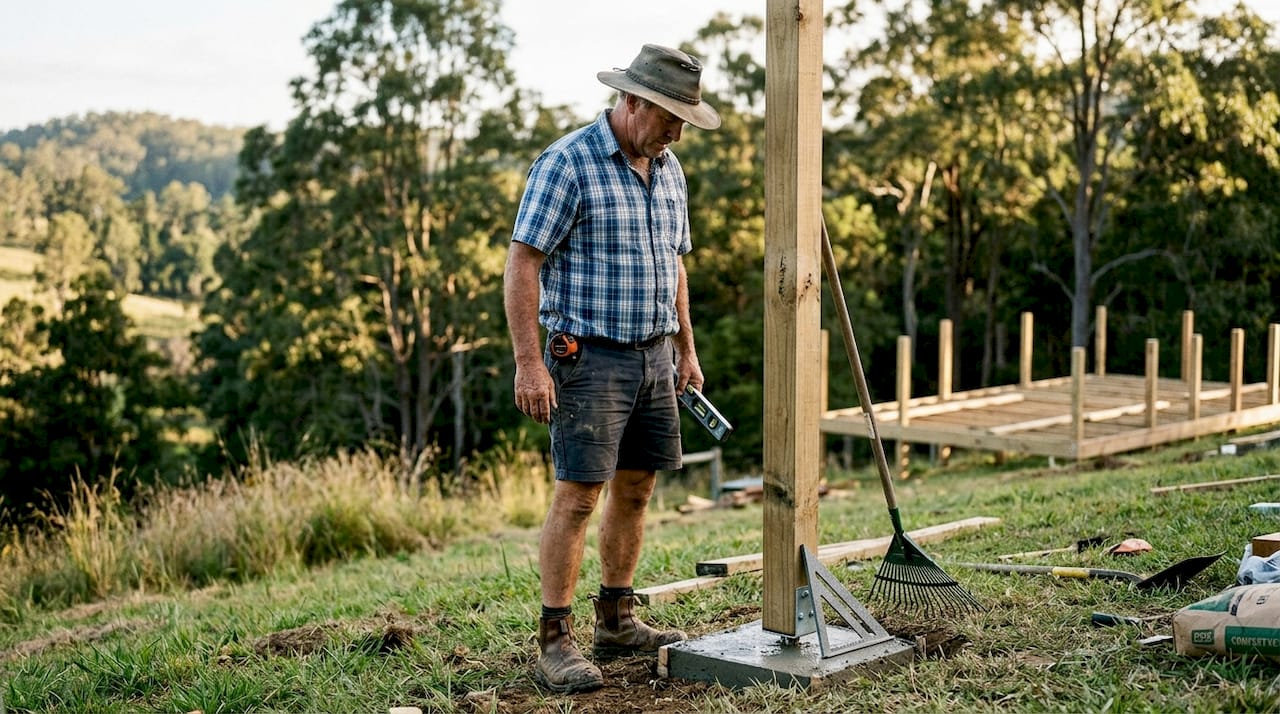
A timber deck footing is the buried structural base that transfers the full weight of your deck safely into the ground below. Without it, deck posts sink into soft soil, frames rack out of level, and the whole structure becomes a safety hazard. Every code-compliant deck starts here, and getting this part right determines how long your deck lasts. This guide covers what a timber deck footing is, how each type works, what the building codes require, and how to calculate the number you need for your specific project.
What is a timber deck footing and why does it matter?
A timber deck footing is the buried concrete base that sits beneath each deck post and spreads the deck’s weight over a wider area of soil. Without that spread, a post bearing directly on soil concentrates all the load onto a small contact point. That concentrated pressure causes the post to sink, especially in soft or clay-heavy ground.
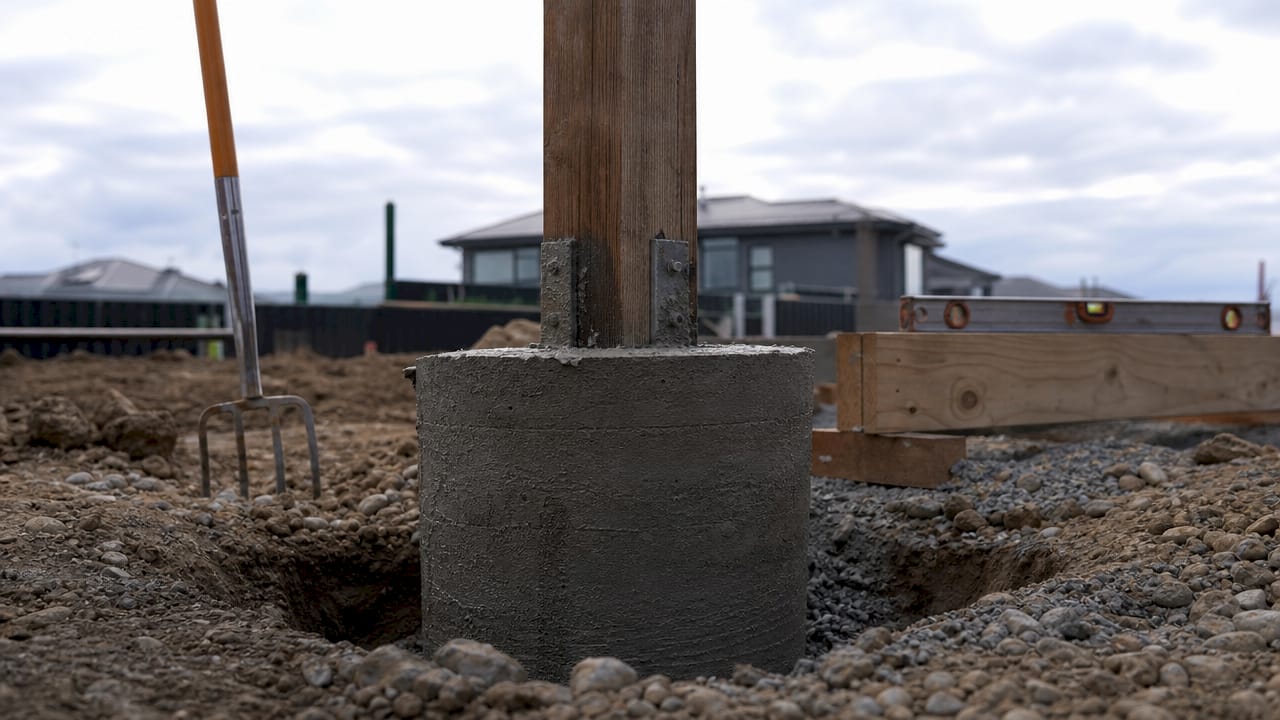
Footings carry two types of load. The dead load is the weight of the deck structure itself: the framing, decking boards, railings, and any permanent fixtures. The live load is everything that moves on top: people, outdoor furniture, and snow in colder climates. A properly sized footing handles both load types without shifting or settling.
The industry term you will see in building codes and engineering documents is “deck footing” or “concrete footing.” The phrase “timber deck footing” is the common homeowner term for the same thing. Both refer to the same structural element.
What are the common types of deck footings and their uses?
Three footing types cover the vast majority of residential deck projects. Each suits a different site condition, skill level, and budget.
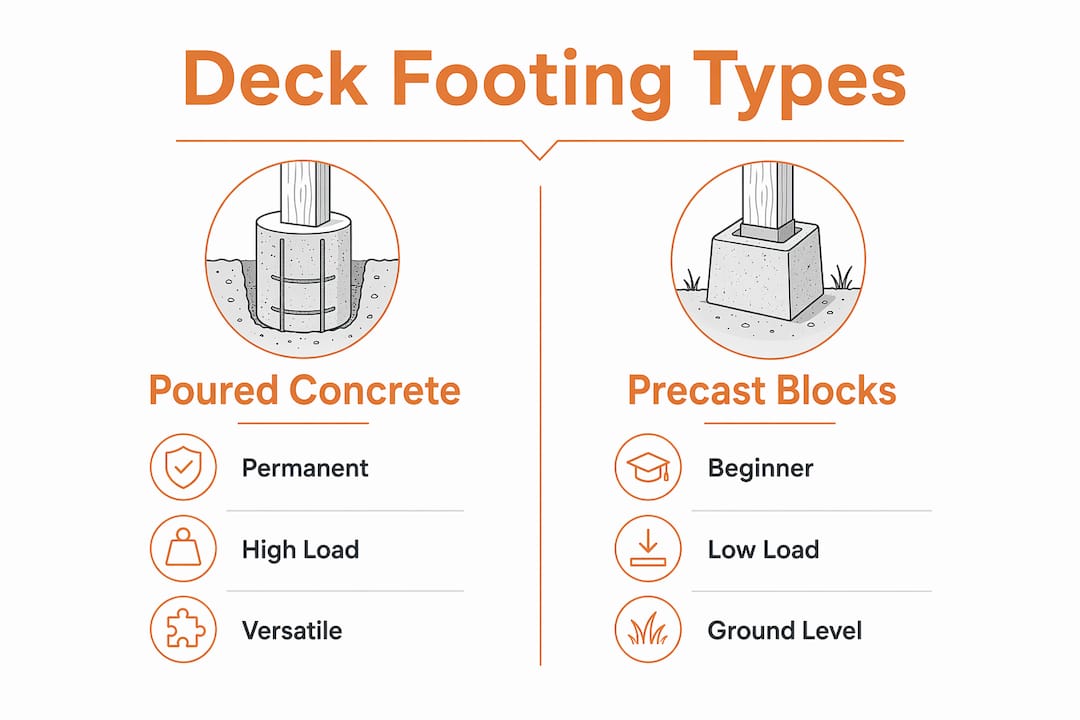
Poured concrete footings are the most common choice for permanent decks. You dig a hole, set a tube form, and pour concrete to create a custom-sized base. They are the most code-friendly option and work on almost any soil type. The trade-off is labor: mixing, pouring, and waiting for cure time adds days to your project.
Precast deck blocks are beginner-friendly options for small, low-level decks that sit close to the ground. They require no digging or concrete mixing. The limitation is load capacity. Deck blocks are not suitable for elevated decks, heavy loads, or sites with frost heave risk.
Screw piles (also called helical piers) are steel shafts that a machine drives deep into the ground. They anchor into stable soil well below the frost line and handle high loads on challenging terrain. Installation requires specialized equipment and a licensed installer, which raises the cost significantly.
| Footing type | Best use | Skill level | Relative cost | Code compliance |
|---|---|---|---|---|
| Poured concrete | Permanent, elevated decks | Intermediate | Moderate | High |
| Precast deck block | Small, ground-level decks | Beginner | Low | Limited |
| Screw pile | Deep soil, high-load sites | Professional | High | High |
- Poured concrete suits most suburban residential decks.
- Deck blocks work for freestanding garden platforms only.
- Screw piles are the go-to for sloped blocks or unstable soil.
- Local codes in many areas prohibit deck blocks for attached or elevated structures.
Pro Tip: Check with your local building department before buying materials. Some councils prohibit deck blocks for any deck attached to a house, regardless of height.
How do deck footings work structurally?
Footings work by spreading a concentrated point load across a larger surface area. A post bearing on a 2-foot-square footing distributes its load across 4 square feet of soil instead of the few square inches at the post base. That difference in contact area is what prevents post sinking.
Soil bearing capacity is the key variable. Dense, compacted gravel can support far more weight per square foot than loose fill or clay. Softer soils require larger footings to keep the pressure per square foot within safe limits. This is why footing size is not one-size-fits-all. It depends on your soil type, the total deck load, and the number of footings sharing that load.
Frost protection is the other critical function. In climates with freezing winters, water in the soil expands as it freezes and pushes upward. This force, called frost heave, can lift a footing several inches if it sits above the frost line. IRC Table R507.3 specifies minimum footing depths based on local frost line data.
Footings and piers are related but distinct. A footing is the buried base that bears on soil. A pier is the vertical concrete column that extends from the footing up to or above grade. Footings and piers are often poured as a single continuous unit, but they serve different functions. The footing resists compression from the load above. The pier lifts the post connection point above ground level to protect the timber from moisture and rot.
“Under-sizing footings is a major cause of structural failure. Footings spread point loads to protect deck integrity.” — Decks.com
What are the building code requirements for deck footings?
Building codes set the minimum standards for footing depth, size, and concrete strength. The 2026 International Residential Code (IRC) Section R403.1.1 requires a minimum concrete strength of 2,500 psi for all footings. That strength threshold is the floor, not the target. Many contractors use 3,000 psi or higher for added durability.
Depth requirements depend on your location. The IRC requires footings to sit at least 12 inches below undisturbed soil. In frost-prone areas, the footing must go below the local frost line, which can be 24–48 inches deep in colder states. Footings that sit above the frost line will heave and shift every winter, cracking the concrete and pushing posts out of alignment.
Follow these steps for a code-compliant footing installation:
- Call 811 (Dig Safe) before any excavation to locate underground utilities.
- Dig the hole to the required depth for your frost line or a minimum of 12 inches into undisturbed soil.
- Set a tube form (such as a Sonotube) plumb and level in the hole.
- Mix concrete to a stiff consistency. Concrete that is too watery loses strength as the excess water evaporates, leaving voids in the finished footing.
- Pour in lifts and rod or vibrate to remove air pockets.
- Set a post base anchor (such as a Simpson Strong-Tie post base) into the wet concrete at the correct location.
- Allow full cure time before loading. Concrete reaches working strength in 24–48 hours but full design strength at 28 days.
Common mistakes that cause footing failures:
- Digging to the minimum depth but landing on disturbed fill instead of native soil.
- Using a wet concrete mix that looks easy to pour but cures weak.
- Skipping the post base anchor and embedding the timber post directly in concrete, which traps moisture and causes rot.
- Placing footings before checking the layout for square.
Pro Tip: Use a Simpson Strong-Tie ABA post base or equivalent. It holds the post above the concrete surface, keeps timber dry, and provides a code-approved load path from post to footing.
How do you determine the number and placement of footings?
The number of footings your deck needs depends on the total load and the bearing capacity of your soil. More footings mean each one carries less weight. Fewer footings mean each one must be larger to compensate. Footing quantity and soil capacity are directly linked.
For a typical residential deck, the structural plan specifies footing locations based on beam spans and post spacing. Most residential decks use post spacing of 6–8 feet, which drives the footing grid. A 12-by-16-foot deck attached to a house typically needs four to six footings depending on the beam layout.
Key factors that affect footing count and placement:
- Deck size and shape. Larger decks carry more total load and need more footings to distribute it.
- Beam span. Longer beams need more support points, which means more footings.
- Soil type. Clay or soft fill requires closer footing spacing than compacted gravel.
- Cantilever. Any deck section that extends beyond its last support point adds load to the nearest footings.
The 3-4-5 triangle method is the standard DIY tool for squaring up footing layouts. Measure 3 feet along one string line and 4 feet along the perpendicular line. The diagonal between those two points should measure exactly 5 feet. If it does, your layout is square. Adjust until it is before you dig a single hole.
Verify your footing plan with your local building department before breaking ground. Many jurisdictions require a permit and an inspection of the footings before you pour concrete. An inspector who catches a placement error before the pour saves you from demolishing cured concrete later. For deck construction guidance specific to Australian building standards, local regulations add another layer of requirements worth reviewing early.
Key takeaways
A timber deck footing is the buried concrete base that transfers all deck loads safely into stable soil, and getting its depth, size, and concrete strength right is the single most important step in any deck build.
| Point | Details |
|---|---|
| Definition | A deck footing is the buried concrete base that spreads deck load across stable soil. |
| Footing types | Poured concrete suits most decks; deck blocks work only for small, ground-level platforms. |
| Code requirements | IRC requires 2,500 psi concrete and a minimum 12-inch depth below undisturbed soil. |
| Frost line depth | Footings must sit below the local frost line to prevent heave and seasonal shifting. |
| Footing count | Base the number of footings on deck size, beam spans, and your soil’s bearing capacity. |
Why most DIYers get footings wrong (and how to avoid it)
Most homeowners spend their planning time on decking boards and railing styles. The footings get treated as a quick checkbox. That is the wrong priority order. The footing system is the only part of your deck you will never see again once it is built. If it fails, everything above it fails with it.
The mistake I see most often is digging to the right depth on paper but landing on disturbed fill. Fill soil around new homes is often loose and poorly compacted. A footing sitting on fill will settle, even if it is technically deep enough. Always probe the bottom of the hole. If it feels soft or you can push a rebar stake in by hand, dig deeper until you hit firm native soil.
The second most common error is concrete mix consistency. Homeowners add extra water because stiff concrete is harder to pour. That extra water weakens the finished footing significantly. Use a mix stiff enough that it holds its shape when you squeeze a handful. If water runs out of your fist, the mix is too wet.
Consulting your local building department early is not bureaucratic overhead. It is free structural advice. Inspectors have seen every footing failure in your area and know exactly which soil conditions and frost depths apply to your block. That conversation takes 20 minutes and can save you from a costly rebuild. If you are unsure at any point, bring in a licensed builder or structural engineer for a single site visit. The cost is minimal compared to the risk of a footing failure under a loaded deck.
— Vic
Get your deck footings done right with VW Concreting
Footings are the one part of a deck build where a mistake is expensive to fix after the fact. VW Concreting has completed over 145 outdoor construction projects across Melbourne, including concrete footings, slabs, and full decking installations.
The team handles soil assessment, formwork, concrete pouring, and post anchor placement to meet local code requirements. If you want footings poured correctly the first time, without the guesswork of DIY concrete mixing, view our concreting work or reach out directly for a consultation. For homeowners who want to understand the full scope of what professional decking services in Melbourne include, the VW Concreting team is ready to walk you through the process.
FAQ
What is a timber deck footing?
A timber deck footing is the buried concrete base beneath each deck post that transfers the deck’s weight into stable soil. It prevents posts from sinking and keeps the deck level and structurally sound.
How deep should deck footings be?
Footings must sit at least 12 inches below undisturbed soil per IRC requirements. In frost-prone climates, they must go below the local frost line, which can be 24–48 inches deep depending on your region.
What concrete strength do deck footings need?
IRC Section R403.1.1 sets the minimum at 2,500 psi. Many contractors use 3,000 psi or higher for additional durability and long-term performance.
Can I use deck blocks instead of poured concrete footings?
Deck blocks work for small, freestanding, ground-level platforms only. Most local building codes prohibit them for elevated or house-attached decks due to load and frost heave limitations.
How many footings does a deck need?
The number depends on deck size, beam spans, and soil bearing capacity. A typical 12-by-16-foot attached deck needs four to six footings. Always verify the layout with your local building department before digging.
Leave A Comment