
Sustainable concrete practices in Melbourne builds are defined as construction methods that reduce embodied carbon, incorporate recycled materials, and use deliberate mix design to meet both structural and environmental performance targets. Low-carbon concrete mixes in Melbourne reduce embodied carbon by 30% to 70% over conventional concrete. That range is not theoretical. It is commercially available today through supplementary cementitious materials, recycled content products, and verified mix designs. Green Star Building v1.1 now requires Environmental Product Declarations (EPDs) for concrete mixes, which means Melbourne builders who have not yet shifted their specification habits face both a compliance gap and a missed carbon reduction opportunity.
What sustainable concrete practices define Melbourne builds?
The industry term for this field is low-carbon concrete specification, and it sits at the intersection of mix design, procurement, and design intent. Sustainable concrete practices in Melbourne builds cover three core levers: cement replacement, recycled material content, and design strategies that reduce total concrete volume and finishes.
Supplementary cementitious materials (SCMs) are the primary tool for cutting embodied carbon. Fly ash and ground granulated blast furnace slag (GGBFS) replace a portion of Portland cement in the mix. Both are industrial byproducts, which means using them reduces waste from other industries while cutting the carbon intensity of concrete production.

Circular concrete products like ECOCycle® contain 10% to 100% recycled construction and demolition materials. That range gives Melbourne builders flexibility to match recycled content levels to project sustainability targets without changing installation workflows. Structural performance remains equivalent to conventional mixes when the product is correctly specified.
The Nightingale Skye House in Melbourne demonstrates what is possible in practice. That project used up to 46% cement replacement combined with recycled water and manufactured sand. The result met both structural requirements and the project’s sustainability targets, proving that high replacement rates are not a compromise.
Pro Tip: Request EPD documentation from your concrete supplier before tender. Mixes backed by verified EPDs let you slot directly into Green Star and ESG reporting without manual carbon calculations.
Here is a summary of the main mix design approaches and their typical carbon reduction outcomes:
| Mix design approach | Key materials | Embodied carbon reduction |
|---|---|---|
| Low SCM replacement | Fly ash or GGBFS at 20–30% | 20–35% |
| High SCM replacement | GGBFS at 40–70% | 40–70% |
| Recycled content concrete | Recycled C&D aggregates | Variable, up to 70% |
| Combined approach | High SCM + recycled water + manufactured sand | Up to 70% |
How does thermal mass design reduce waste and energy in Melbourne?
Exposed concrete slabs and soffits provide thermal mass that absorbs heat during the day and releases it at night. Melbourne’s climate swings significantly between day and night temperatures, which makes this property especially valuable. A well-designed exposed concrete structure can reduce or eliminate the need for mechanical heating and cooling during shoulder seasons.
Exposed concrete soffits and slabs also eliminate the need for plasterboard, suspended ceilings, and paint finishes. Removing those layers reduces material waste, shortens the construction program, and lowers total project cost. The sustainability gain is compounded: less material used, less carbon embodied, and better energy performance over the building’s life.
Achieving this outcome requires deliberate design decisions made early. The following steps define a thermal mass design workflow for Melbourne projects:
- Confirm exposed finish intent at concept stage. Structural engineers and architects must agree on slab and soffit tolerances before documentation begins.
- Specify a mix that achieves the required surface finish. High SCM mixes can behave differently during finishing. Trial pours on non-critical elements confirm workability and appearance.
- Coordinate services early. Mechanical, electrical, and hydraulic services must be fully coordinated before the slab is poured. Penetrations and conduits cannot be added after the fact without destroying the exposed finish.
- Protect the surface during construction. Exposed concrete is the finished ceiling. Damage during construction is permanent. Specify protection boards and enforce their use.
- Brief the formwork contractor separately. The quality of an exposed soffit depends entirely on formwork quality. Standard formwork tolerances are not sufficient.
Pro Tip: Specify a minimum 28-day curing period for high SCM mixes. GGBFS-heavy blends gain strength more slowly than standard mixes. Rushing stripping times causes surface defects that cannot be repaired on an exposed finish.
Why does early collaboration determine sustainable concrete outcomes?
Early collaboration of architects, sustainability consultants, engineers, and suppliers at least six months before tender is the single most effective practice for delivering sustainable concrete outcomes. Late engagement forces specification compromises. Suppliers cannot guarantee mix availability. Engineers cannot optimize structural design for lower-carbon options. The result is a project that defaults to conventional concrete because there is no time to do anything else.
The Biyal-a Armstrong Creek Library demonstrates what early collaboration produces. That project achieved a 5-Star Green Star rating using ECOPact® low-carbon concrete. The outcome was possible because the project team aligned on mix specifications, EPD requirements, and sustainability targets before documentation was finalized.
Successful high-sustainability projects treat concrete as an expressive, high-performance architectural element. That treatment requires early-stage specification, not a last-minute swap. When the mix design is locked in at tender, the opportunity to reduce embodied carbon by 40% or more has already passed.
The key disciplines to engage early are:
- Sustainability consultant: Sets the Green Star or ESG targets and identifies which concrete elements carry the highest embodied carbon.
- Structural engineer: Optimizes slab thickness and reinforcement to reduce total concrete volume before specifying mix design.
- Concrete supplier: Confirms mix availability, lead times, and EPD documentation for the specified products.
- Architect: Aligns finish requirements with mix design constraints, particularly for exposed concrete applications.
Environmental Product Declarations provide verified embodied carbon data that is critical for Green Star and ESG reporting. Specifying mixes with EPDs removes the need for manual carbon footprint calculations and gives the project team a defensible, auditable record. Green Star Building v1.1 requires EPDs for concrete mixes on projects registering from mid-2026.
What are the practical steps for specifying sustainable concrete on site?
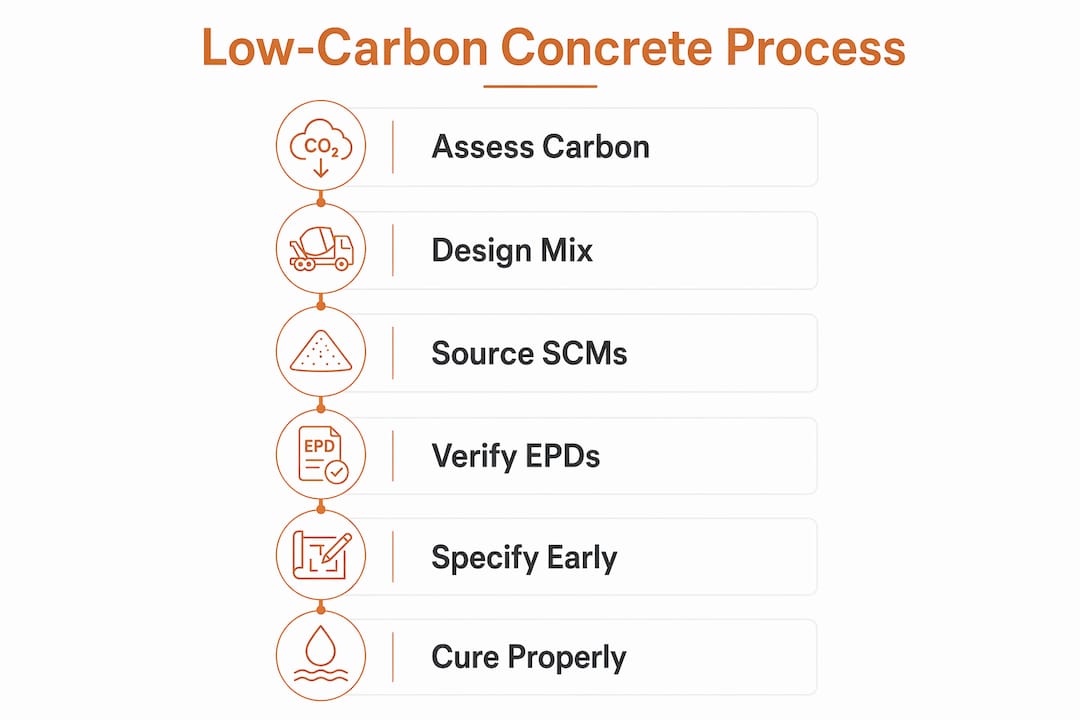
The specification and installation process for low-carbon concrete follows a clear sequence. Skipping steps, particularly early in the process, is the most common reason projects miss their sustainability targets.
- Assess the project’s embodied carbon baseline. Use a life cycle assessment tool to identify which structural elements contribute most to embodied carbon. Concrete slabs and columns typically dominate.
- Set mix specifications aligned to sustainability targets. Define the minimum cement replacement percentage and recycled content required to meet Green Star or project-specific carbon budgets.
- Engage suppliers at pre-tender stage. Confirm that the specified mixes are available in Melbourne, obtain EPD documentation, and discuss pricing. Premiums on sustainable mixes are generally modest relative to total structure budgets.
- Conduct pre-pour testing. High SCM mixes require workability testing and trial pours to confirm placement and finishing behavior. Do not skip this step on exposed finish elements.
- Monitor curing on site. High cement replacement mixes need extended curing. Assign a specific quality control check for curing duration and protection.
- Document everything. Collect batch tickets, EPD references, and test results for every pour. This documentation supports Green Star submissions and future ESG reporting.
Builders who do not specify by intent leave 30% to 50% carbon savings on the table. The barrier is not technology or cost. It is specification habit. Defaulting to a conventional mix because “it’s what we always use” is the most expensive sustainability mistake a Melbourne builder can make in 2026.
Pro Tip: Add a sustainable concrete specification clause to your standard subcontractor brief. A single paragraph requiring EPD documentation and minimum SCM replacement levels costs nothing to include and prevents last-minute mix substitutions.
The table below summarizes the key steps, responsible parties, and common failure points:
| Step | Responsible party | Common failure point |
|---|---|---|
| Embodied carbon assessment | Sustainability consultant | Skipped or done post-tender |
| Mix specification | Structural engineer + architect | Default to conventional mix |
| Supplier engagement | Project manager | Engaged too late for EPD confirmation |
| Pre-pour testing | Site supervisor | Omitted on time-pressured programs |
| Curing monitoring | Site supervisor | Standard curing times applied to high SCM mixes |
| Documentation | Project manager | Batch tickets not collected or filed |
For guidance on concrete installation quality under Melbourne’s variable weather conditions, including wet weather procedures that affect curing outcomes, field protocols matter as much as mix design.
Key Takeaways
Sustainable concrete in Melbourne builds requires deliberate mix specification, early multi-disciplinary collaboration, and verified EPD documentation to achieve 30% to 70% embodied carbon reductions.
| Point | Details |
|---|---|
| Low-carbon mixes are available now | SCM-based and recycled-content mixes reduce embodied carbon by 30–70% without changing installation workflows. |
| EPDs are mandatory from mid-2026 | Green Star Building v1.1 requires verified EPD documentation for all concrete mixes on registered projects. |
| Early collaboration is non-negotiable | Engage architects, engineers, consultants, and suppliers at least six months before tender to lock in sustainable specifications. |
| Thermal mass design reduces total materials | Exposed concrete soffits eliminate plasterboard, suspended ceilings, and paint, cutting waste and improving energy performance. |
| Specification habit is the main barrier | Builders leave 30–50% carbon savings unused by defaulting to conventional mixes without intentional specification. |
Concrete’s role in Melbourne’s sustainable future is already decided
The question Melbourne builders face is not whether to use sustainable concrete. It is whether they will specify it deliberately or keep leaving carbon savings unused by default.
What I have seen across projects is that the cost objection disappears quickly once builders price it properly. The premium on a high SCM mix is real but small relative to a total structure budget. The cost of a Green Star non-compliance or a missed EPD submission is far larger. The math is not close.
The more interesting shift is in how concrete is being treated architecturally. Exposed concrete used to mean “unfinished.” Now it means “intentional.” Projects like Nightingale Skye House and the Biyal-a Armstrong Creek Library show that concrete can be the primary architectural expression of a building, not just the structural substrate hidden behind other materials. That shift changes the sustainability calculation entirely. When concrete is the finish, you remove an entire layer of materials from the project.
The next frontier is facade materials and carbon-neutral concrete. Several suppliers are already trialing mixes that use carbon capture during production. Those products will be commercially available in Melbourne within a few years. Builders who have already built the specification habits, supplier relationships, and EPD documentation workflows will be positioned to adopt them immediately. Those who have not will be starting from scratch.
My advice is straightforward: pick one project this year, specify a mix with at least 40% cement replacement, get the EPD, and document the outcome. The learning curve is shorter than most builders expect, and the result is a project you can point to in every future tender.
— Vic
Sustainable concreting services for Melbourne projects
Com has completed over 145 projects across Melbourne since 2001, with experience across driveways, slabs, and commercial builds where sustainable mix selection and quality installation both matter.
For Melbourne builders ready to move from conventional to low-carbon concrete, Com’s team brings direct experience with sustainable mix specifications, EPD-backed products, and the on-site quality control that high SCM mixes require. Whether you are working on a commercial slab or a residential development, the right concreting services in Melbourne make the difference between a specification that holds up under Green Star scrutiny and one that does not. For larger or more complex builds, the comprehensive project services page covers the full scope of what Com delivers.
FAQ
What is low-carbon concrete and how does it differ from standard concrete?
Low-carbon concrete replaces a portion of Portland cement with supplementary cementitious materials like fly ash or GGBFS, reducing embodied carbon by 30% to 70%. Structural performance remains equivalent to conventional concrete when the mix is correctly specified.
Are EPDs required for concrete on Melbourne Green Star projects?
Green Star Building v1.1 requires EPDs for concrete mixes on projects registering from mid-2026. EPDs provide verified embodied carbon data that supports both Green Star submissions and ESG reporting.
Does sustainable concrete cost significantly more than conventional concrete?
Premiums on sustainable concrete mixes are generally modest relative to total structure budgets. High SCM mixes may require longer curing times, but the cost difference rarely justifies defaulting to conventional concrete.
What is the best way to use concrete’s thermal mass in Melbourne buildings?
Leaving concrete soffits and slabs exposed eliminates plasterboard and suspended ceilings while allowing the slab to absorb and release heat across Melbourne’s day-night temperature swings. This reduces both material waste and mechanical heating and cooling loads.
How early should suppliers be engaged on a sustainable concrete project?
Engage concrete suppliers at least six months before tender to confirm mix availability, secure EPD documentation, and align specifications with architectural and sustainability targets. Late engagement is the most common reason projects default to conventional mixes.
Leave A Comment