The finish on a concrete slab does far more than most homeowners realize. It determines how safe a surface is underfoot, how long it holds up against weather and traffic, and whether it blends into the background or becomes a genuine design feature. The role of residential concrete finishes covers all of this: protection, performance, and appearance working together from the moment the pour is complete.
The five finishes you’ll encounter most often in residential settings are:
- Broom finish: Dragged across fresh concrete to create parallel grooves; the standard for driveways, paths, and pool surrounds where slip resistance matters most
- Trowel finish: Steel-troweled smooth for interior floors, garages, and slabs where flatness and easy cleaning are the priority
- Exposed aggregate: The top cement layer is washed away to reveal stone and pebble beneath, giving a textured, durable outdoor surface
- Stamped concrete: Patterned mats pressed into wet concrete to replicate stone, brick, or slate; popular for patios and entryways
- Stained concrete: Acid-based or water-based stains applied to add color and depth, often used on interior floors and decorative outdoor areas
Get the finish wrong and you’re dealing with slip hazards, premature cracking, or costly retrofits. Get it right and the surface can last many years with minimal attention.
Table of Contents
- What role do concrete finishes play in residential projects?
- Common types of residential concrete surfaces and their features
- Benefits of concrete finishes and where each one fits
- How to choose the right finish for your residential project
- How to maintain residential concrete finishes long-term
- Why quality finishing determines long-term project success
- Environmental impact and sustainability of concrete finishes
- Cost comparison of residential concrete finishes
- Installation processes and timelines for each finish type
- How climate and substrate affect which finish works
- VW Concreting brings the right finish to every residential project
- Key Takeaways
What role do concrete finishes play in residential projects?
Concrete finishes are not just cosmetic. They are the primary defense against wear, preventing dusting, cracking, and delamination that can undermine a slab’s structural integrity over time. A poorly finished floor is vulnerable to all three, and fixing any of them after the fact is expensive.
The finish also controls traction. Smooth troweled concrete can become dangerously slick when wet, while a broom or exposed aggregate surface maintains grip even in rain. For outdoor ramps, pool decks, and driveways, that difference is not a minor detail. It’s a safety decision made at the time of pour.
From a property value standpoint, decorative concrete for residences adds real appeal. The residential segment held 58.32% of decorative concrete revenue in 2024, which tells you homeowners are now treating finish selection as a genuine design decision, not just a contractor default.
Common types of residential concrete surfaces and their features
Each finish type suits a specific set of conditions. Choosing based on location and use, rather than appearance alone, is what separates a surface that lasts decades from one that needs attention within a few years.
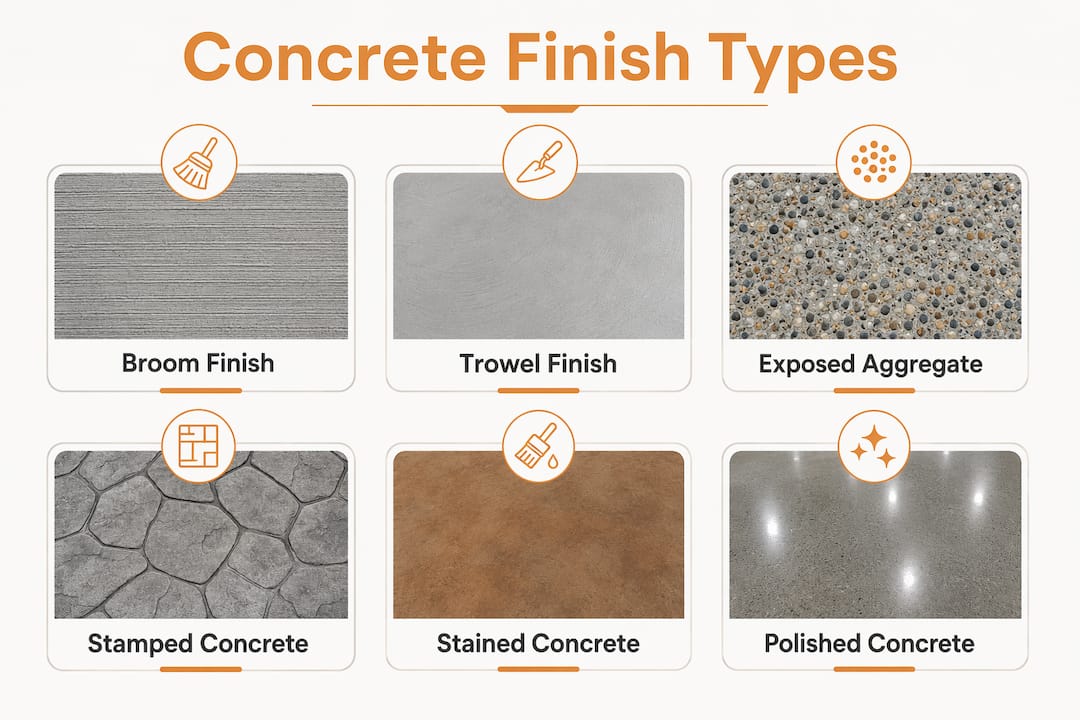
Broom finish is the most widely used outdoor finish. A stiff broom is dragged across freshly floated concrete to create parallel grooves that shed water and provide grip. It’s the standard for driveways, paths, and ramps because it delivers reliable slip resistance at minimal cost. Fine broom textures suit residential driveways where appearance matters; coarser textures handle steep slopes and heavy traffic.
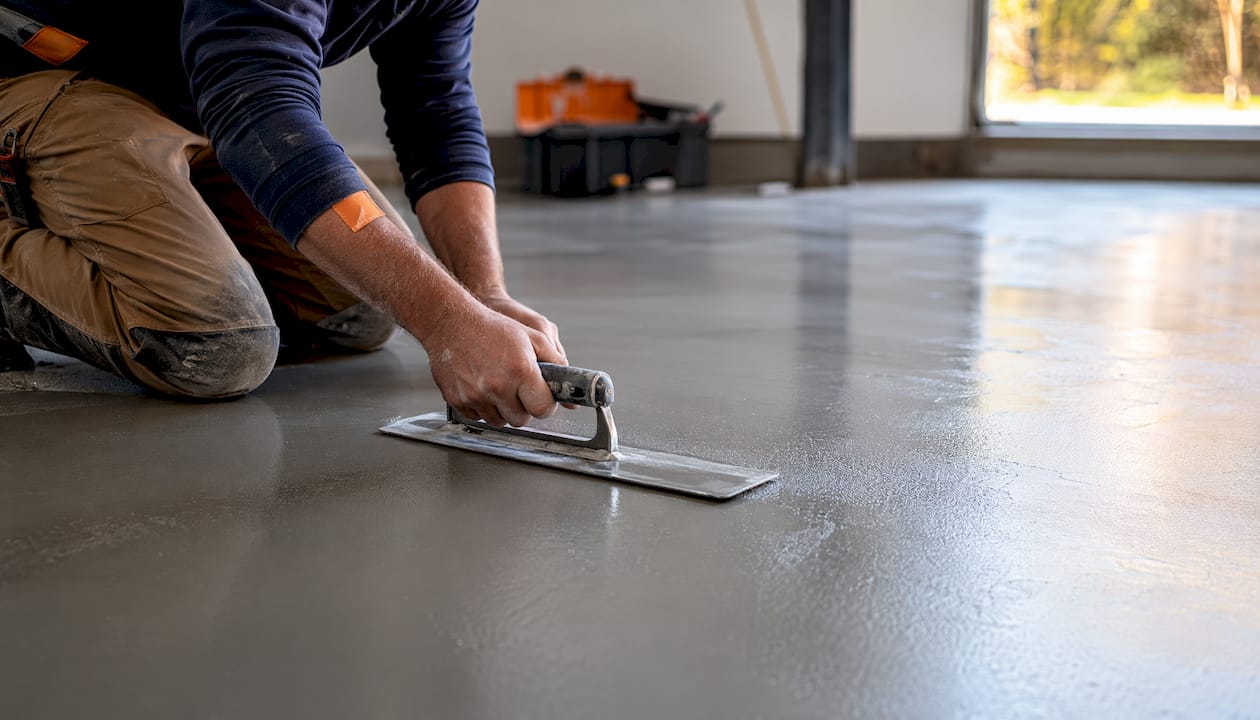
Trowel finish produces a smooth, dense surface by closing the concrete with a steel trowel, either by hand or power float. It’s the go-to for interior floors, garage slabs, and warehouse spaces where flatness and abrasion resistance are priorities. Not suitable for outdoor use without additional treatment, since smooth concrete gets dangerously slick when wet.
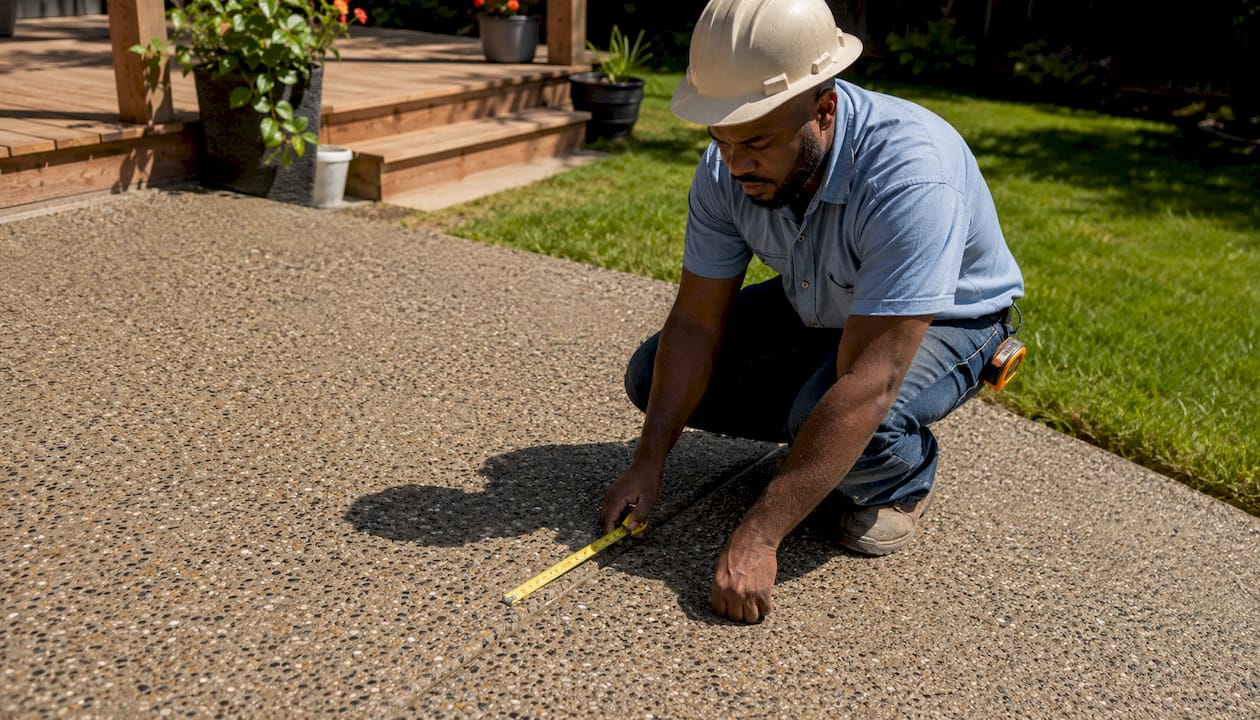
Exposed aggregate removes the top layer of cement paste by washing and brushing before final set, revealing the stone and pebble within the mix. Aggregate type, whether granite, flint, gravel, or recycled glass, determines the final look. The result is a textured, slip-resistant surface that performs well on pool decks, patios, and driveways even in wet conditions.
Stamped concrete uses rigid or flexible polyurethane mats pressed into freshly placed concrete to replicate natural stone, slate, brick, cobblestone, or timber. Color is added through integral pigment or surface-applied color hardener. It’s popular for patios, pool decks, and entryways where a premium look is the goal.
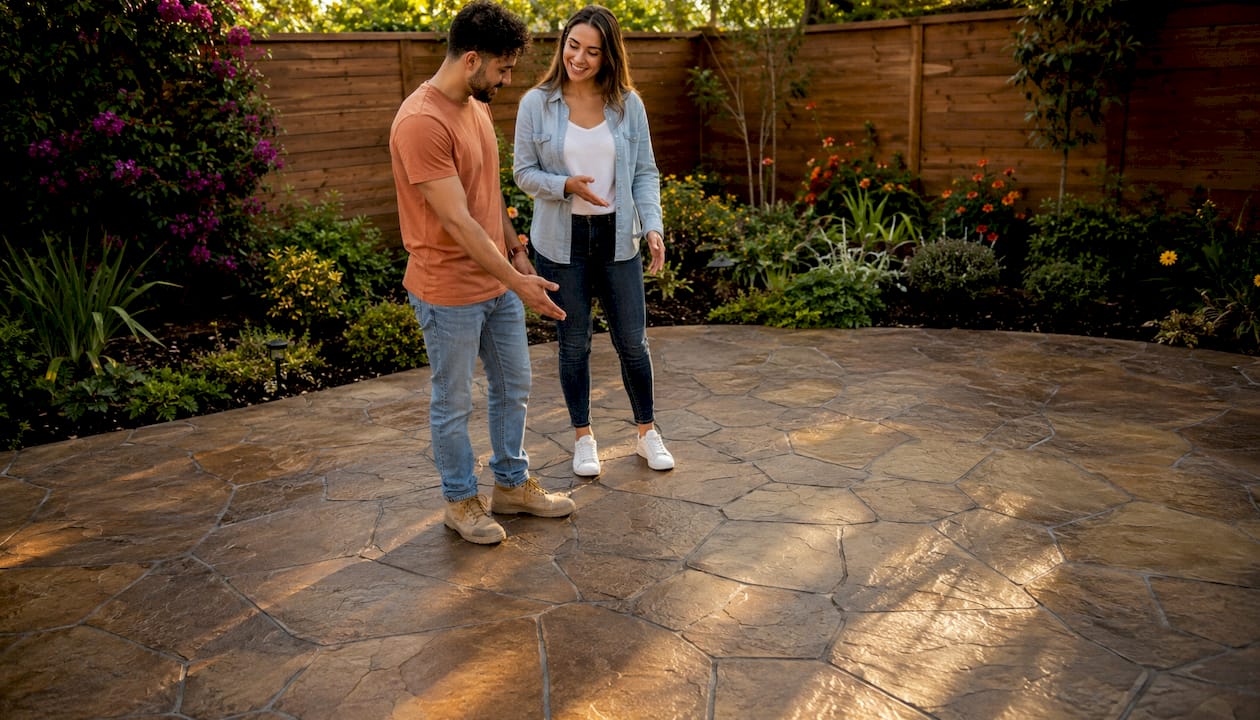
Stained concrete introduces color either as an integral pigment mixed throughout the pour or as an acid-based or water-based stain applied after hardening. Acid stains react chemically with the concrete to produce earthy, variegated tones. Water-based stains offer a broader color palette. Both work well on interior floors and decorative outdoor areas, though exterior use requires UV-resistant sealers.
Polished concrete is ground with progressively finer diamond abrasives, then treated with chemical densifiers and sealed to a satin or high-gloss finish. It’s popular for residential interiors due to its durability and low maintenance, though its medium slip resistance makes it better suited to dry indoor environments.
| Finish Type | Primary Use | Indoor/Outdoor | Slip Resistance | Maintenance |
|---|---|---|---|---|
| Broom | Driveways, paths, ramps | Outdoor | High | Low (reseal every 3–5 yrs) |
| Trowel | Garages, interior floors | Indoor | Low (when wet) | Low |
| Exposed aggregate | Patios, pool decks, driveways | Outdoor | High | Moderate (reseal every 3–5 yrs) |
| Stamped | Patios, entryways, pool decks | Outdoor | Medium | Moderate (reseal every 2–3 yrs) |
| Stained | Interior floors, decorative areas | Both | Varies by base | Moderate (reseal) |
| Polished | Residential interiors, retail | Indoor | Medium | Low |
Benefits of concrete finishes and where each one fits
Durability is the most consistent benefit across all finish types. Proper finishing protects concrete from early wear and environmental damage, extending surface life and reducing long-term repair costs. A well-specified broom or exposed aggregate finish, properly cured and sealed, can realistically last many years on a residential driveway.
Slip resistance varies sharply by finish. Broom and exposed aggregate finishes provide high traction and are the preferred choice for wet outdoor areas like pool surrounds and driveways. Polished concrete offers medium slip resistance, making it appropriate for dry interiors. Smooth troweled surfaces should never be used outdoors or in wet areas without additional anti-slip treatment.
Maintenance requirements differ just as much. Broom and trowel finishes need very little beyond occasional cleaning. Stamped and stained surfaces require periodic resealing to protect color and surface integrity. Polished concrete, despite its high upfront cost, is generally among the lowest-maintenance options over long periods.
Aesthetic flexibility is where decorative finishes earn their place. Stamped concrete can replicate the look of natural stone or brick at a fraction of the material cost. Stained concrete adds warmth and depth to interior floors. Exposed aggregate brings a natural, textured look to outdoor spaces without sacrificing function.
- Broom finish: best for driveways, sidewalks, and pool surrounds where safety in wet conditions is the priority
- Trowel finish: suited to garages, basements, and interior slabs where a flat, cleanable surface is needed
- Exposed aggregate: ideal for patios, pool decks, and driveways where traction and a natural aesthetic both matter
- Stamped concrete: fits patios, entryways, and decorative driveways where appearance drives the decision
- Stained concrete: works well on interior floors and covered outdoor areas where color customization is the goal
- Polished concrete: best for dry residential interiors, living areas, and kitchens where a refined look is wanted
Pro Tip: For pool surrounds specifically, exposed aggregate or broom finish are the two safest choices. Both maintain grip even when the surface is constantly wet. Check out this guide on pool surround finishes before making a final call.
How to choose the right finish for your residential project
The right finish comes from matching the surface treatment to where the slab goes, what it needs to do, and how much ongoing maintenance is realistic. Four factors drive that decision.
Area use and traffic: High-traffic outdoor surfaces like driveways and paths need textured finishes with proven slip resistance. Interior floors in living areas can prioritize appearance. Garage slabs sit in the middle, needing flatness and durability without the decorative premium.
Climate and exposure: Freeze-thaw cycles eliminate certain options. Salt finish, for example, performs poorly in hard-freeze climates because the pitted texture traps moisture that expands on freezing. Stained concrete on exterior surfaces in cold climates can be damaged by snow removal operations. Broom and exposed aggregate hold up consistently across most American climate zones.
Aesthetic preference: Stamped and stained finishes give you the most design control. Exposed aggregate and broom finishes lean toward a natural, functional look. Polished concrete suits minimalist interiors where the floor itself is a deliberate design element.
Maintenance capability: If resealing every two to three years is not realistic for your schedule or budget, stamped concrete is a harder sell. Broom and exposed aggregate finishes with a three-to-five year sealing interval are more forgiving.
The 1-2-3 rule captures the foundation for avoiding failures: correct mix design, correct timing, and correct finish selection for the environment. Skipping the third step, matching the finish to the site conditions, is the most common cause of residential concrete problems.
- Driveway or path: broom or brushed finish for cost-effective, high slip resistance
- Residential patio or garden path: exposed aggregate or stamped for a decorative, durable result
- Pool surround: exposed aggregate or broom, since bare feet and wet conditions demand maximum grip
- Interior living area or kitchen: polished or stained concrete for a refined, low-maintenance floor
- Garage or utility slab: trowel finish with a dust-proof sealer for a smooth, cleanable surface
Pro Tip: Finish selection must happen at the specification stage, before the pour. Applying a smooth trowel finish to an outdoor ramp and then trying to correct the slip hazard afterward means grinding, coating, or full replacement. None of those options are cheap. See the driveway finish options guide for a practical comparison before you commit.
How to maintain residential concrete finishes long-term
Sealing is the single most important maintenance step for most residential concrete finishes. A quality concrete sealer protects against dust, moisture, oil penetration, and everyday surface wear. Without it, even a well-installed finish degrades faster than it should.
Sealing schedules vary by finish type. Stamped concrete needs resealing every 2–3 years to maintain color and durability, while broom and exposed aggregate finishes require resealing every 3–5 years. Polished concrete needs occasional mopping and periodic recoating but generally requires the least intervention of any finish type.
Routine cleaning keeps surfaces performing well between sealing cycles:
- Use a pH-neutral cleaner for most concrete surfaces; avoid harsh acids or bleach, which can degrade sealers and etch the surface
- Rinse exposed aggregate and broom-finished surfaces with a garden hose regularly to clear debris from the texture
- For stamped concrete, avoid pressure washing at high settings, since aggressive water pressure can lift the sealer and accelerate color fading
- Address oil stains on garage slabs and driveways quickly; the longer oil sits, the deeper it penetrates
- Inspect for cracks annually, especially after a hard winter, and fill hairline cracks before water gets in and widens them
Understanding why concrete color fades outdoors helps you plan maintenance before the surface shows visible wear rather than after.
Why quality finishing determines long-term project success
The most common misconception about concrete finishes is that they are purely decorative. They are not. Finishing is the step that determines whether a slab resists wear, sheds water correctly, and holds its structural integrity over decades.
Real-world consequences of poor finishing show up fast. A smooth troweled surface on an outdoor ramp creates a slip hazard and costly retrofit that could have been avoided entirely at the specification stage. A stamped patio sealed with the wrong product starts showing color loss within a single season. These are not edge cases; they are predictable outcomes of skipping the right process.
Timing is as critical as technique. The window for applying a broom texture or pressing stamps into concrete is narrow, measured in hours, and depends on temperature, humidity, and mix design. An experienced finisher reads the slab and acts at the right moment. Miss it and the surface either tears under the broom or the stamps don’t press cleanly.
Pro Tip: When hiring a contractor, ask specifically about their finishing process and timing approach. A crew that can explain why they wait a certain period before brooming or stamping, based on the day’s conditions, is a crew that knows what they’re doing.
Quality finishing also protects home value. Surfaces that hold up without constant repair signal craftsmanship to future buyers in a way that fresh paint or new fixtures simply don’t.
Environmental impact and sustainability of concrete finishes
Concrete itself has a significant carbon footprint, but the finish choice can either compound or reduce that impact over time. Finishes that extend slab life reduce the need for replacement, which is the most resource-intensive outcome in any concrete project.
Exposed aggregate and broom finishes, with lifespans of 25–30 years when properly maintained, represent a lower environmental burden per year of service than finishes requiring frequent resurfacing or replacement. Polished concrete goes further: the grinding and densifying process uses the existing slab material rather than adding coatings, and its low maintenance requirements mean fewer chemical products over its service life.
Stained concrete, particularly water-based stains, has improved considerably in recent years. Water-based formulas carry lower VOC (volatile organic compound) levels than older acid-based products, making them a better choice for enclosed interior spaces. For exterior applications, UV-resistant water-based sealers now outperform many solvent-based alternatives in both durability and environmental profile.
Integral color pigments, typically iron oxide-based, are UV-stable and do not leach into surrounding soil the way some synthetic dyes can. Choosing integral color over surface-applied dyes is the more durable and environmentally consistent option for colored residential concrete.
Cost comparison of residential concrete finishes
Finish costs vary widely depending on complexity, labor, and materials. These ranges reflect typical US residential installation costs per square foot.
| Finish Type | Typical Cost (per sq ft) | Lifespan | Notes |
|---|---|---|---|
| Broom finish | — | 25–30 years | Most cost-effective outdoor option |
| Trowel finish | — | 20+ years | Standard interior slab finish |
| Exposed aggregate | — | 25–30 years | Moderate cost, long service life |
| Stamped concrete | — | 25+ years | Pattern and color complexity add cost |
| Stained concrete | $3–$25 | 20–25 years | Wide range based on stain type and prep |
| Polished concrete | — | 20+ years | Higher upfront, lowest long-term maintenance |
Broom finish is the cheapest to install and the most practical for most outdoor residential applications. Polished concrete costs more upfront but consistently outperforms cheaper options over a 10–20 year window because it doesn’t need frequent resurfacing. Stamped concrete sits in the middle on cost but typically requires more ongoing maintenance among decorative options.
Installation processes and timelines for each finish type
Every finish type has a specific installation window tied to the concrete’s curing stage. Getting the timing right is what separates a clean result from a surface that tears, smears, or fails to take the texture.
Broom finish is applied after initial floating, once the bleed water has evaporated and the surface has stiffened slightly. A stiff-bristled broom is dragged across the surface in one direction, typically perpendicular to foot traffic. The whole process adds minimal time to a standard pour day.
Trowel finish requires multiple passes with a steel trowel, either by hand or power float machine, as the concrete progressively stiffens. Each pass closes the surface further. Timing between passes depends on temperature and humidity. The full process can take several hours on a single slab.
Exposed aggregate involves seeding or mixing decorative stone into the top layer, then washing away the surface cement paste before it fully sets. The timing window is tight: too early and the aggregate shifts; too late and the paste has hardened. Most crews target a specific surface hardness before washing begins.
Stamped concrete requires the stamps to be pressed into the concrete while it is still plastic enough to take the impression cleanly. Color hardener is broadcast onto the surface before stamping. A release agent prevents the stamps from bonding. The full process, including stamping and cleanup, typically extends a pour day by several hours.
Stained concrete is applied after the slab has fully cured, often 28 days after the pour. Acid stains react with the concrete over several hours and are then neutralized and rinsed. Water-based stains dry faster. Sealing follows once the stain has fully dried.
Polished concrete is a multi-day process. Sequential grinding passes with progressively finer diamond abrasives, combined with densifier application between passes, can take two to four days on a residential floor depending on the target finish level.
How climate and substrate affect which finish works
Not every finish works in every climate or on every substrate. Matching the finish to both conditions is as important as matching it to the intended use.
Freeze-thaw climates (most of the northern United States) favor broom and exposed aggregate finishes. Both shed water effectively and resist the expansion pressure that freeze-thaw cycles create. Salt finish is a poor choice in these regions because the pitted texture traps moisture that freezes and expands, accelerating surface deterioration. Stained concrete on exterior surfaces in cold climates can also be damaged by snow removal operations, particularly where metal shovels or chemical deicers are used.
Hot, dry climates create a different challenge: rapid moisture loss during the pour shortens the finishing window significantly. In high-heat conditions, the bleed water evaporates faster, which means the surface stiffens quicker and the crew has less time to apply texture or stamps cleanly. Experienced contractors in these regions adjust mix design and schedule pours for cooler parts of the day.
Substrate compatibility matters when finishing over existing concrete. Overlays and stains applied to older slabs require thorough surface preparation, including grinding or acid etching, to achieve proper adhesion. A stain applied to a sealed or contaminated slab will not penetrate and will peel. Polished concrete on an existing slab works well when the slab is structurally sound; a slab with significant cracking or delamination needs repair before grinding begins.
For brushed concrete driveways, substrate preparation and climate timing are two of the most common points where DIY attempts fall short of professional results.
VW Concreting brings the right finish to every residential project
Choosing the right concrete finish is one decision. Getting it installed correctly, on time, and to a standard that holds up for decades is another. VW Concreting has completed over 145 residential and commercial projects across Melbourne since 2001, specializing in driveways, slabs, and outdoor surfaces where finish quality directly affects safety and longevity.
Where most homeowners run into trouble is the gap between knowing which finish they want and finding a crew that can deliver it consistently. VW Concreting’s team handles the full process, from site preparation through to final sealing, so the finish you specify is the finish you get. Whether you’re after a broom-finished driveway, an exposed aggregate patio, or a stamped concrete entryway, the work is backed by real experience across Melbourne’s varied soil and climate conditions.
Browse the residential driveways and slabs portfolio to see finished projects, or get in touch directly for a quote on your next concrete surface.
Key Takeaways
The finish you choose determines how safe, durable, and low-maintenance your concrete surface will be for the next 25–30 years, making it one of the most consequential decisions in any residential concrete project.
| Point | Details |
|---|---|
| Finish choice affects safety | Smooth troweled concrete gets dangerously slick when wet; broom and exposed aggregate maintain grip outdoors. |
| Sealing schedules vary by finish | Stamped concrete needs resealing every 2–3 years; broom and exposed aggregate require resealing every 3–5 years. |
| Cost ranges differ widely | Broom finish is generally the most cost-effective outdoor option, while stamped concrete installation costs can be significantly higher, depending on pattern and color complexity. |
| Climate eliminates certain options | Salt finish deteriorates in freeze-thaw climates; stained exterior concrete can be damaged by snow removal in cold regions. |
| VW Concreting | Delivers residential concrete finishes across Melbourne with over 145 completed projects since 2001. |
Leave A Comment