Plain concrete paving in Melbourne typically runs $79 to $160 per square meter, while decorative finishes like exposed aggregate push that to $125 to $210 per square meter. A standard 40 to 45 square meter driveway usually lands between $2,725 and $9,450 total, with the spread driven almost entirely by site access, old concrete removal, and finish choice.
TL;DR:
- Extra charges often come from site preparation for reactive soils, difficult truck access, removal and disposal of old concrete, and permits, not just the per-square-meter rate.
- Finish options like exposed aggregate, stamped, or coloured concrete can double the total project cost compared to plain concrete, especially for larger driveways.
- A comprehensive quote should itemize all costs, including excavation, base preparation, permits, and exclusion items, to avoid unexpected expenses.
- Scheduling in Melbourne should consider seasonal demand, with shoulder seasons offering better availability and weather conditions for curing.
Table of Contents
- How Much Does Concrete Paving Cost in Melbourne?
- What Actually Drives the Price of Your Quote?
- How Finish Choice Changes Your Total Cost
- What Should a Concrete Paving Quote Actually Include?
- How Long Does Concrete Paving Take From Pour to Full Use?
- VW Concreting’s Local Track Record on Pricing
- Budgeting and Financing Your Concrete Paving Project
- When Is the Best Time to Schedule Concrete Paving in Melbourne?
- What Melbourne Homeowners Get Wrong About Concrete Budgets
- Get an On-Site Quote From VW Concreting
- Sources
How Much Does Concrete Paving Cost in Melbourne?
Those headline numbers only tell part of the story, because Melbourne pricing splits into clear tiers depending on what you’re pouring and how it’s finished. Plain broom-finish concrete sits at the affordable end, often quoted at $65 to $90 per square meter supplied and laid, while decorative options start where plain concrete leaves off.
Here’s how the tiers generally break down across local Melbourne guides:
- Plain concrete: $79 to $160 per square meter, sometimes as low as $65 for large, easy-access jobs
- Exposed aggregate: $125 to $210 per square meter
- Coloured or stamped concrete: roughly $100 to $150 per square meter in most local pricing guides
- Concrete pavers: comparable to $6.50 to $14.00 per square foot in US material-and-install terms, useful mainly as a benchmark against poured concrete
Worked examples make these ranges concrete (pun intended). A small garden path around 10 square meters often costs less per job than you’d expect from the per-meter rate, because most concreters charge a minimum job fee regardless of size. A single-car driveway between 25 and 40 square meters generally totals $2,725 to $6,800 in plain finish. Step up to a double driveway or a combined driveway-and-patio pour of 45 to 60 square meters, and you’re looking at $5,000 to $9,450, with exposed aggregate pushing the top end toward $11,000 for the same footprint.
That minimum-job charge catches a lot of homeowners off guard. If you’re only pouring a short path or patching a small section, expect the price per square meter to look inflated compared to a full driveway, because concreters still have to mobilize a crew, order a minimum concrete batch, and set up formwork regardless of job size. It’s often smarter to bundle a small path with a larger patio or driveway pour if you’re planning both anyway, since combining jobs spreads that fixed cost across more square meters.
What Actually Drives the Price of Your Quote?
Two driveways of identical size can carry wildly different quotes, and the gap almost always comes down to a handful of line items that don’t show up in the advertised per-meter rate.
Site preparation is usually the biggest swing factor. Reactive clay soils, common across parts of Melbourne, may need extra excavation or a thicker sub-base to prevent cracking down the line. If your block has reactive soil, budget for this upfront rather than treating it as a surprise change order.
Truck access matters more than most homeowners expect. When a concrete truck can’t reverse close enough to the pour site, crews either barrow the mix by hand over longer distances or bring in a line pump, and both options add cost and can stretch the job by a day.
Other common cost drivers include:
- Removing and disposing of old concrete, including tip fees
- Steel reinforcement or mesh for driveways carrying vehicle loads
- Drainage work and council crossover permits
- Engineered requirements for sloped or heavily reactive sites
- Seasonal labor availability, which tightens pricing during peak building months
Pro Tip: Ask your concreter to itemize removal and tip fees separately from the pour itself. Some quotes bundle demolition into the total, which makes it hard to compare against a competitor’s price for the new slab alone.
How Finish Choice Changes Your Total Cost
Finish is the single biggest lever you control once site conditions are locked in, and the gap between options is larger than most people assume before they start pricing jobs.
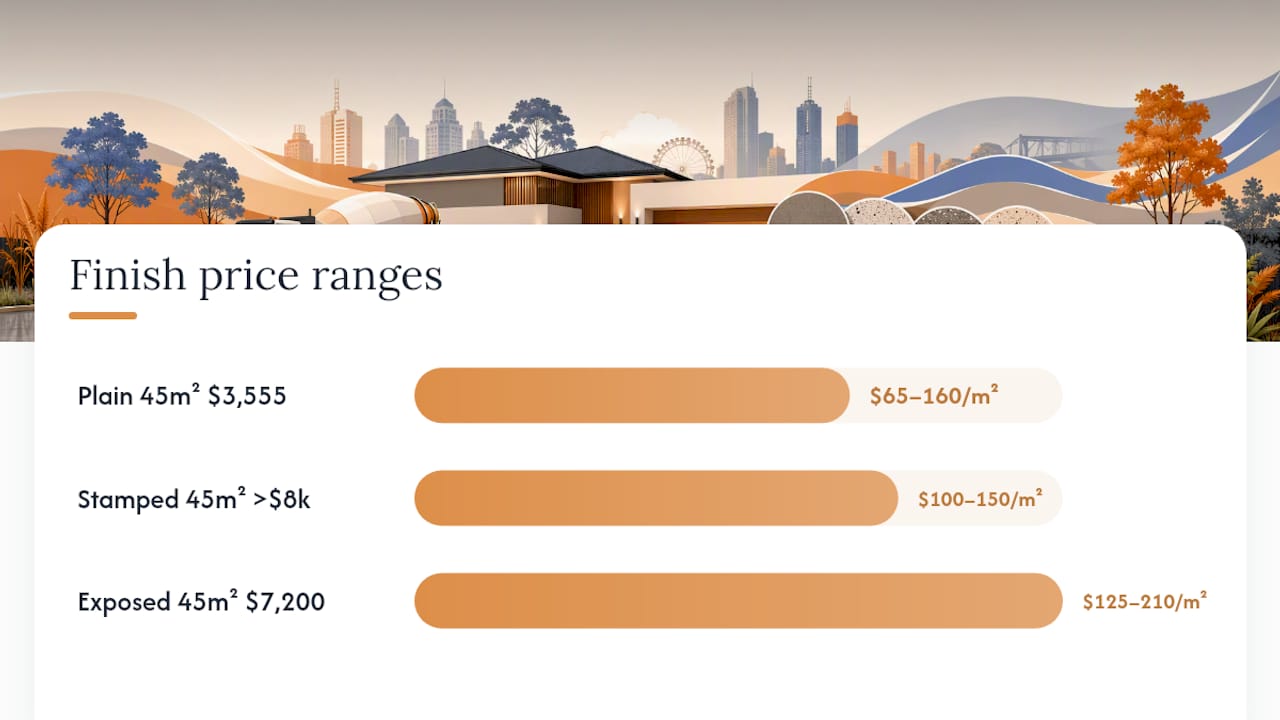
Plain concrete remains the budget benchmark at $65 to $160 per square meter. It’s durable, low-maintenance, and perfectly fine for back patios or areas that aren’t the focal point of your property. Exposed aggregate typically adds a premium, landing at $125 to $210 per square meter, and it’s commonly recommended for street-facing driveways because the textured surface improves slip resistance and hides minor stains better than a smooth finish. Coloured and stamped concrete sit in a similar $100 to $150 per square meter band, chosen more often for pool surrounds and patios where visual impact matters more than heavy vehicle wear.
Maintenance differences matter as much as upfront cost. Plain concrete shows oil stains and tire marks more visibly, while exposed aggregate’s texture camouflages everyday grime. Stamped and coloured finishes look striking when new but can fade or chip at the edges over years of sun exposure, and repairs are trickier to color-match than a plain patch.
Run the math on a 45 square meter driveway and the finish decision swings your total by thousands. Plain concrete at $79 per square meter lands around $3,555. The same footprint in exposed aggregate at $160 per square meter comes to $7,200, and a premium stamped finish could push past $8,000. That’s not a rounding error. It’s the difference between a functional driveway and one that changes your street’s first impression of the house.
What Should a Concrete Paving Quote Actually Include?
A vague quote is the fastest way to get blind sided by extras once the job starts. A complete quote for a residential concrete project should itemize excavation, base and sub-base preparation, formwork, the concrete pour itself, your chosen finish, curing time, and disposal of any excavated material. Just as important, the quote should explicitly call out what’s excluded: permits, unexpected rock removal, drainage upgrades, or retaining wall work if your site needs one.
Ten questions separate a solid contractor from a risky one:
- Does the price include site excavation and sub-base preparation?
- Is old concrete removal and tip disposal included or billed separately?
- What warranty do you offer on cracking or settling?
- Can you provide references or photos from recent Melbourne jobs?
- Are you covered by public liability insurance?
- Who handles council crossover permits and liaison?
- What’s your realistic start date and how long will the job take?
- Who actually performs the finishing work, you or a subcontractor?
- Is site cleanup included in the quoted price?
- Is this a per-square-meter rate or a fixed total for the whole job?
Compare quotes on total price, not just the advertised per-meter rate; a low headline figure with a long exclusions list often costs more once the missing items get added back in.
How Long Does Concrete Paving Take From Pour to Full Use?
Small paths typically wrap up in a day or two of active work. Larger driveways and patios usually need two to four days once you factor in formwork, the pour itself, and finishing.
Curing follows a predictable schedule: foot traffic is generally fine after 24 to 48 hours, but vehicles need to stay off the surface for at least seven days, and the slab doesn’t reach full structural strength until around 28 days. Jobs requiring a pump for restricted access add time to the schedule and cost to the quote. You can help keep things on track by clearing site access before the crew arrives and confirming drainage plans early so nothing stalls mid-pour.
VW Concreting’s Local Track Record on Pricing
Since 2001, VW Concreting has completed more than 145 projects across Melbourne, covering driveways, exposed aggregate finishes, paving, and the site preparation work that determines whether a job stays on budget.
Our published pricing for concrete paths runs from $79 to $170 per square meter, reflecting the same access, site prep, and finish variables that drive every quote across Melbourne.
That range lines up closely with the broader market figures throughout this guide, which is exactly the point. When a contractor’s real pricing matches the independent benchmarks, you can trust the quote in front of you instead of guessing whether it’s inflated or too good to be true.
Budgeting and Financing Your Concrete Paving Project
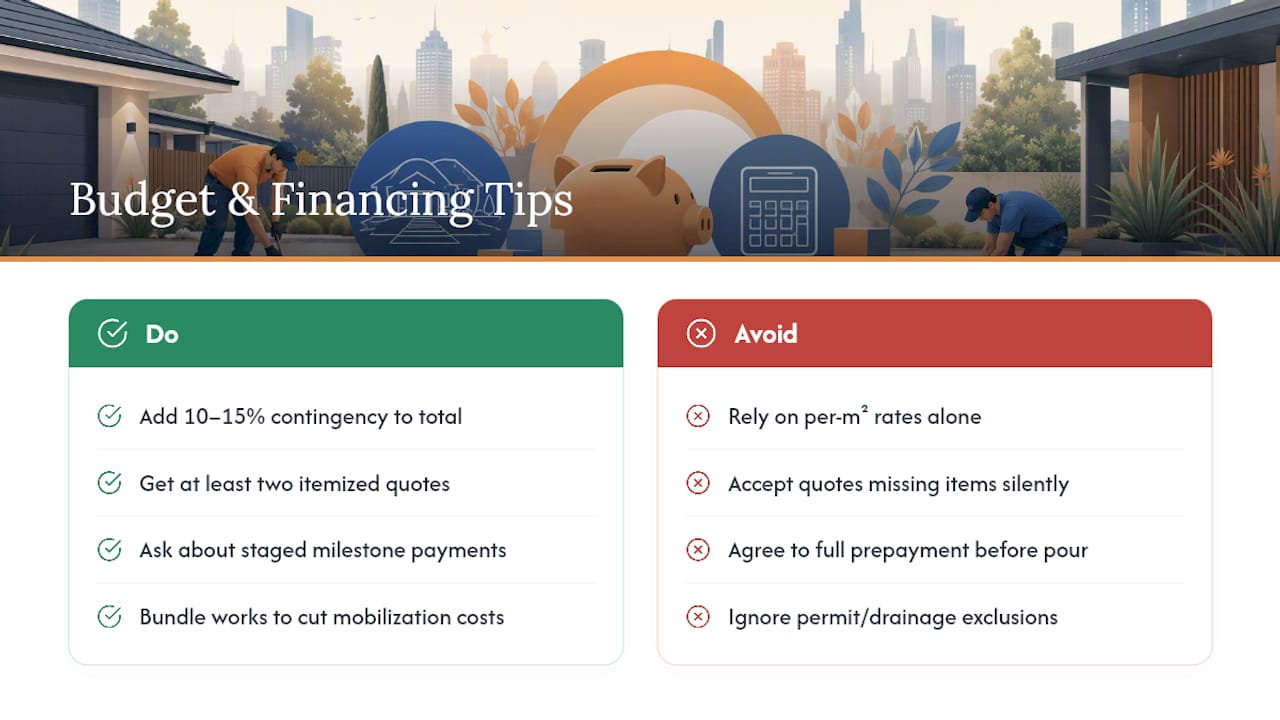
Start with the full job in mind, not just the headline per-meter rate. Add a contingency of roughly 10 to 15% on top of your quoted total to cover surprises like unexpected rock, reactive soil, or a drainage fix you didn’t know you needed until the crew started digging.
Get at least two itemized quotes before committing. Comparing fixed totals side by side, rather than per-meter rates alone, exposes whether one contractor is quietly excluding removal, permits, or drainage that another has already priced in.
If you’re financing the work, many Melbourne contractors accept staged payments tied to project milestones, such as a deposit, a payment after the pour, and a final payment after curing. Ask about this upfront rather than assuming full payment is due on completion. For larger combined projects, homeowners sometimes bundle a driveway with fencing or landscaping work in a single contract, which can reduce mobilization costs since the crew is already on site. If you’re weighing pavers instead of poured concrete for part of the project, it’s worth reading how pavers compare to poured concrete for a patio upgrade before locking in your budget.
Avoid financing structures that require full payment before any concrete has been poured. That arrangement gives you no leverage if the finished work doesn’t match what was quoted.
When Is the Best Time to Schedule Concrete Paving in Melbourne?
Melbourne’s concreting demand follows the building season, and that seasonality shows up in both pricing and scheduling availability. Spring and early summer, roughly September through December, are the busiest months as homeowners tackle outdoor projects before the holidays. Booking a contractor during this window often means longer lead times and less room to negotiate on price, since crews are working at capacity.
Late autumn and winter, particularly May through August, tend to be quieter for residential concreting. Contractors have more scheduling flexibility, and some offer better availability or slightly more competitive pricing to keep crews busy through the slower months. The tradeoff is weather: concrete curing slows in cold temperatures, and heavy rain can delay a pour entirely, so you’ll want a contractor who plans around Melbourne’s wetter months rather than one who gets caught out by them.
If your project isn’t time-sensitive, scheduling for the shoulder seasons, March to April or late August to September, often gets you a good balance of workable weather and contractor availability before the spring rush hits.
What Melbourne Homeowners Get Wrong About Concrete Budgets
The most common budgeting mistake is pricing the concrete and ignoring the site. Homeowners fixate on the per-square-meter finish cost and forget that access, removal, and prep can add as much as the pour itself.
For most Melbourne suburban driveways, exposed aggregate hits the best balance of cost and curb appeal without tipping into premium territory. Whatever finish you choose, get an itemized quote and confirm council crossover requirements before signing anything.
— Vic
Get an On-Site Quote From VW Concreting
A local concreting company is the practical next step once you know your rough budget and want a number you can actually rely on. Unlike a generic online estimate, an on-site visit accounts for your specific access, soil, and drainage conditions before a single figure gets quoted, which is where most Melbourne cost surprises actually come from.
The team handles the full range of paving work covered in this guide: plain and coloured driveways, exposed aggregate finishes, and the site preparation that determines whether a job stays on budget. At an on-site visit, expect the crew to measure your space, check truck access, and walk through drainage and crossover requirements before finalizing inclusions and exclusions in writing.
If you’re ready to move past estimates and get a number specific to your property, request a quote through the driveways and slabs project page and get a site visit scheduled.
Sources
This guide draws on Melbourne-specific concreting price data and local driveway cost guides for per-square-meter ranges, plus a US paver pricing reference used only to benchmark material and installation costs against poured concrete. Each source reflects current published pricing rather than fixed industry standards, so rates shift over time and by contractor.
- Concreting Cost Melbourne 2026: $79–$160/sqm
- Concrete Driveway Cost Melbourne 2026 | Price Guide | Concreters Near Me
- Concrete Pavers Price List: Material Costs and Installation Prices for US Buyers 2026
Leave A Comment