
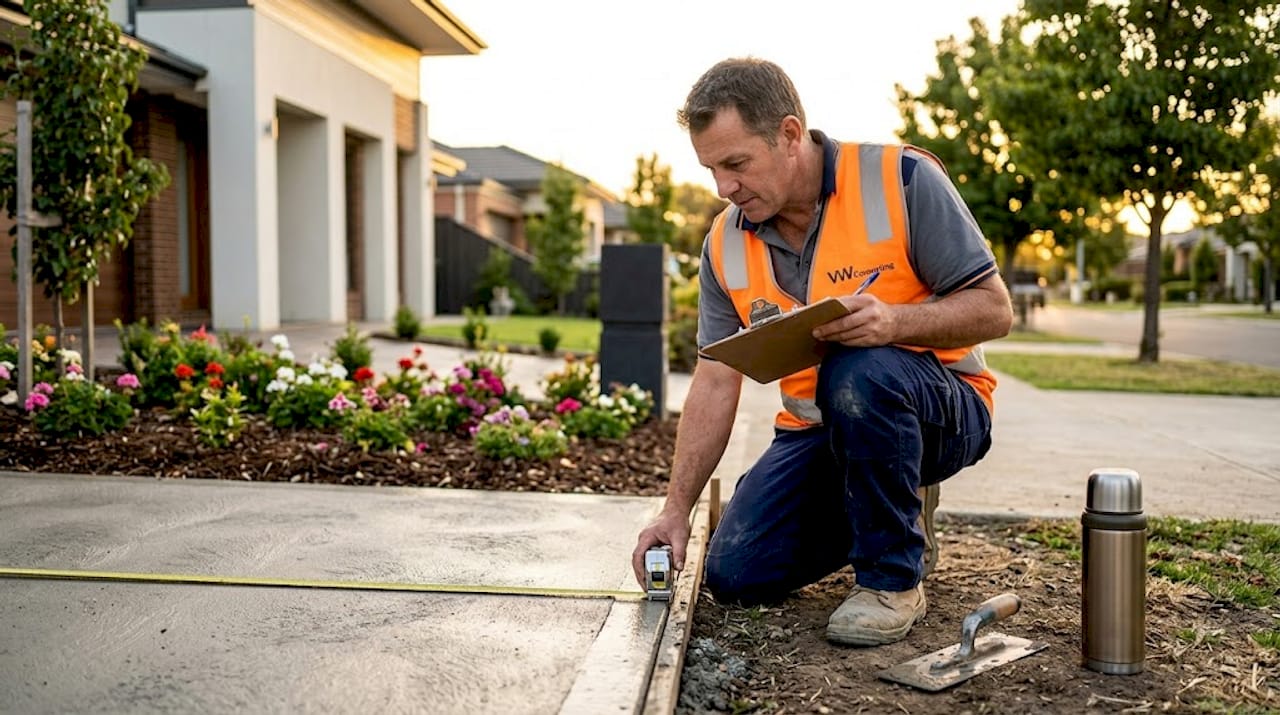
Most Melbourne homeowners assume that pouring more concrete automatically means a stronger, longer-lasting driveway. It’s an understandable assumption, but it’s only partially true. The right concrete thickness depends on what your driveway actually needs to handle, from the weight of your vehicles to the quality of the soil underneath. Get it wrong in either direction and you’re either wasting money on unnecessary concrete or setting yourself up for cracks, settlement, and costly repairs within a few years. This guide cuts through the confusion and gives you the practical information you need to make smart decisions.
Table of Contents
- Why concrete thickness matters for your driveway
- Recommended concrete thickness in Melbourne: Standards and common scenarios
- Key factors that influence the right thickness for your driveway
- Improving driveway performance: Thickness and beyond
- What most homeowners overlook about concrete thickness for driveways
- Get professional advice for your next driveway project
- Frequently asked questions
Key Takeaways
| Point | Details |
|---|---|
| 100 mm is standard | Most Melbourne driveways use a 100 mm slab for typical cars and light vehicles. |
| Vehicle weight matters | Heavier vehicles need up to 150 mm thickness for proper performance. |
| Proper foundation is crucial | Subgrade preparation and site engineering are as important as the slab itself. |
| Tailor to your site | Check local council and site-specific needs before finalizing thickness. |
| Combine with good practices | Reinforcement and expert installation maximize driveway life and durability. |
Why concrete thickness matters for your driveway
Concrete thickness is not just a number on a spec sheet. It directly determines how your slab handles the loads placed on it every single day. When a vehicle drives across your driveway, the slab flexes slightly. That flexing creates stress in the concrete, and repeated stress over time leads to cracking. A thicker slab flexes less, which means less stress and a longer service life.
As slab-on-grade guidance from WBDG explains, thickness decisions are fundamentally load-transfer and flexing decisions: thicker slabs reduce flexing under wheel loads and therefore reduce stress cracking risk, assuming the supporting layers and reinforcement and joints are appropriate. That last part matters enormously. Thickness works as part of a system, not as a standalone fix.
Here’s what happens when thickness is too low for the intended use:
- The slab flexes excessively under load, generating tensile stress at the bottom of the concrete
- Cracks form at the base first, then work their way upward
- Edges and corners are especially vulnerable because they lack support on multiple sides
- Settlement in the subgrade (the soil layer beneath the slab) accelerates cracking
On the other hand, a slab that is unnecessarily thick costs more in materials and labor without delivering proportional benefits. The goal is the right thickness for your specific situation, not the maximum possible.
“Thicker slabs reduce flexing under wheel loads and therefore reduce stress cracking risk, assuming the supporting layers and reinforcement/joints are appropriate.” — WBDG Slabs on Grade Guidance
Thickness also works alongside other critical factors: the quality and compaction of the subgrade, the type of reinforcement used, the placement and spacing of control joints, and the concrete mix design. Ignoring any one of these while obsessing over slab depth is a common and expensive mistake. If you want to understand the full picture of preventing driveway cracks, thickness is just one piece of a larger puzzle.
Pro Tip: Always ask your concreter about the subgrade preparation plan before discussing slab thickness. A well-prepared base can make a correctly specified slab outperform a thick slab on poor ground.
Recommended concrete thickness in Melbourne: Standards and common scenarios
Now that you understand why thickness matters, let’s talk numbers. In Melbourne, residential driveway concrete thickness follows Australian residential pavement guidance, which accounts for vehicle weight, frequency of use, and the type of access being created.
The key measurement used in these guidelines is GVM, which stands for Gross Vehicle Mass. This is the maximum operating weight of a vehicle, including passengers and cargo. Most standard passenger cars fall well below 3 tonnes GVM, which puts them in the most common residential category.
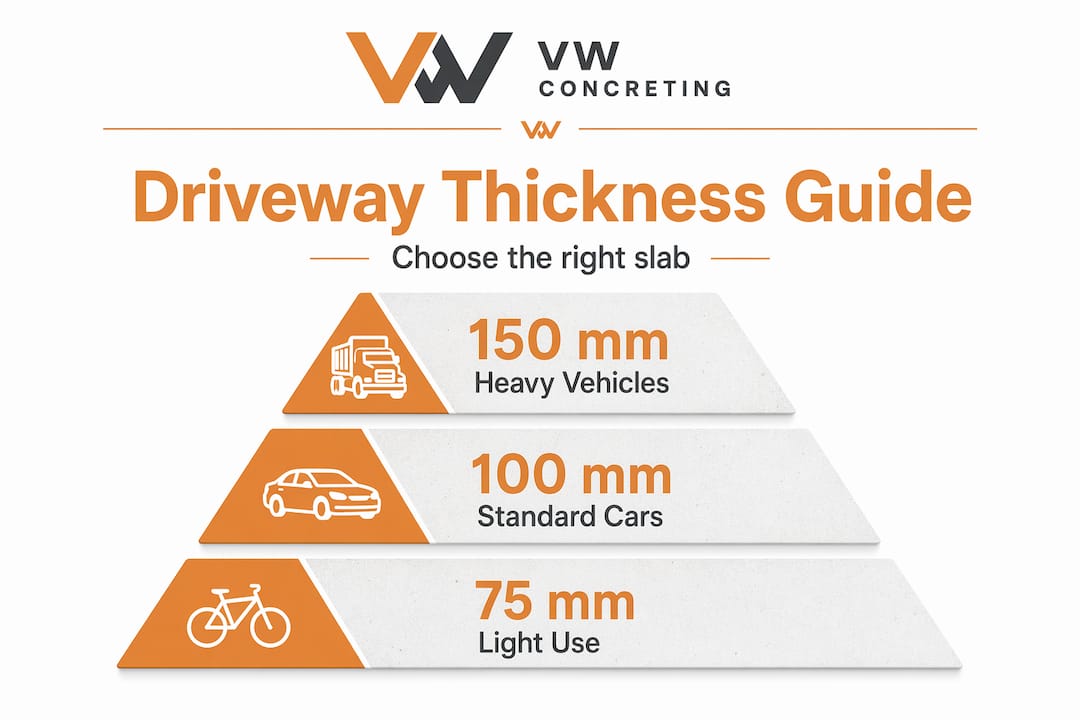
According to Australian residential pavement guidance, for Melbourne residential driveways, the common minimum concrete slab thickness is 100 mm for vehicles under about 3 tonnes GVM. Foot-traffic-only paths and patios are lower, around 75 mm minimum, and heavier vehicle driveway access is typically higher, at about 150 mm minimum for vehicles in the 3 to 10 tonnes GVM range.
Here’s a quick reference table to make sense of those numbers:
| Application | Vehicle/Use Type | Minimum Slab Thickness |
|---|---|---|
| Garden path or patio | Foot traffic only | 75 mm |
| Standard residential driveway | Passenger cars under 3 tonnes GVM | 100 mm |
| Heavy residential access | Light trucks, vans, SUVs 3 to 10 tonnes GVM | 150 mm |
| Commercial or industrial access | Heavy vehicles above 10 tonnes GVM | Engineer-specified |
The vast majority of Melbourne residential driveways fall into that middle category: standard passenger vehicles, family SUVs, and the occasional tradesperson’s van. A 100 mm slab, properly reinforced and supported, handles this load profile reliably. However, if you regularly have heavy deliveries, a concrete truck accessing your property, or a large motorhome parked on the slab, you need to think about stepping up to 150 mm or getting an engineer’s assessment.
Real-world examples illustrate this well. A homeowner in Truganina who pours a 75 mm slab for a double car driveway thinking it will save money may find cracking within two to three years as the slab fails to handle the repeated load of two family vehicles. Conversely, a homeowner who specifies 150 mm for a standard car driveway on a well-compacted base is spending significantly more without gaining meaningful performance benefits.
Finish choices also interact with your thickness decision. If you’re considering exposed aggregate driveways, the same thickness standards apply, but the decorative finish adds visual appeal without compromising structural integrity. Many Melbourne homeowners are surprised to learn about the benefits of exposed aggregate beyond aesthetics, including improved slip resistance and long-term durability. For those interested in a textured finish, slate concrete driveways are another popular option that pairs well with standard residential thickness specifications.
Key takeaway: Most Melbourne homes need 100 mm minimum for standard driveways. Anything less is a false economy. Anything more should be driven by actual load requirements, not guesswork.
Key factors that influence the right thickness for your driveway
Standard guidelines give you a starting point, but your driveway is not a textbook scenario. Several site-specific factors can push your requirements above or below the typical minimums, and understanding them helps you have a more informed conversation with your concreter.
Vehicle weight and loading patterns
The most obvious factor is what will actually drive on your driveway. If you own a large 4WD, a boat trailer, or a heavy campervan, your loading profile is different from someone with a small hatchback. Delivery trucks from online shopping, fuel deliveries, or trade vehicles visiting your property regularly also add up over time. Think about the heaviest vehicle that will use your driveway, not just the most common one.
Soil type and subgrade quality
Melbourne’s soils vary significantly across suburbs. Reactive clay soils, which expand when wet and shrink when dry, are common in many parts of Melbourne and create movement beneath your slab that standard thickness alone cannot compensate for. Sandy or well-drained soils are more stable and may require less engineering intervention. Before any concrete is poured, the subgrade should be assessed, compacted properly, and sometimes treated with a layer of compacted road base to create a stable, uniform platform.
Drainage and site conditions
Poor drainage is a silent enemy of concrete driveways. Water pooling beneath the slab softens the subgrade, reduces its load-bearing capacity, and accelerates settlement and cracking. Proper site grading, drainage channels, and sometimes agricultural drainage beneath the base layer are essential in low-lying or poorly draining properties.
Council and crossover requirements
This is where many homeowners get caught off guard. If your driveway crosses a council-owned verge or footpath, or if your property is part of a subdivision or development, local council requirements may specify thickness and construction standards that exceed residential minimums. As Australian pavement guidance notes, if you’re crossing a verge or the driveway is part of a council or authority asset or subdivision works, expect site-specific requirements that may push thickness upward beyond typical minimums.
Always check with your local council before work begins. Failing to meet crossover specifications can result in the council requiring you to redo the work at your own expense.
When to bring in an engineer
For most standard residential driveways, an experienced concreter with local knowledge is sufficient. But for complex sites, heavy vehicle access, sloped properties, or anything that involves council infrastructure, a structural engineer’s assessment is worth the investment. The cost of an engineer’s report is a fraction of the cost of tearing out and replacing a failed slab. Protecting your investment starts before the concrete is even ordered.
Pro Tip: Ask your local council about crossover permit requirements before finalizing your driveway design. Some Melbourne councils have very specific thickness and reinforcement requirements for the section of driveway crossing the verge.
Improving driveway performance: Thickness and beyond
Once you’ve settled on the right thickness for your situation, there are several additional steps that significantly improve your driveway’s long-term performance. Thickness sets the foundation, but these practices determine whether your driveway lasts 10 years or 30 years.
As slab-on-ground guidance emphasizes, success and durability depend on soil understanding, detailing joints and dowels, and construction methods. Thickness is just one part of the design approach for slab-on-ground systems.
Here are the key practices that work alongside proper thickness:
- Steel reinforcement mesh: Mesh (typically SL72 or SL82 for residential driveways) sits within the slab and holds cracks together if they do form, preventing them from widening and becoming structural failures.
- Control joints: These are planned weak points cut into the surface that guide where the slab cracks if it needs to move. Without them, cracks appear randomly and often in the most visible or damaging locations.
- Quality concrete mix: A minimum 25 MPa (megapascal) concrete mix is standard for residential driveways in Melbourne. Higher-strength mixes (32 MPa or 40 MPa) are available for heavy-duty applications and add meaningful durability.
- Proper curing: Concrete gains strength through a chemical process called hydration, which requires moisture. Curing compounds or wet curing methods applied after pouring ensure the slab reaches its design strength.
- Decorative finishes: Options like exposed aggregate, slate concrete, or broomed finishes add grip and visual appeal without affecting structural performance.
Here’s a summary of how these practices contribute to driveway lifespan:
| Practice | Primary benefit | Impact on lifespan |
|---|---|---|
| Steel reinforcement mesh | Controls crack width | High |
| Control joints | Guides crack location | High |
| Quality concrete mix (25+ MPa) | Increases surface hardness and strength | High |
| Proper curing | Ensures design strength is achieved | Medium to high |
| Compacted road base | Stabilizes subgrade, reduces settlement | High |
| Decorative finish | Adds grip, reduces surface wear | Medium |
Explore the full range of concrete driveways and slabs to see how these elements come together in real Melbourne projects.
Pro Tip: Prioritize both quality materials and expert installation. A premium concrete mix poured by an inexperienced crew will underperform a standard mix installed by professionals who understand joint placement, curing, and subgrade preparation.
What most homeowners overlook about concrete thickness for driveways
After more than two decades working on driveways across Melbourne, we’ve noticed a consistent pattern. Homeowners spend a lot of time asking about slab thickness and very little time asking about what goes underneath it. That’s understandable because thickness is a concrete number (no pun intended) and soil compaction is invisible. But in our experience, the driveways that fail early almost never fail because the slab was 10 mm too thin. They fail because the base was poorly prepared, the joints were skipped to save time, or the site drainage was never properly addressed.
There’s also a tendency to treat thickness specifications as universal. They’re not. A 100 mm slab on a well-compacted, well-drained sandy base in one suburb can outperform a 150 mm slab on reactive clay in another suburb if the clay site wasn’t properly managed. Melbourne’s soil variability is real, and it demands a site-specific approach rather than a one-size-fits-all specification.
We’ve also seen homeowners get surprised by council requirements, particularly for crossover sections. A homeowner who pours a beautiful driveway only to be told by the council that the crossover section doesn’t meet local specifications faces a costly and frustrating redo. Understanding why driveways crack and what actually drives long-term failure changes how you approach the whole project.
The hard-won lesson from years on the tools is this: invest in a tailored solution. Talk to your concreter about the soil, the drainage, the vehicles that will use the driveway, and the council requirements. Then let the thickness specification follow from those answers, not the other way around. Real durability is about the whole system working together, and no amount of extra concrete compensates for skipping the fundamentals.
Get professional advice for your next driveway project
Choosing the right concrete thickness is a decision that affects your driveway’s performance for decades. Getting it right means understanding your site, your vehicles, your council’s requirements, and the full system of materials and methods that make concrete driveways last.
At VW Concreting, we’ve been delivering quality driveways across Melbourne since 2001, with over 145 completed projects behind us. Our team assesses each site individually, recommending the right slab thickness, reinforcement, and finish for your specific needs and budget. Whether you’re after a clean functional slab or a stunning exposed aggregate driveway, we bring the same level of care and craftsmanship to every job. Explore our driveway construction services and reach out to our team for an honest, obligation-free consultation. Let’s build something that lasts.
Frequently asked questions
What is the standard concrete thickness for a residential driveway in Melbourne?
The common minimum thickness is 100 mm for vehicles under 3 tonnes GVM, with thicker slabs required for heavier vehicles or site-specific conditions like reactive soils or council crossover requirements.
Can thicker concrete prevent all driveway cracks?
Thicker concrete reduces crack risk significantly, but it doesn’t eliminate it entirely. As WBDG slab guidance notes, the supporting layers and reinforcement and joints must also be appropriate for thickness to deliver its full benefit.
Do I need thicker concrete for my driveway if delivery trucks use it?
Yes. Heavy vehicle access in the 3 to 10 tonnes GVM range typically requires a minimum of 150 mm, and anything heavier should be assessed by a structural engineer before work begins.
Does the local council set special requirements for driveway thickness?
Sometimes, particularly for crossovers or subdivision works. Site-specific requirements from councils or authorities can push thickness beyond typical residential minimums, so always check before you pour.
Is reinforcement mesh necessary if my slab is thick enough?
Yes. Even with adequate thickness, reinforcement mesh is still recommended because it controls crack width and holds the slab together if movement does occur, significantly extending the driveway’s functional life.
Leave A Comment