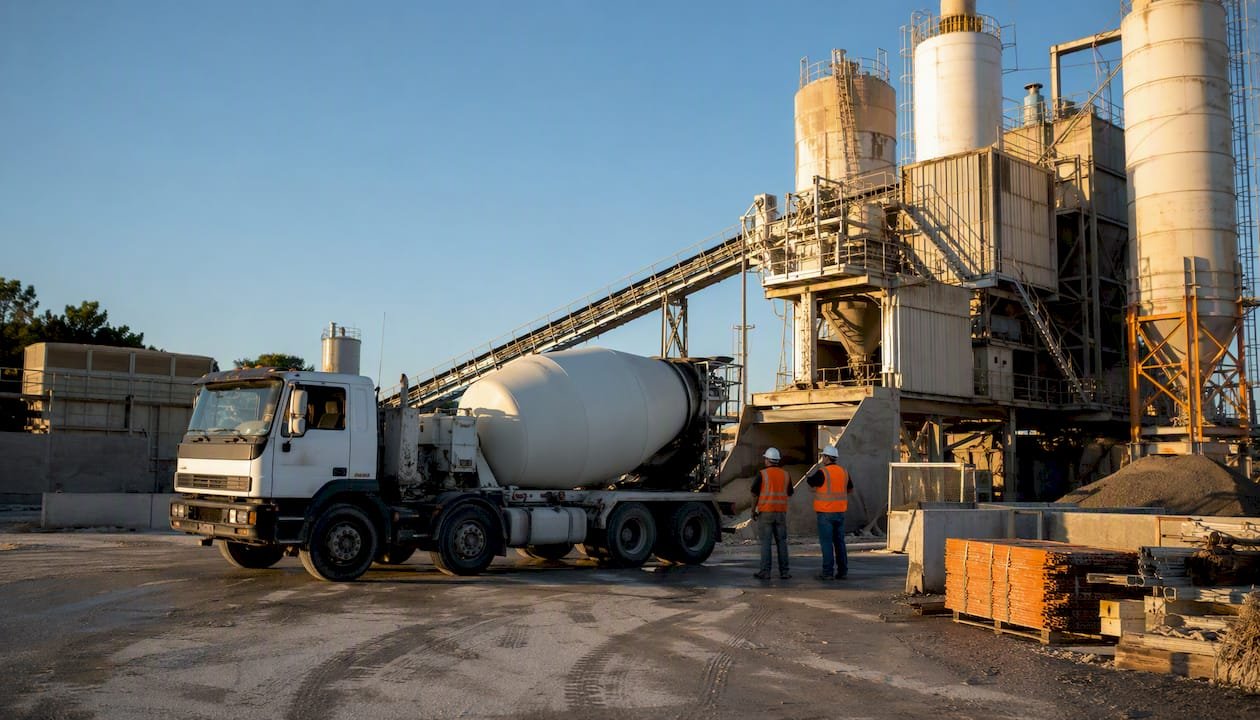
Ready-mix concrete delivers consistent, spec-compliant concrete to your site while cutting labor costs, reducing waste, tightening schedules, and lowering your total project risk. If you’re specifying concrete for anything larger than a small patch repair, the advantages of ready mix concrete over on-site mixing are substantial enough to affect your bottom line on every job.
Here’s what you get immediately:
- Consistent quality: Every load meets a tested mix design, with batch records and test certificates to back it up.
- Speed: Batch plants produce 30–60 cubic meters per hour versus roughly 4–5 cubic meters per hour from a typical on-site mixer, enabling continuous pours that site mixing simply cannot support.
- Labor savings: Your crew stops mixing and starts placing, finishing, and moving on to the next task.
- Less waste: Order to volume, not to estimate. Excess material disposal costs drop sharply.
- Safer sites: No bulk aggregate stockpiles, no mixer dust, fewer trip hazards for other trades working nearby.
- Specification flexibility: Tailored mix designs, admixtures, and slump targets for any structural or architectural requirement.
This article covers specification checklists, ordering logistics, production figures, cost modeling, and supplier selection so you can act on these advantages immediately.
Table of Contents
- What ready-mix concrete actually is, and how it differs from other options
- The real benefits of ready mix concrete supply on your projects
- Plant vs. on-site mixing: what the production numbers mean for your schedule
- Project types where ready-mix supply gives you the clearest advantage
- Limitations and red flags to manage before you order
- How to specify and order ready-mix: the contractor’s checklist
- Cost considerations: when ready-mix concrete pays off
- On-site tactics that get the most from your ready-mix delivery
- Key Takeaways
- The case for ready-mix is stronger than the price tag suggests
- VW Concreting: ready-mix specification and placement in Melbourne
- Authoritative sources and standards for ready-mix specification
What ready-mix concrete actually is, and how it differs from other options
Ready-mix concrete (RMC) is batched at a centralized plant, loaded into transit mixer trucks, and delivered to your site in a plastic, workable state. The plant controls every input: aggregate gradation, cement content, water-cement ratio, and admixture dosing, using calibrated scales and automated systems rather than a laborer with a shovel.
The main alternatives contractors encounter are site-mixed concrete and volumetric (metered) trucks. Site-mixed concrete uses a drum mixer on-site, drawing from raw materials stored at the job. It gives you flexibility but sacrifices consistency, requires storage space, and is slow. Volumetric trucks carry raw materials and mix on demand, producing as little as 1 cubic yard in roughly 40 seconds. They avoid transit hydration constraints entirely, which makes them useful for remote sites or micro-pours where a transit mixer would arrive with concrete already stiffening.
Transit-mixed RMC starts hydrating the moment water contacts cement at the plant. Typical delivery windows run 60–90 minutes before workability degrades. For longer hauls or hot weather, retarders slow hydration and extend that window. Plasticizers and superplasticizers improve workability without adding water, protecting your water-cement ratio and your structural performance.
The real benefits of ready mix concrete supply on your projects
Consistent quality and structural reliability
Plant batching eliminates the human variability that kills on-site mixing. Calibrated equipment, automated admixture dosing, and lab-verified recipes produce repeatable mixes load after load. The practical result: fewer weak spots, less color variation in architectural pours, and a paper trail of batch records and compressive strength test results you can hand to an engineer or inspector.

Controlling the water-cement ratio at the plant is the single biggest driver of reduced rework. Add water on-site to improve workability and you’re trading short-term convenience for long-term durability problems. Plant mixes arrive at the specified slump, so that temptation disappears.
Time savings and continuous pours
A continuous pour on a large slab or footing requires a concrete supply rate your on-site mixer cannot match. Cold joints, where a fresh load bonds to a partially set earlier pour, are a structural defect. With RMC, you schedule back-to-back truck deliveries timed to your placement rate and avoid cold joints entirely.
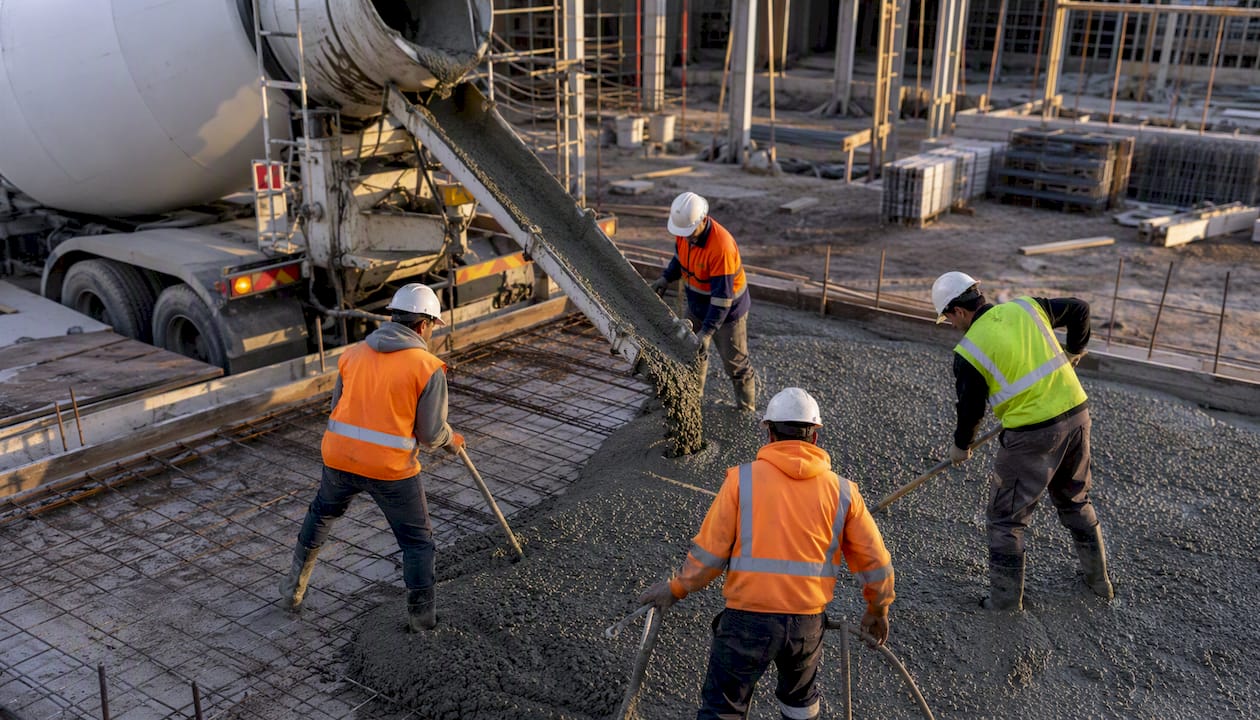
The production speed gap is significant. On-site mixers typically produce 4–5 cubic meters per hour. A batch plant delivers much higher volume per hour than on-site mixers, which means your pour rate is limited by your crew and pump, not your concrete supply.
Labor and site cost savings
Ready-mix adoption shifts contractor labor from mixing to higher-value tasks, specifically placing, finishing, and quality checking. You don’t need a dedicated mixing crew, a mixer operator, or someone managing raw material deliveries. On a multi-trade site, that freed-up space and labor has real dollar value.
Storage overhead drops too. No aggregate stockpiles, no cement bags to protect from moisture, no mixer maintenance. For tight urban sites or projects with limited laydown area, this alone can justify the switch.
Waste reduction and material efficiency
Ready-mix lets you order exact volumes matched to your pour plan, cutting the overordering that inflates disposal costs on site-mixed jobs. Better mix control at the plant also means less cement waste. Plant batching can reduce cement consumption by approximately 10–12% through tighter mix design and the use of supplementary cementitious materials (SCMs) like fly ash or ground granulated blast-furnace slag (GGBS).
Statistic: Centralized ready-mix production and delivery can reduce CO2 emissions by approximately 25% compared with equivalent site-mixed approaches, primarily through fewer transport trips and more efficient material use.
Safety and site management
Bulk aggregate piles, cement bags, and running mixers create dust, trip hazards, and congestion. Remove them and your site is cleaner, quieter, and safer for every trade working alongside the concrete crew. Dust exposure from cement handling is a real occupational health concern; plant batching keeps that exposure at the plant, not on your job site.
Specification flexibility and architectural finishes
RMC suppliers can dial in almost any mix design: high-early-strength mixes for fast-track projects, low-heat mixes for mass pours, fiber-reinforced mixes for industrial slabs, and decorative mixes for colored concrete or exposed aggregate finishes. You specify the outcome; the plant engineers the mix.
Pro Tip: For pours requiring a pump, specify a mix with a higher slump (typically 150–180 mm) and confirm with your supplier that the mix design is pump-rated. A standard slump mix can cause pump blockages and cost you hours on pour day.
Plant vs. on-site mixing: what the production numbers mean for your schedule
The productivity gap between plant batching and on-site mixing has direct implications for how you schedule crews, plan continuous pours, and manage subcontractor sequencing.
| Metric | Batch plant (RMC) | On-site mixer (8/12 drum) |
|---|---|---|
| Hourly output | 30–60 m³/hr | ~4–5 m³/hr |
| Mix consistency | Calibrated, lab-verified | Operator-dependent |
| Cement consumption | ~10–12% lower (SCM use) | Baseline |
| CO2 vs. site-mixed | — | Baseline |
| Cold joint risk | Low (scheduled deliveries) | High (slow output) |
Statistic: A batch plant’s output of 30–60 cubic meters per hour means a 30 m³ residential slab pour that would take a full day with an on-site mixer can be placed in under two hours with RMC, freeing your finishing crew to work the entire slab while the concrete is still in its optimal placement window.
The hydration clock starts at the plant. For sites more than 45–60 minutes from the plant, request retarder dosing in your mix design. This extends workability without adding water, protecting your water-cement ratio and your structural outcome. For genuinely remote sites or jobs where timing is unpredictable, a volumetric truck is worth the trade-off in consistency.
Project types where ready-mix supply gives you the clearest advantage
Ready-mix concrete supply is the right call across a wide range of project types. Here’s where it consistently outperforms alternatives:
- Large slabs and footings: Volume and continuous-pour requirements make on-site mixing impractical. RMC eliminates cold joint risk and keeps finishing crews moving.
- Commercial and multi-residential foundations: Structural specifications, engineer sign-off, and test certificate requirements are standard. Plant batching delivers the documentation trail you need.
- Pump-critical jobs: Tight access, elevated pours, or large floor plates require pumping. RMC suppliers can spec pump-rated mixes; concrete pumping logistics are far simpler when the mix arrives ready to go.
- Infrastructure and civil pours: High-volume, high-specification work where consistency across multiple loads is non-negotiable.
- Architectural and decorative finishes: Exposed aggregate, colored concrete, and polished finishes require precise aggregate selection and water-cement control that plant batching provides.
- Schedule-sensitive projects: When a delayed pour costs you a day of subcontractor time, the reliability of a scheduled RMC delivery is worth the premium over site mixing.
- Multi-trade sites with limited laydown: Eliminating raw material storage frees space and reduces congestion for other trades.
Where RMC may not be the best fit: micro-pours under 1 cubic yard, very remote sites with long transit times and no retarder option, or jobs requiring immediate mix adjustments that a volumetric truck handles better.
Limitations and red flags to manage before you order
Ready-mix is not a set-and-forget solution. These are the operational risks that catch contractors off guard:
Transit time and hydration: Hydration starts at the plant. If your site is far from the batching plant or access delays are likely, workability loss is a real risk. Confirm retarder dosing for any haul over 45 minutes.
Site access and truck weight: Standard transit mixers are heavy. Soft ground, narrow access roads, or weight-restricted bridges can prevent delivery. Mini-mix trucks or volumetric options exist for these cases, but confirm availability with your supplier before committing.
Small-job economics: Ready-mix suppliers typically have minimum load charges. On very small pours, the minimum load cost can make RMC uneconomical compared with a volumetric truck or bagged mix.
Waiting time charges: If your crew isn’t ready when the truck arrives, you pay. Waiting time fees add up fast on poorly staged pours.
Red-flag checklist before ordering:
- Confirmed site access route and load-bearing capacity
- Pump availability and pump-rated mix confirmed
- Back-to-back delivery intervals agreed with dispatch
- Retarder dosing specified for long transits
- Crew and finishing equipment staged and ready
How to specify and order ready-mix: the contractor’s checklist
Getting your order right prevents the most common pour-day problems. Work through this in sequence:
- Calculate your volume accurately. Measure the pour dimensions precisely, then add 3–5% for waste, form variations, and spillage. Underordering mid-pour is far more costly than a small surplus.
- Specify the mix design. State the target compressive strength (e.g., 4,000 psi / 28 MPa for a standard residential slab), aggregate size, and any SCM substitutions (fly ash, GGBS).
- Specify slump and workability. Match slump to your placement method: lower slump for hand-placed footings, higher slump for pumped pours. Confirm with your supplier what slump is achievable with the specified mix.
- List required admixtures. Retarder for long transits or hot weather, accelerator for cold weather, superplasticizer for pump applications. See cold-weather pouring practices for admixture guidance in low temperatures.
- Confirm delivery windows. Give the plant your pour start time and the interval between trucks. A 9 m³ truck placed at 20 m³/hr means a new truck every 27 minutes. Build that schedule before you call.
- Specify pump access and staging. Confirm pump location, hose run length, and whether the mix is pump-rated. Review your concrete placement plan before finalizing the order.
- Confirm test certificate requirements. If your engineer or inspector requires compressive strength test cylinders, tell the supplier at order time, not on pour day.
- Have a contingency plan. What happens if a truck is delayed 30 minutes? Know your cold joint risk threshold and have the plant’s dispatch number on hand.
Pro Tip: For large continuous pours, brief your finishing crew on the delivery schedule before the first truck arrives. Finishing crews that fall behind the pour front create surface defects that are expensive to fix. Pace the pour to the finishers, not the other way around.
Cost considerations: when ready-mix concrete pays off
The per-cubic-yard price of ready-mix is higher than raw materials for site mixing. The total project cost is usually lower. Here’s why that gap closes fast:
| Cost category | Site-mixed | Ready-mix |
|---|---|---|
| Labor (mixing crew) | High | Eliminated |
| Equipment hire (mixer, maintenance) | Yes | None |
| Raw material storage and handling | Yes | None |
| Disposal of excess material | Higher | Lower (order-to-need) |
| Rework from inconsistent mixes | Higher risk | Lower risk |
| Test certificates and documentation | Manual/none | Included |
Statistic: Plant batching can reduce cement consumption by approximately 10–12% through better mix control and SCM use, which directly reduces material cost per cubic yard even before labor savings are counted.
The main cost drivers to negotiate with your supplier: minimum load charges, truck waiting time fees (typically charged per minute after a free period), return load rules, and the cost of test cylinders. On a 50 m³ commercial slab, eliminating a two-person mixing crew for a full day, removing mixer hire, and avoiding one rework call-back can offset a significant per-yard price premium.
For small jobs under 3–4 cubic yards, run the numbers on a volumetric truck. The flexibility to adjust mix volume on-site and avoid minimum load charges can make it more economical, though you trade some consistency.
On-site tactics that get the most from your ready-mix delivery
Good planning at the plant means nothing if the site isn’t ready. These are the field practices that protect your pour:
- Stage truck routes before the first delivery. Mark the access path, confirm turning radius for the mixer, and designate a waiting area so trucks don’t block the street while you’re still setting up.
- Position the pump before the truck arrives. A pump that isn’t primed and positioned when the first load arrives wastes your free unloading time and risks a waiting charge.
- Brief the crew on the delivery cadence. Everyone on the pour should know the truck interval, the placement sequence, and who calls the plant if there’s a delay.
- Place concrete immediately on delivery. Don’t let a load sit in the drum while you sort out a form issue. Hydration doesn’t pause.
- Coordinate retarder and accelerator dosing with the plant in real time. If weather changes between your order and your pour, call dispatch. A quick retarder adjustment is far cheaper than a load that arrives too stiff to place.
- Handle partial loads and returns proactively. If your final truck arrives with more concrete than you need, have a designated overflow area or a small secondary pour planned. Returning a full load costs money.
Pro Tip: Keep the plant’s dispatch number in your phone, not just the sales rep’s. On pour day, dispatch is the person who can adjust your next load’s retarder dosage, delay a truck by 15 minutes, or confirm your back-to-back delivery schedule. That direct line is worth more than any pre-pour paperwork.
For adverse weather pours, review wet weather concreting procedures before finalizing your delivery schedule.
Key Takeaways
Ready-mix concrete supply reduces total project cost, schedule risk, and rework when you specify correctly, stage your site properly, and coordinate deliveries to match your pour rate.
| Point | Details |
|---|---|
| Specify before you order | Lock in mix design, slump, admixtures, and delivery intervals before calling the plant. |
| Stage the site first | Truck routes, pump position, and crew briefing must be complete before the first load arrives. |
| Model total cost, not unit price | Labor, storage, disposal, and rework savings typically offset the higher per-yard price. |
| Use retarders for long transits | Request retarder dosing for any haul over 45 minutes to protect workability and water-cement ratio. |
| VW Concreting for Melbourne projects | VW Concreting specifies and places ready-mix concrete across driveways, slabs, and commercial pours with full documentation. |
The case for ready-mix is stronger than the price tag suggests
The contractors who push back on ready-mix usually do it on price. They see the per-yard cost, compare it to raw materials, and decide site mixing is the smarter call. That math ignores most of the actual costs.
What the per-yard comparison misses: the mixing crew’s wages, the mixer hire and fuel, the aggregate delivery, the cement storage, the disposal run for the leftover batch, and the callback when a weak spot shows up in a slab six months later. Add those up across a 50 m³ pour and the ready-mix premium disappears, often into a net saving.
The quality argument is even cleaner. Controlling the water-cement ratio at the plant is the single most reliable way to produce concrete that performs to spec. On-site, that ratio drifts every time someone adds a bucket of water to improve workability. The result is concrete that looks fine on pour day and underperforms for the next 30 years. Ready-mix removes that variable entirely.
The real discipline ready-mix demands is planning. You can’t call a plant 20 minutes before you need concrete and expect a smooth pour. But contractors who build the specification and delivery schedule into their pre-pour checklist consistently report fewer callbacks, cleaner sites, and faster project completions. The concrete supply method isn’t the bottleneck. The planning is.
VW Concreting: ready-mix specification and placement in Melbourne
VW Concreting has completed over 145 projects across Melbourne, specifying and placing ready-mix concrete for driveways, slabs, commercial pours, and architectural finishes. The difference between a smooth pour and a costly rework usually comes down to three things: the right mix design, a properly staged site, and a delivery schedule that matches your crew’s placement rate. That’s exactly what the VW Concreting team manages on every job.
For contractors and builders who want a concreting partner that handles specification, delivery coordination, and placement from a single point of contact, explore VW Concreting’s driveways and slabs work or get in touch to discuss your next project.
Authoritative sources and standards for ready-mix specification
Use these references when writing specifications, reviewing supplier qualifications, or setting QA requirements on your projects:
- ASTM International: ASTM C94 covers ready-mixed concrete specifications, including mixing, delivery, and testing requirements. C94 is the standard your supplier’s batch records should reference.
- National Ready Mixed Concrete Association (NRMCA): The NRMCA publishes mix design guides, plant certification standards, and contractor education resources. Supplier plant certification through NRMCA is a reliable quality signal.
- Portland Cement Association (PCA): PCA’s design and construction guides cover water-cement ratio, durability, and mix design fundamentals. Useful for specifying structural mixes.
- American Concrete Institute (ACI): ACI 301 (Specifications for Structural Concrete) and ACI 318 (Building Code) set the structural design and specification standards your engineer will reference.
- VW Concreting: Concrete Placement Plan: Step-by-step guide to planning pours and crew sequencing for Melbourne projects.
- VW Concreting: Site Preparation Best Practices: Staging rules and site prep checklist before your ready-mix delivery arrives.
- VW Concreting: Concrete Pumping Guide: Technical guidance on pump specifications, hose runs, and pump-rated mix requirements.
Leave A Comment