
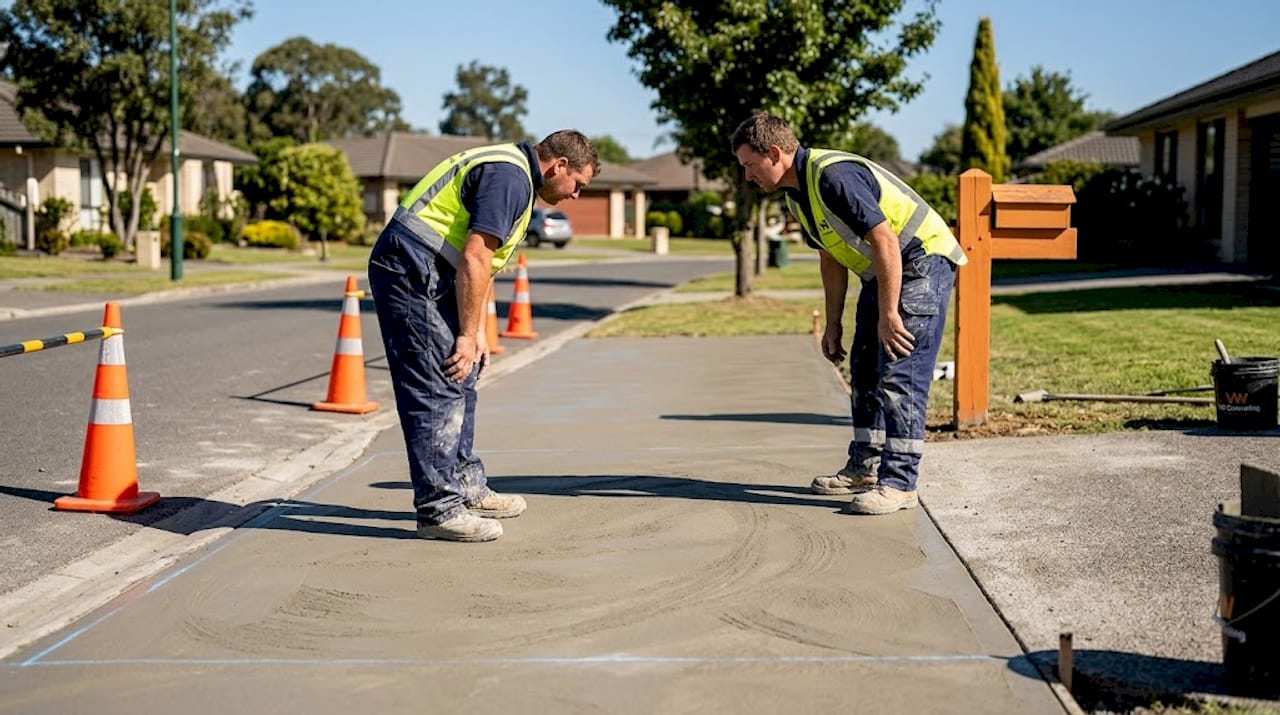
Many Melbourne homeowners spend thousands on a beautiful driveway, only to overlook the one section that takes the most punishment every single day. The concrete apron — that short stretch of concrete where your driveway meets the street — is often treated as an afterthought. But get it wrong, and you’re looking at cracking, drainage problems and potential council compliance issues that can cost far more to fix than they would to prevent.
When planning a concrete driveway Melbourne homeowners should understand that the apron plays a crucial role in both durability and functionality. It’s the area that handles constant vehicle pressure, weather exposure and water runoff every day.
Understanding what a driveway apron actually is, how it’s built and what the local Melbourne regulations are can save you real money, prevent future damage and ensure your concrete driveway Melbourne project remains strong, compliant and built to last.
Table of Contents
- What is a concrete driveway apron?
- Key regulations every homeowner should know
- Engineering essentials: How concrete aprons are built for durability
- Common problems and how to prevent failure
- Repair or replacement: Making the right call
- The often-overlooked value of a well-built concrete apron
- Ready to upgrade your driveway? Get expert concreting help
- Frequently asked questions
Key Takeaways
| Point | Details |
|---|---|
| Defines property boundary | A concrete apron driveway forms the critical transition between street and home, affecting both access and curb appeal. |
| Regulations impact design | Melbourne councils control apron materials, drainage, and installation methods for safety and compliance. |
| Durability is engineered | Proper base preparation, reinforcement, and curing are essential to prevent cracking and settling. |
| Prevention saves money | Identifying early signs of apron problems helps avoid costly full driveway replacements. |
| Expert assessment matters | Targeted repairs are often possible; consulting professionals ensures lasting results. |
What is a concrete driveway apron?
The term “apron” gets thrown around loosely, and that causes confusion. Some homeowners think it’s just the decorative edge of a driveway. Others assume it’s the same as the whole driveway slab. Neither is quite right.
A concrete driveway apron is the transitional concrete section where a driveway meets the road, often sitting within the public right-of-way, and typically forming the first stretch from the street toward the property or garage. Think of it as the handshake between public infrastructure and your private property. It’s the section that vehicles roll over every time they enter or exit your driveway.
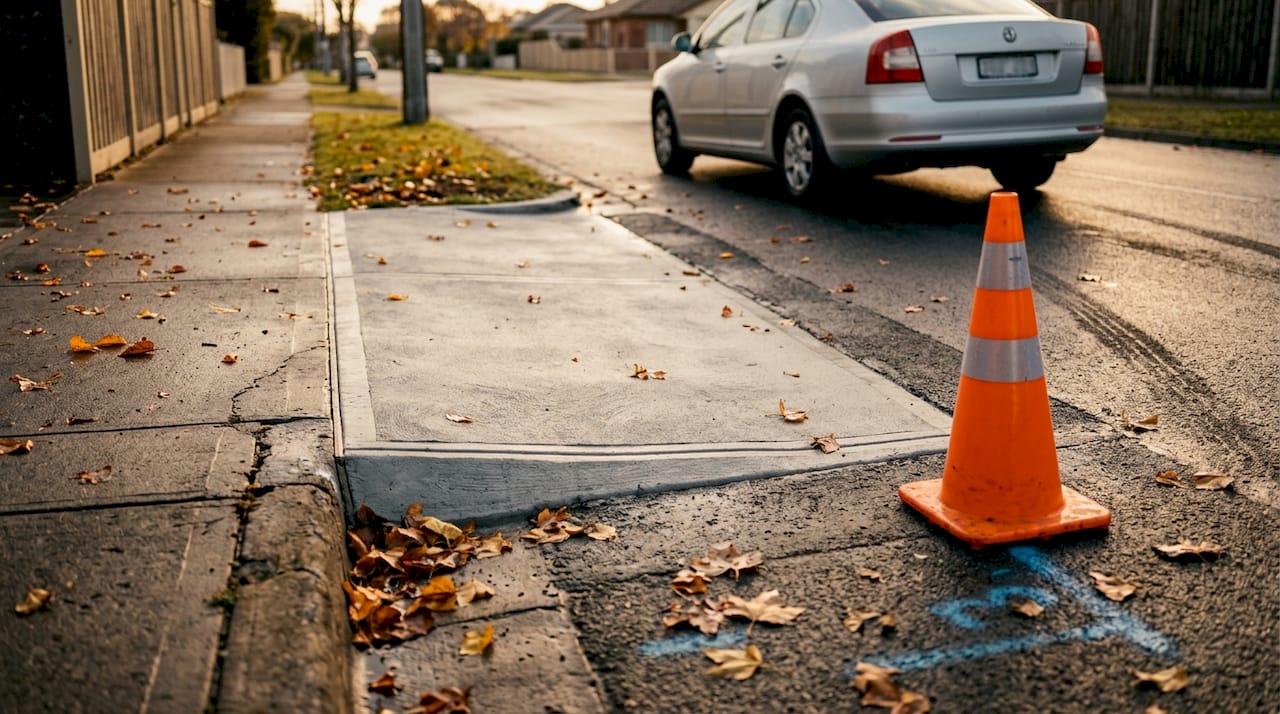
Aprons typically measure between 8 and 15 feet in depth (roughly 2.4 to 4.5 meters), though the exact size depends on your property’s setback, your council’s requirements, and the width of your driveway. Wider driveways or those serving double garages naturally require wider aprons.
Here’s a quick breakdown of where the apron sits relative to the rest of your driveway:
| Zone | Location | Ownership/Responsibility |
|---|---|---|
| Road surface | Street itself | Local council |
| Driveway apron | Edge of road to property boundary | Often shared or council-regulated |
| Private driveway | Property boundary to garage | Homeowner |
| Garage slab | Inside garage | Homeowner |
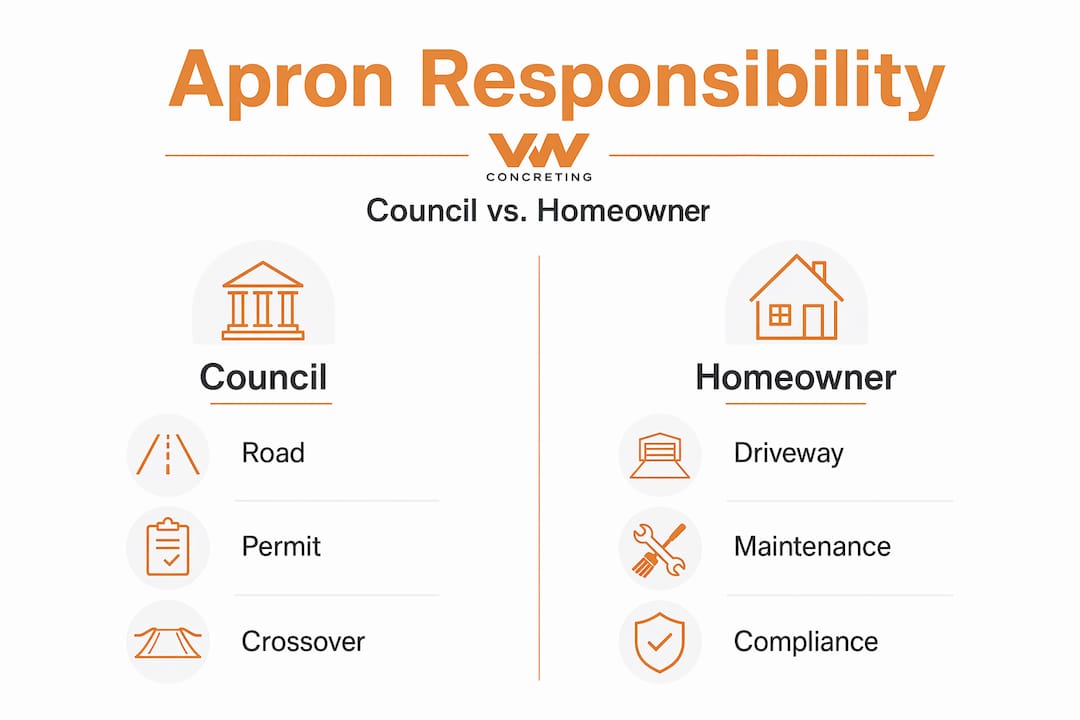
In Melbourne specifically, the apron often falls within the council’s road reserve, which means your local council has a say in what materials you use, how thick the slab must be, and even how water drains off it. This is why many homeowners are surprised to discover they can’t simply pour a new apron without checking in with their local council first. Knowing how to prevent driveway cracks starts with understanding this zone and building it correctly from day one.
Key regulations every homeowner should know
Here’s where things get serious. The apron isn’t just a functional slab, it’s a regulated one.
Driveway aprons are regulated by local municipality and council rules because they function as a stormwater drainage component and because they sit close to buried utilities and road infrastructure. This affects what materials, thickness, reinforcement, and installation method are allowed. In plain terms: you can’t just wing it.
In Melbourne, most local councils require:
- A minimum concrete thickness (often 100mm to 150mm) depending on vehicle loads
- Specific drainage gradients to direct water away from the road and toward your property’s stormwater system
- Use of reinforced concrete (not plain concrete) in most cases
- A permit before any work begins in the road reserve
- Inspection by a council officer or licensed contractor before and after the pour
- Work to be carried out by a registered contractor, not a DIY job
Why stormwater matters so much: The apron is one of the first places where rainwater either gets managed properly or starts causing problems. If the slope is wrong, water pools at the base of your driveway, softens the subbase, and accelerates cracking. It can also push water toward the road, which councils take seriously.
Statistic to note: Poorly graded driveways and aprons are among the leading causes of premature concrete failure in residential properties across Victoria. Even a 1 to 2 degree error in slope can redirect hundreds of liters of water in the wrong direction during a heavy Melbourne downpour.
Pro Tip: Before you get any quotes, call your local council or check their website for crossover and driveway apron requirements. Some Melbourne councils have specific approved contractor lists, and using someone not on that list can void your permit and force a costly redo.
The permit process sounds daunting, but it’s usually straightforward when you work with an experienced concreting contractor who knows Melbourne’s requirements. The real risk is skipping it entirely and facing a compliance order after the fact.
Engineering essentials: How concrete aprons are built for durability
A concrete apron that lasts 20 to 30 years doesn’t happen by accident. It’s the result of careful preparation, correct materials, and disciplined execution. The apron is a high-stress zone because vehicles are constantly turning, braking, and transitioning between the elevation of the street and the grade of your private driveway. That combination of stress and movement means shortcuts show up fast.
Here’s how a properly built apron comes together:
- Excavation and subgrade preparation: The existing ground is excavated to the required depth, typically 150mm to 200mm below the finished surface level. Any soft or unstable soil is removed and replaced with compacted fill.
- Base layer compaction: A crushed rock or gravel base (usually 100mm thick) is laid and compacted in layers. This is the most critical step. A poorly compacted base is the number one cause of slab settlement and cracking.
- Formwork setup: Timber or steel forms are set to the correct grade and slope, ensuring the finished slab drains away from the road and toward your property’s drainage system.
- Reinforcement installation: Steel mesh or rebar is placed within the forms, positioned at the correct height within the slab (not resting on the ground). Reinforcement controls cracking and holds the slab together if movement occurs.
- Concrete pour: Concrete is poured, screeded, and finished to the specified surface texture. For driveways, a broom finish is common because it provides grip without being too rough.
- Curing: This is where patience matters. Curing and construction staging directly affect durability. Improper curing reduces early strength and increases the risk of surface defects and cracking.
| Construction step | Common shortcut | Consequence |
|---|---|---|
| Base compaction | Thin or uncompacted base | Settlement, cracking |
| Reinforcement | No mesh or wrong placement | Slab breaks apart under load |
| Drainage slope | Flat or reverse grade | Water pooling, subbase erosion |
| Curing | Driving on it too soon | Surface scaling, reduced strength |
If you’re interested in a more decorative finish, aggregate concrete for driveways offers both durability and visual appeal, and it can be applied to aprons as well as the main driveway slab for a cohesive look.
Pro Tip: Ask your contractor what curing method they use. A quality contractor will either apply a curing compound or keep the slab moist for at least 7 days. Understanding proper curing times is one of the simplest ways to protect your investment.
Common problems and how to prevent failure
Even well-built aprons can run into trouble if maintenance is ignored or if the original construction had subtle flaws. Knowing what to look for early can save you from a full replacement.
Common failure drivers include inadequate drainage or water pooling, poor or insufficient base compaction, and slab thickness or reinforcement mismatches at the transition. These lead to cracking, uneven settling, and premature failure that often starts right at the apron.
Here are the most common problems Melbourne homeowners encounter:
- Cracking along the apron edge: Usually caused by poor base compaction or no reinforcement. Small hairline cracks can be sealed, but wide or structural cracks need professional assessment.
- Water pooling at the base of the driveway: A sign that the drainage slope is wrong or that the subbase has settled unevenly. Left unchecked, this softens the ground beneath the slab and accelerates failure.
- Spalling (surface flaking): Often caused by poor curing, the use of de-icing salts (less common in Melbourne but still relevant), or a low-quality concrete mix. The surface literally peels away in layers.
- Uneven settling between apron and road: When the apron sinks relative to the road edge, it creates a lip that can damage low-clearance vehicles and signals serious subbase problems.
- Tree root intrusion: Melbourne’s established suburbs are full of large street trees. Roots can lift and crack an apron from below, especially if the original slab was thin or unreinforced.
“The transition between the street and the private driveway is where the most stress concentrates. That’s where failures begin, and that’s where the most care needs to go during construction.”
Prevention comes down to three things: proper base preparation, correct reinforcement, and adequate drainage. If all three are done right from the start, your apron will outlast most of the rest of your driveway. For ongoing maintenance, our driveway crack prevention guide covers practical steps you can take to extend the life of your concrete.
Repair or replacement: Making the right call
When your apron starts showing problems, the instinct is often to assume the worst and budget for a full driveway replacement. But that’s not always necessary, and knowing the difference can save you significant money.
A failed apron doesn’t always require full driveway replacement. Some situations allow targeted apron replacement using saw-cut lines and matching profiles, while more extensive cracking extending beyond the apron may warrant full replacement. The key is getting an honest assessment from a qualified contractor.
Here’s how to evaluate your situation:
- Identify the extent of damage: Is the cracking or settling limited to the apron zone (the first 2 to 4 meters from the street), or does it continue up the driveway toward the garage?
- Check for subbase issues: If the slab is rocking or hollow-sounding when you walk on it, the subbase has failed. This usually means full removal and reconstruction, not just patching.
- Assess the drainage: If water is pooling in the same spot every time it rains, a patch won’t fix the underlying slope problem. The grade needs to be corrected.
- Look at the transition joint: Where the apron meets the main driveway, there should be a clean joint. If this area is cracked or crumbling, it’s often the starting point for wider failure.
- Get a professional assessment: A qualified concreting contractor can use simple tools to check slab thickness, base condition, and drainage grade before recommending repair or replacement.
When targeted replacement is possible, contractors use a saw to cut a clean line at the boundary between the damaged apron and the intact driveway. This creates a straight, professional edge and allows the new concrete to bond cleanly. Matching apron profiles to the existing driveway finish ensures the repair looks intentional rather than patched.
Pro Tip: If your apron is more than 20 years old and showing multiple issues, replacement is almost always more cost-effective than repeated repairs. Patching old concrete is like putting a new tire on a car with a bent rim. It buys time but doesn’t solve the problem.
The often-overlooked value of a well-built concrete apron
After more than two decades working on Melbourne driveways, we’ve noticed a consistent pattern. Homeowners invest heavily in the main driveway slab, choose premium finishes, and then accept whatever the cheapest quote offers for the apron. It’s a false economy that almost always comes back to bite them.
The apron is the first thing your car touches when you arrive home. It’s also the first thing visitors, neighbors, and potential buyers see. A cracked, sunken, or poorly finished apron signals neglect, regardless of how good the rest of the driveway looks. It’s the handshake that sets the tone.
What we’ve seen repeatedly is that homeowners who cut corners on the apron end up spending more within five years than they would have on a properly built one from the start. The protection against cracks starts at the apron, not halfway up the driveway.
There’s also a compliance angle that catches people off guard. Melbourne councils are increasingly active about road reserve maintenance, and an apron that doesn’t meet current standards can result in a notice to fix, at the homeowner’s expense. Building it right the first time isn’t just about aesthetics. It’s about protecting your investment and staying on the right side of your local council.
The practical wisdom we’d share with any Melbourne homeowner: treat the apron as the foundation of your entire driveway project, not an add-on. Specify the same concrete mix, the same reinforcement standard, and the same drainage attention you’d give to the main slab. The extra cost is minimal. The long-term benefit is significant.
Ready to upgrade your driveway? Get expert concreting help
A well-built apron is the starting point for a driveway that performs and looks great for decades. If you’re planning a new driveway or dealing with an aging apron that’s showing its age, working with experienced local professionals makes all the difference.
At VW Concreting, we’ve completed over 145 projects across Melbourne since 2001, and we understand both the technical requirements and the council regulations that apply to driveway aprons in this city. Our professional driveway apron solutions cover everything from initial assessment and permit support to the finished pour. If you’re interested in a premium finish, explore our aggregate driveway options for a result that combines durability with genuine curb appeal. Contact us today for a consultation and quote.
Frequently asked questions
What is the main purpose of a driveway apron?
The driveway apron transitions between the street and your property, providing a stable surface that supports vehicles entering and exiting while directing water away from the road.
Why do most councils and municipalities regulate driveway aprons?
Aprons are regulated because they sit within the public road reserve near buried utilities and stormwater infrastructure, so councils must control materials, thickness, and drainage to protect public assets.
How soon can I drive on a new concrete apron?
You should wait at least 7 days before driving on a new apron, since improper curing reduces early strength and significantly increases the risk of surface defects and long-term cracking.
What are the warning signs my apron needs repair or replacement?
Watch for visible cracking, water pooling near the street edge, uneven settling, or a hollow sound underfoot, as these all point to base compaction or drainage failures that won’t resolve on their own.
Should I replace the whole driveway if just the apron fails?
Not necessarily. Targeted apron replacement using saw-cut lines is often sufficient when damage is confined to the apron zone, but widespread cracking extending up the driveway may justify a full replacement.
Leave A Comment