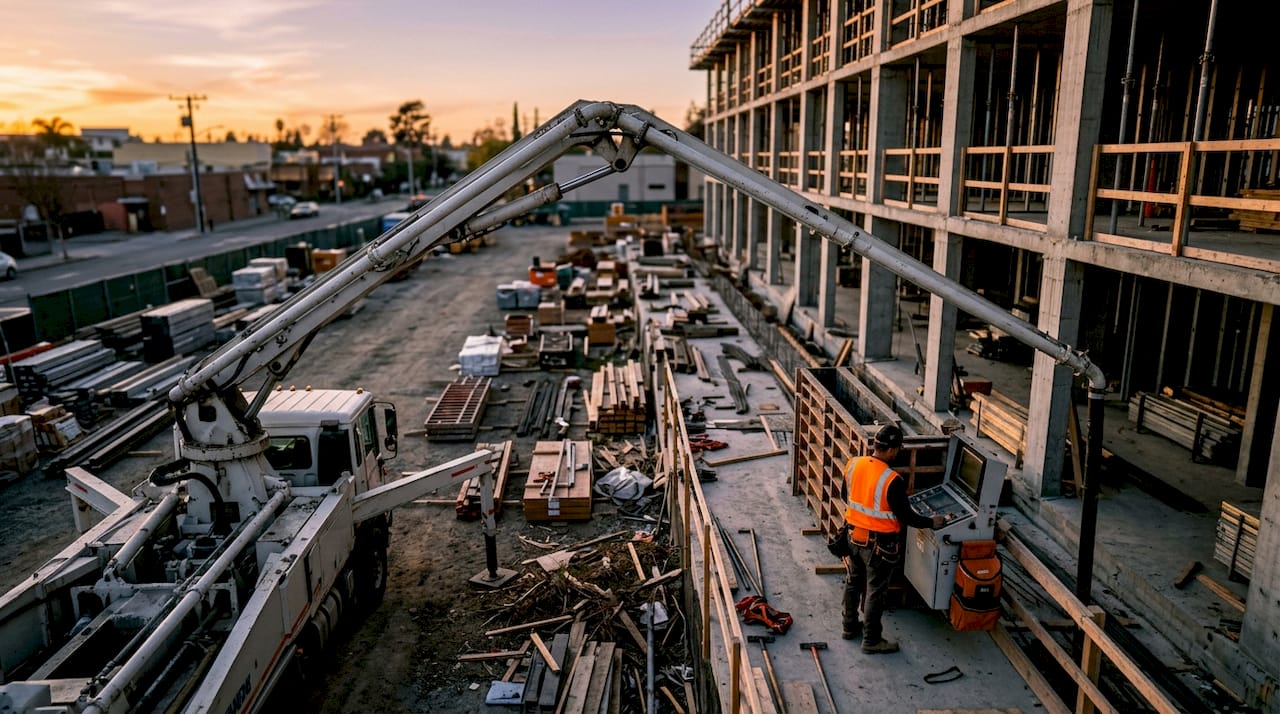
Concrete pumping is the process of using specialized machinery to transport and place liquid concrete precisely where needed on a construction site. The role of concrete pumping projects has grown from a convenience to a core method for any build requiring speed, accuracy, or difficult access. BS EN 13670 standards limit direct discharge to a 600mm drop and a horizontal range of just 3–4 meters from a truck chute. Beyond those limits, pumping is the only practical solution. For project managers and builders working on mid-sized to large pours, understanding how pumping works and when to use it directly affects your schedule, budget, and structural quality.
What is the role of concrete pumping in construction projects?
Concrete pumping is the mechanized delivery of wet concrete through a pipeline or boom arm directly to the placement point. The industry term for this process is “pump-placed concrete,” and it sits within the broader category of concrete placement methods alongside direct chute discharge, crane-and-bucket, and conveyor belt systems. Pumping stands apart because it removes the distance and height constraints that limit every other method.
The core function is simple. A pump draws concrete from a truck mixer and pushes it through a sealed pipe to the exact location where it needs to go. That sealed delivery path is what makes pumping so valuable. Manual relay methods using wheelbarrows or buckets expose concrete to air, delay placement, and create workability problems. Pumping maintains concrete freshness by minimizing transfer time and avoiding early setting that manual transport causes.

The importance of concrete pumping shows up most clearly on projects where time and access are both constrained. A high-rise floor slab, a basement foundation, or a large commercial pour cannot wait for slow manual delivery without risking cold joints or segregation. Pumping solves both problems at once.
How does concrete pumping work, and what equipment is used?
A concrete pump works through a piston or peristaltic mechanism that draws concrete into a cylinder and forces it through a pipeline under pressure. The operator controls flow rate and direction from a panel, adjusting output to match the placement team’s pace. Two main equipment types handle the majority of construction projects.
Line pumps use a trailer-mounted unit connected to flexible rubber or steel hoses. They work best for:
- Ground-level slabs and footings
- Narrow-access sites where a large boom truck cannot maneuver
- Horizontal pours over long distances
- Smaller residential projects and driveways
Boom pumps mount on a truck with a hydraulic arm that unfolds to reach height and distance. They suit:
- High-rise vertical pours
- Large commercial slabs requiring fast, continuous output
- Sites where the truck must stay on the street while concrete reaches upper floors
- Insulated concrete form (ICF) construction requiring controlled, low-pressure delivery
Line pumps vs. boom pumps each match specific site restrictions and pour requirements. Choosing the wrong type adds cost without adding capability.
Pro Tip: Before hiring a pump, confirm the site’s access width, the pour height, and the total volume. A boom pump is overkill for a 15 m³ residential slab with street access. A line pump will not reach a 10th-floor pour. Matching equipment to the job prevents wasted mobilization costs.
What benefits does concrete pumping bring to construction projects?
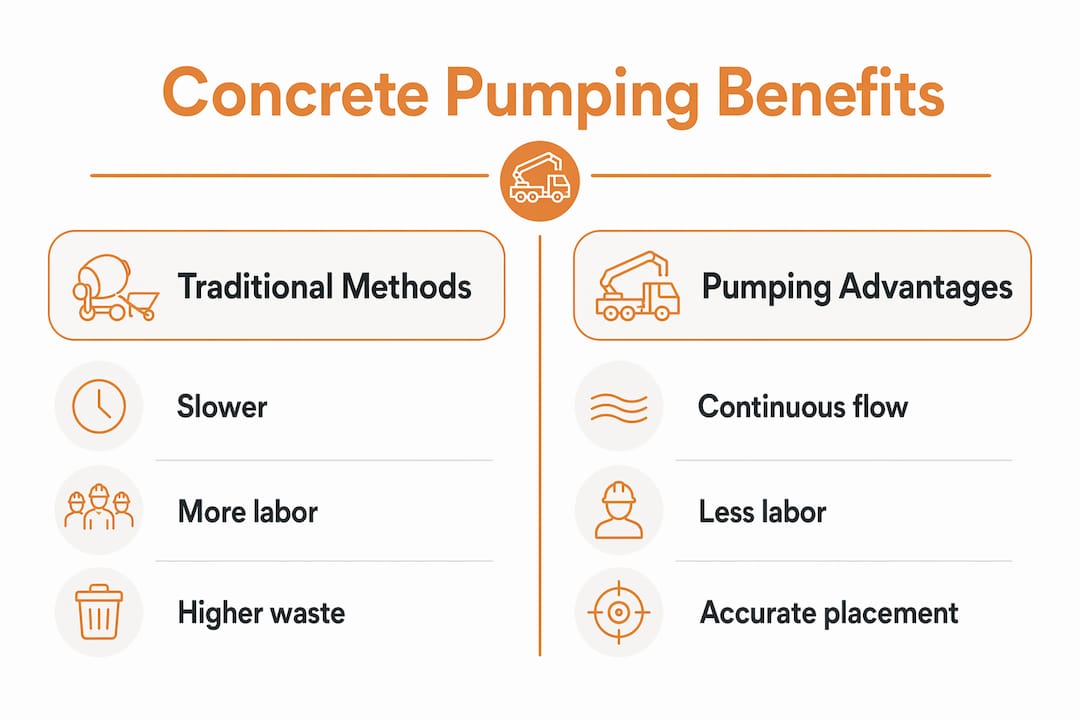
The concrete pumping benefits over traditional placement methods are measurable across speed, safety, accuracy, and cost. Each advantage compounds the others, which is why pumping has become the default choice for professional builders.
Speed and continuous flow
Pumping delivers concrete continuously without the stop-start rhythm of wheelbarrow relays or crane lifts. A boom pump can place concrete across a large slab in a fraction of the time a manual crew would take. That speed matters because concrete has a fixed workability window. Manual transport bottlenecks delay placement and force crews to add water or accept lower-quality concrete. Pumping eliminates that risk entirely.
Reduced labor and improved safety
Concrete pumping reduces labor needs to just 2–3 operators, replacing large crews moving heavy loads by hand. Fewer workers on site means fewer slip hazards, less congestion, and lower injury risk. Concrete is heavy, and repetitive manual handling causes strain injuries that cost projects time and money. Mechanized delivery reduces heavy lifting and repetitive tasks, cutting accident rates significantly.
Placement accuracy and waste reduction
Pumping delivers concrete through a sealed pipe directly to the formwork. There is no spillage from tipping buckets or overfilling wheelbarrows. The operator places concrete exactly where the finishing crew needs it, reducing waste and rework. On complex pours with tight tolerances, that accuracy is not optional.
Logistical flexibility
Pumps allow trucks to stay at accessible street-level locations while concrete reaches upper floors or confined basement areas. This removes the need for cranes lifting concrete buckets, which are slow, expensive, and weather-dependent. On tight urban sites in Melbourne, where street access is limited and neighboring properties are close, this logistical advantage alone justifies pumping.
Cost savings at scale
Concrete pumping reduces delivery and placement costs by 20–30% on mid-sized projects in the 500–1,000 cubic yard range. That saving comes from fewer labor hours, faster pour completion, and reduced equipment hire time. The break-even point sits at around 10–15 m³. Below that volume, direct pour may be cheaper. Above it, pumping almost always wins on total project cost.
What are practical considerations when implementing concrete pumping?
Getting the most from concrete pumping requires more than booking a pump truck. Project managers need to plan around several factors that directly affect quality and cost.
Volume thresholds and hire costs. The break-even for pump hire typically falls at 10–15 m³, with daily fixed mobilization costs that make small pours uneconomical. For pours above 50 m³, pumping is almost always the more cost-effective choice. Plan your pour schedule to consolidate volume where possible.
Preventing cold joints and segregation. Continuous, controlled flow prevents cold joints, which form when a section of concrete begins to set before the adjacent pour arrives. Cold joints are structural defects. Pumping solves this by maintaining an unbroken flow, but only if the operator and finishing crew work at a matched pace. Stopping the pump mid-pour for more than 20–30 minutes creates the same risk as manual relay. For more on preventing joint failures, the guide on control joints in driveways covers the technical detail.
Finishing and vibration discipline. Finishing and vibration after placement are non-negotiable. Pumping places concrete fast, but speed without proper finishing leads to mounding, uneven settlement, and surface failures. Every pump pour needs a vibrator to consolidate the mix and a screed to level the surface immediately after placement.
Operator coordination. Pump operators must understand slump, mix consistency, and formwork type to control flow rate correctly. A mix that is too stiff will block the line. A mix that is too wet will segregate in the pipe. Brief your operator on the mix design before the pour starts.
Site safety setup. Clear the pump line path before the pour. Pressurized lines that fail or disconnect are a serious hazard. Establish communication signals between the operator and the placement crew, especially on noisy sites or multi-story pours.
Pro Tip: Schedule your concrete truck deliveries in tight intervals to keep the pump running continuously. Gaps between trucks stall the pour and risk cold joints. Confirm truck arrival times with your batch plant the morning of the pour.
Which construction projects benefit most from concrete pumping?
Pumping delivers the greatest advantage on projects where volume, height, or access create challenges for traditional placement methods.
| Project type | Why pumping is the best choice |
|---|---|
| High-rise buildings | Boom pumps reach upper floors without cranes, maintaining continuous vertical pours |
| Basement foundations | Pumping delivers concrete into confined excavations with precision and speed |
| Large commercial slabs | High output rates cover large areas within the workability window |
| Restricted urban sites | Trucks stay on the street while concrete reaches any point on the site |
| ICF construction | Line pumps deliver low-pressure, controlled flow suited to foam formwork |
| Infrastructure projects | Bridges, retaining walls, and tunnels require continuous pours that only pumping can sustain |
High-rise construction is where pumping’s vertical reach becomes irreplaceable. A boom pump can extend 40–60 meters or more, placing concrete on floors that no chute or bucket system can reach efficiently. For basement pours, pumping delivers concrete into excavations that restrict equipment access, maintaining the speed needed to avoid cold joints in deep formwork.
Large commercial slabs present a different challenge. The sheer volume of concrete required means the pour must finish before the first-placed concrete begins to set. Pumping’s continuous output is the only reliable way to meet that timeline. On restricted urban sites, the ability to keep trucks on a public road while the boom arm reaches across the site boundary is a genuine logistical solution, not just a convenience.
ICF construction deserves special mention. Insulated concrete forms use lightweight foam panels as permanent formwork, and they require low-pressure, controlled delivery to avoid blowouts. Line pumps matched to ICF projects deliver exactly that control. For builders working on residential ICF homes, pumping is not optional. It is the only placement method that works reliably with foam formwork.
Key Takeaways
Concrete pumping is the most cost-effective and structurally reliable placement method for any construction project exceeding 10–15 m³, delivering measurable gains in speed, safety, and quality.
| Point | Details |
|---|---|
| Break-even volume | Pump hire becomes cost-effective at 10–15 m³; pours above 50 m³ almost always save money with pumping. |
| Labor reduction | Pumping cuts on-site crew to 2–3 operators, reducing slip hazards, congestion, and injury risk. |
| Cold joint prevention | Continuous pump flow eliminates cold joints that form when manual relay methods stall mid-pour. |
| Equipment matching | Line pumps suit ground-level and narrow-access pours; boom pumps handle height and high-volume slabs. |
| Finishing discipline | Every pump pour requires immediate vibration and screeding to prevent surface failures and uneven settlement. |
Why pumping is the decision that shapes the whole pour
I have watched project managers treat the pump as an afterthought, something booked the week before the pour after every other decision is already locked in. That approach costs money and quality every time. The pump choice shapes the mix design, the truck delivery schedule, the finishing crew size, and the formwork timing. When you plan around the pump from day one, everything else falls into place.
The insight that changed how I think about concrete pumping is this: the pump is not just a delivery tool. It is a workflow coordinator. When trucks stay on the street and concrete flows continuously to the placement point, the whole site runs more smoothly. Finishing crews are not waiting. Formwork is not sitting idle. The pour completes in one continuous operation, which is exactly what monolithic structures need.
Technological advances in pump machinery have made this coordination even tighter. Modern boom pumps have remote-controlled arms and electronic flow management that let a single operator place concrete with a level of accuracy that was impossible a decade ago. For builders working on complex or high-value projects, that precision is worth every dollar of the hire cost.
My advice to any project manager reading this: put the pump on the planning schedule before you finalize the mix design. The two decisions are connected. A mix designed for pump delivery performs better, wastes less, and finishes faster than one adapted after the fact.
— Vic
VW Concreting’s approach to pump-placed projects
VW Concreting has completed over 145 projects across Melbourne since 2001, and concrete pumping sits at the center of how the team handles large, complex, or access-restricted pours.
Whether the job is a comprehensive development project or a residential driveway and slab, VW Concreting matches the right placement method to the site conditions, volume, and structural requirements. The team coordinates mix design, truck scheduling, and finishing to get the pour right the first time. For builders and project managers in Melbourne looking for a concreting partner who treats pumping as a planning decision rather than a last-minute hire, VW Concreting’s driveway and slab work shows the standard the team delivers on every job.
FAQ
What is concrete pumping?
Concrete pumping is the mechanized process of transporting wet concrete through a sealed pipeline from a mixer truck to the placement point on a construction site. It replaces manual methods like wheelbarrows and crane-and-bucket systems.
When does concrete pumping become cost-effective?
The break-even point for pump hire is around 10–15 m³. For pours above 50 m³, pumping almost always reduces total placement costs compared to manual methods.
What are the main types of concrete pumps?
Line pumps handle ground-level, horizontal, and narrow-access pours. Boom pumps suit high-rise, high-volume, and hard-to-reach placements where a hydraulic arm is needed to reach height or distance.
How does pumping prevent cold joints?
Pumping delivers concrete in a continuous, controlled flow that prevents the delays between pours that cause cold joints. Manual relay methods introduce gaps that allow partial setting before adjacent concrete arrives.
Does concrete pumping require special mix design?
Yes. Pump mixes need a slump and consistency suited to the pipe diameter and pump pressure. A mix that is too stiff blocks the line. Your pump operator and batch plant should confirm the mix design before the pour begins.
Leave A Comment