What are the best examples of outdoor commercial paving?
The strongest examples of outdoor commercial paving share one trait: material and design chosen together, not separately. Concrete pavers, permeable interlocking concrete pavement (PICP), and natural stone dominate commercial projects across the United States because each handles heavy traffic while giving designers real aesthetic control.
Here is a quick reference of what you will encounter most on well-executed commercial sites:
- Concrete pavers: factory-made units in dozens of shapes, colors, and textures; machine-installable on large sites
- PICP: interlocking concrete units with open joints that allow stormwater infiltration; eliminates runoff without retention ponds
- Natural stone (granite, bluestone, flagstone): premium look with decades-long service life when properly maintained
- Porcelain pavers: low maintenance, stain-resistant, consistent finish; favored for plazas and retail entries
- Brick and clay pavers: warm, traditional aesthetic; excellent for walkways and heritage-style commercial districts
- Exposed aggregate concrete: textured surface with embedded stone; popular for driveways and high-traffic entries
- Composite and recycled-content pavers: growing use in sustainability-focused projects
Pro Tip: Specify your paving material before finalizing site grading. Drainage slope requirements differ significantly between impermeable concrete and PICP systems, and retrofitting costs more than planning ahead.
What materials and styles define modern commercial paving?
Concrete pavers lead commercial projects for good reason. They are available in varied shapes, colors, and textures, and their modular format means damaged units can be replaced individually without tearing out an entire surface. That repairability alone reduces long-term costs on high-traffic sites.
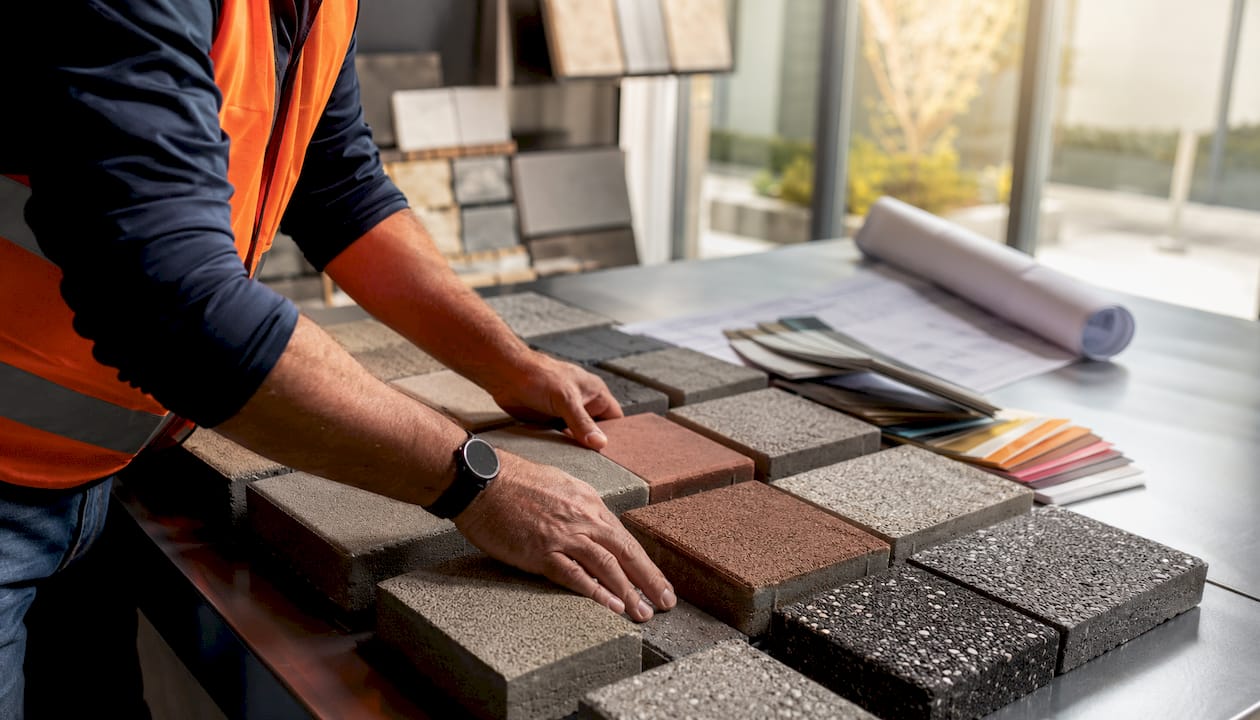
Natural stone brings something manufactured materials cannot replicate: genuine variation. Granite handles the heaviest loads and resists scratching. Bluestone suits formal walkways and entries. Flagstone works well in naturalistic or resort-style settings where irregular joints read as intentional design. Current commercial trends favor large-format pavers with geometric patterns, including hexagons and ombré gradients, for a distinctly modern aesthetic.
Porcelain is gaining ground fast in retail and hospitality projects. It resists moisture, staining, and temperature swings, and it comes in finishes that convincingly mimic stone or wood without the maintenance burden. Mixing materials, such as concrete field pavers with natural stone borders, is a proven way to balance cost and appearance without visual clutter.
Material highlights at a glance:
- Concrete pavers: versatile, machine-installable, cost-effective at scale
- Natural stone: premium durability, unique appearance, higher upfront cost
- Porcelain: low maintenance, modern finish, excellent stain resistance
- Brick and clay: traditional character, good for pedestrian-priority zones
- Exposed aggregate: textured grip, decorative aggregate visible at surface
How do layout patterns and applications shape commercial paving performance?
Pattern choice affects more than looks. Running bond, stack bond, and herringbone each distribute load differently across a paved surface, which influences how quickly a surface degrades under repeated vehicle or foot traffic. Herringbone, for instance, locks pavers together under load and is the preferred pattern for driveways and parking areas carrying heavy vehicles.
Commercial applications each have their own demands. Parking lots need surfaces that handle vehicle weight, resist oil staining, and drain efficiently. Plazas and pedestrian walkways prioritize comfort underfoot and slip resistance. Entry driveways often carry the branding weight of a property, so material quality and finish matter as much as structural performance. Hardscape planning integrated early in a project avoids costly redesigns later.
Pattern and application pairings worth knowing:
- Herringbone: parking lots, driveways, high-load roadways
- Running bond: walkways, plazas, retail streetscapes
- Stack bond: modern plazas, feature entries, low-traffic pedestrian areas
- Random/irregular flagstone: resort paths, naturalistic settings, garden courtyards
- Large-format grid: contemporary retail entries, hotel drop-off zones
Why are advanced paving technologies worth the investment?
PICP is the clearest example of a paving technology that solves a regulatory problem while improving a site. At BMW of Dallas, a 70,000 sq. ft. PICP system captured and discharged stormwater in a controlled manner, allowing the dealership to expand parking without exceeding government runoff limits. The system also eliminated the need for retention ponds, freeing that land for car display. In a 2012 demonstration, the surface handled over 500 gallons of water per minute with zero puddling.
Machine-assisted installation delivers a different kind of return. At Alton Town Center in Palm Beach Gardens, Florida, machine installation completed 150,000 sq. ft. of concrete pavers three to four times faster than hand installation would have allowed. The project also used colored pavers for traffic markings instead of paint, saving close to $250,000 compared to poured header curbs and eliminating the fading and peeling that painted markings develop over time.
Key technology benefits:
- PICP manages stormwater without retention ponds, maximizing usable site area
- Machine installation cuts labor time and cost on large commercial sites
- Colored pavers as traffic markings outlast paint with zero repainting cost
- Recycled-content and composite pavers reduce material waste on sustainability-focused projects
- Individual paver replaceability lowers long-term maintenance costs versus poured surfaces
How does professional expertise shape a commercial paving outcome?
Getting the material right is only half the job. The other half is installation quality, and that is where experience separates a surface that lasts 30 years from one that needs repair in five. Proper subgrade preparation, correct joint spacing, and accurate slope for drainage are details that do not show up in a photo but determine whether a paved surface performs under real commercial conditions.
Com has completed over 145 projects across Melbourne’s commercial and residential sectors, with specializations in concrete paving, landscaping, and outdoor construction. That breadth matters on commercial sites where driveways, walkways, and plazas need to connect visually and perform as a system. Reviewing completed commercial projects gives decision-makers a concrete sense of what craftsmanship looks like at scale.
Hardscape design integrated early in the planning process consistently produces better functional and aesthetic outcomes. Specifying paving materials alongside civil engineering, not after it, keeps drainage, accessibility, and load requirements aligned from the start.
Pro Tip: Ask your contractor for project photos that show the base preparation, not just the finished surface. A well-prepared subgrade is the single biggest predictor of long-term paving performance.
How do commercial paving costs compare across material types?
Cost varies widely depending on material, site conditions, and installation method. Concrete pavers sit in the mid-range and offer the best value at scale, particularly when machine installation is viable. Natural stone commands a higher upfront price but delivers a longer service life in high-visibility areas, which shifts the lifecycle math in its favor for premium retail or hospitality projects.
Porcelain pavers carry a higher material cost than concrete but require minimal sealing or reapplication over time. Poured concrete is typically the lowest upfront option for large areas like parking lots, though it cannot be spot-repaired the way modular pavers can. PICP costs more than standard impermeable paving initially, but it can eliminate retention pond construction and ongoing pond maintenance, which often offsets the premium entirely on larger sites.
| Material | Relative upfront cost | Maintenance level | Best application |
|---|---|---|---|
| Concrete pavers | Mid | Low to moderate | Driveways, plazas, walkways |
| Natural stone | High | Moderate | Entries, feature walkways |
| Porcelain pavers | High | Very low | Retail plazas, hospitality |
| PICP | High | Low | Parking lots, stormwater-sensitive sites |
| Poured concrete | Low | Moderate | Large parking areas, slabs |
High-quality paving materials reduce long-term maintenance and replacement costs despite higher initial investment, a calculation that consistently favors premium materials in high-traffic commercial settings.
Key Takeaways
Concrete pavers, PICP, and natural stone remain the most reliable choices for commercial outdoor paving because they balance load capacity, design flexibility, and long-term cost.
| Point | Details |
|---|---|
| Material drives lifecycle cost | Premium materials like natural stone and PICP cost more upfront but reduce maintenance and replacement over time. |
| Pattern affects load performance | Herringbone distributes load best for driveways and parking; running bond suits pedestrian walkways. |
| PICP solves stormwater compliance | A 70,000 sq. ft. PICP system at BMW of Dallas eliminated runoff issues and replaced retention ponds. |
| Machine installation saves time and money | At Alton Town Center, machine installation was significantly faster than hand installation, saving a substantial amount of money. |
| Early planning prevents costly changes | Integrating hardscape design early aligns drainage, accessibility, and material choices before construction begins. |
Leave A Comment