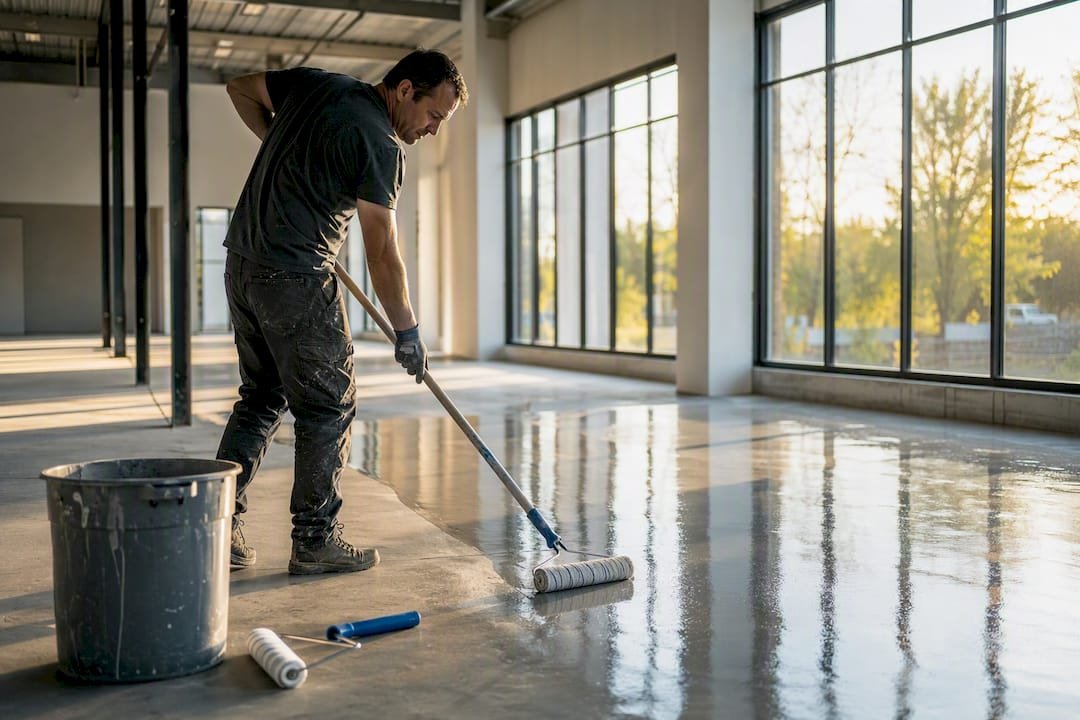
A properly installed epoxy floor lasts 10 to 20 years in a residential garage or basement, 5 to 15 years in commercial settings, and 3 to 10 years in industrial environments under heavy loads. A DIY kit, by contrast, often fails within 1 to 5 years. The gap between those numbers almost never comes down to the epoxy itself. It comes down to what happened to the concrete before a drop of resin ever touched it.
- Residential garage/basement: 10 to 20+ years professionally installed, 1 to 5 years DIY
- Commercial/retail: 5 to 15 years depending on foot and cart traffic
- Industrial/warehouse: 3 to 10 years under forklift and heavy rolling loads unless a high-build system is specified
That last variable, surface preparation, decides more about epoxy floor lifespan than the brand of epoxy, the color, or even the number of coats applied.
Key Takeaways
Epoxy floor lifespan depends far more on surface preparation and system selection than on the epoxy brand or color chosen.
| Point | Details |
|---|---|
| Lifespan varies by setting | Expect 10 to 20 years residential, 5 to 15 years commercial, 3 to 10 years industrial. |
| Prep decides longevity | Mechanical profiling and moisture testing prevent the early peeling that shortens most floor lives. |
| Maintenance adds years | Routine cleaning and a periodic topcoat can extend service life at a fraction of replacement cost. |
| DIY costs more long-term | Kits often fail within 1 to 5 years, making per-year cost higher than a professional install. |
| Com prioritizes documented prep | Com tests moisture and mechanically profiles slabs before installing epoxy floors built for decades of use. |
Table of Contents
- What Is the Average Lifespan of Epoxy Floors by Setting?
- What Factors Determine How Long an Epoxy Floor Lasts?
- When Should You Recoat, Repair, or Replace an Epoxy Floor?
- How Do You Extend the Life of an Epoxy Floor?
- What Should You Require From Your Epoxy Installer?
- How Much Should You Budget for a Floor That Lasts?
- What Do Most People Get Wrong About Epoxy Installers?
- Get an Epoxy Floor Built to Last, Not Just Look Good
- Sources
What Is the Average Lifespan of Epoxy Floors by Setting?
Residential garages sit at the top of the epoxy flooring longevity curve for a simple reason: light traffic. A family car rolling in and out twice a day puts far less mechanical stress on a floor than a forklift making 200 passes a shift. Installers who profile the concrete correctly and use a 100% solids epoxy with a urethane topcoat commonly report garage floors still performing at 15 to 18 years with no delamination, based on anonymized project histories collected across residential jobs.
- Residential garage/basement: 10 to 20 years with professional prep; often under 5 years with a rolled-on DIY kit over unprepared concrete
- Commercial retail/showroom: 5 to 15 years, shortened by rolling display carts, cleaning chemicals, and daily foot traffic
- Industrial/warehouse floors: 3 to 10 years, pushed toward the low end by forklift tires, pallet jacks, and spilled solvents
The pattern that shows up over and over: a DIY install on a garage floor that was never mechanically profiled tends to bubble or peel within two or three years, usually starting at the tire tracks. A professionally profiled and primed floor in the same garage, same climate, same car, often outlasts it by a decade or more. Same epoxy chemistry, wildly different outcome, because the surface underneath told a different story.
What Factors Determine How Long an Epoxy Floor Lasts?
Epoxy flooring durability comes down to five variables, and only one of them is out of your hands.
- Surface preparation. Mechanical profiling, meaning diamond grinding or shot blasting, opens the concrete’s pores so epoxy can bond mechanically instead of just sitting on top. Acid etching can work in limited cases, but it’s a weaker bond and more failure-prone than mechanical profiling, which is why ICRI and ASTM guidance both favor it for anything beyond a light-duty patch job.
- System type and thickness. A DIY kit typically lays down a thin, low-solids coating. A 100% solids epoxy system with a dedicated primer coat and a clear urethane or polyaspartic topcoat builds real film thickness, and that thickness is what resists abrasion over years, not months.
- Traffic type. Foot traffic barely stresses a floor. Passenger tires stress it more, especially with hot-tire pickup. Rolling steel wheels and forklifts under sustained load are the hardest on any coating, which is why industrial floors sit at the shorter end of the lifespan range regardless of installation quality.
- Environmental exposure. Moisture vapor pushing up through a slab, temperature swings that cause expansion and contraction, and UV light all attack epoxy differently. UV in particular accelerates polymer degradation, which is why bare epoxy left in direct sun yellows faster than a topcoated surface.
- Cure time between coats. Many systems require 24 to 48 hours between coats, and rushing that window is one of the most common causes of adhesion failure between layers.
Pro Tip: Ask your installer what the ambient slab temperature was during application. Epoxy cures chemically, not just by drying, and pouring it over a cold slab in early morning can extend cure time well beyond the label’s estimate.
When Should You Recoat, Repair, or Replace an Epoxy Floor?
Not every flaw means the floor is done. Here’s what each symptom is actually telling you.
- Peeling or lifting at edges and control joints usually points to a bond failure at the substrate, often from skipped mechanical profiling or moisture that was never tested for.
- Bare, worn-through patches in high-traffic paths mean the topcoat is gone; a simple recoat won’t hold if the base epoxy underneath is also compromised.
- Dulling, fine scratching, and hot-tire pickup (that sticky, bubbled look where tires sat) are cosmetic and mechanical wear signs that a fresh topcoat usually fixes.
- Yellowing or amber discoloration is almost always UV related and cosmetic, not structural, especially on floors without a UV-stable topcoat.
- Persistent bubbling tied to a specific area, especially near exterior walls, often signals moisture vapor coming through the slab, and that’s a substrate problem no topcoat will solve.
How Do You Extend the Life of an Epoxy Floor?
Maintenance is cheap compared to replacement, and most of it takes minutes.
- Sweep or dust-mop weekly to remove grit before it gets ground into the surface by foot or tire traffic, since abrasive particles act like sandpaper under load.
- Clean with a pH-neutral cleaner, never ammonia-based or highly acidic products, which can dull the topcoat’s sheen and shorten its protective life.
- Recoat with a maintenance topcoat every several years rather than waiting for visible failure. A fresh polyaspartic or polyurethane layer can meaningfully extend service life at a fraction of full replacement cost.
- Add protective measures: rubber-backed mats at entry points, plywood or steel distribution pads under jack stands and heavy equipment, and tire pads for vehicles parked long-term to reduce hot-tire pickup.
- Choose maintenance sanding over a full strip when the base layer is still bonded well; a full strip-and-recoat is only necessary once wear has gone past the topcoat and into the base epoxy itself.
Pro Tip: If you notice hot-tire pickup only under one specific spot, that’s usually the exact spot where the topcoat is thinnest. It’s a strong sign your original installer skipped or under-applied that final layer.
What Should You Require From Your Epoxy Installer?
The floor’s fate is decided before installation day, not after. Here’s what to put in writing.
“Surface prep and moisture control are the root causes of most premature failures. Insist on test documentation before work begins.” That’s the difference between a floor that lasts two decades and one that peels in year two.
- Mechanical profiling, not acid etching, for garage, commercial, or industrial floors. Diamond grinding or shot blasting is the industry-preferred method under ICRI and ASTM guidance.
- Moisture testing before any coating goes down, with results below the manufacturer’s acceptable relative-humidity threshold documented in writing.
- Crack and joint repair completed and specified in the contract, not glossed over as “included.”
- Primer specification and target mil thickness for every coat, so you know exactly what system you’re paying for.
- Ventilation and safety practices during application, since epoxy application involves occupational health hazards that a professional crew should already be controlling for.
For a step-by-step look at how professional crews sequence this prep work, this industrial floor coating preparation guide walks through the process in more technical detail.
How Much Should You Budget for a Floor That Lasts?
DIY kits run the lowest upfront cost, but that’s the whole story only if you ignore the second install you’ll need in three to five years. Professional residential epoxy sits in the middle. High-performance commercial and industrial systems, with thicker builds and specialty topcoats, cost more up front but stretch service life well past what a standard system delivers under heavy traffic.
- DIY kits: lowest sticker price, but frequently need full redo within 1 to 5 years, which erases the savings on a per-year basis
- Standard professional install: mid-range cost, 10 to 20 years of service with routine maintenance
- High-spec commercial/industrial systems: highest upfront cost, justified when traffic or chemical exposure would shorten a standard system’s life
The math that matters isn’t the invoice total. It’s cost divided by years of service, and a $5,000 DIY redo every four years loses to a single professional install almost every time.
What Do Most People Get Wrong About Epoxy Installers?
Homeowners and facility managers tend to shop epoxy the way they shop paint: by color chip and price per square foot. That’s backward. The resin itself is nearly commoditized at this point. What separates a floor that hits year eighteen from one that’s bubbling by year two is almost entirely the forty-five minutes of grinding and testing that happened before the first coat went down, work you often can’t see once the floor is finished.
Ask for the moisture test numbers. Ask what grit the diamond grinder used. If an installer can’t produce documentation, that’s your answer about what kind of floor you’re getting, regardless of what the quote says about warranty length.
— Vic
Get an Epoxy Floor Built to Last, Not Just Look Good
Com approaches epoxy flooring the same way it approaches every concrete project it’s built since 2001: prep first, warranty second. Before any epoxy goes down, the team runs moisture checks, mechanically profiles the slab, and repairs cracks and joints, so the floor you’re paying for isn’t hiding a shortcut underneath.
When you request a quote, ask what you’d ask any installer: the prep method, moisture test results, target mil thickness per coat, and what the warranty actually covers if something fails early. Com’s garage epoxy flooring service lays out exactly that process, and you can see it applied on real jobs through the garage epoxy project gallery. If you’re weighing epoxy against other durable surface options for your driveway or slab at the same time, Com’s driveways and slabs page is a good next stop. Get a quote started, and ask for the prep report in writing.
Sources
- How Long Does Epoxy Flooring Last? Lifespan Guide | EpoxyPros
- How Long Does Epoxy Flooring Last? Lifespan, Maintenance | American Polyfloor
- ITRC technical summary on engineered floor coatings (EFCs)
- Degradation and nanofiller release of polymer nanocomposites exposed to UV | NIST
Leave A Comment