

Concrete trafficability is defined as the capacity of concrete to permit traffic without surface damage, starting with controlled traffic within 30 minutes of placement and extending to unrestricted traffic thereafter. This property governs every decision you make about pavement design, mix selection, and construction sequencing. Get it wrong and you face premature cracking, costly repairs, and project delays. Get it right and your structure performs under load for decades. This guide covers the technical factors, design strategies, and material innovations that determine trafficability performance on real projects.
What is concrete trafficability and why does it matter?
Concrete trafficability is defined as the material’s capacity to permit controlled traffic without surface damage within 30 minutes of placement, and uncontrolled traffic without damage thereafter. That two-phase definition is the standard used in the 2025 Uniform Standard Specifications for Public Works Construction. The distinction matters because the failure mode in each phase is different. Early damage is surface abrasion and plastic deformation. Later damage is structural cracking from load-induced stress.
The importance of concrete trafficability extends beyond pavements. Airport runways, commercial parking lots, industrial slabs, and precast stormwater tanks all carry traffic loads that the concrete must resist from day one. A missed trafficability target on an airport taxiway means grounding aircraft. On a commercial driveway, it means surface raveling within the first season. Understanding trafficability as a performance specification, not just a strength number, is what separates good design from reactive repair.
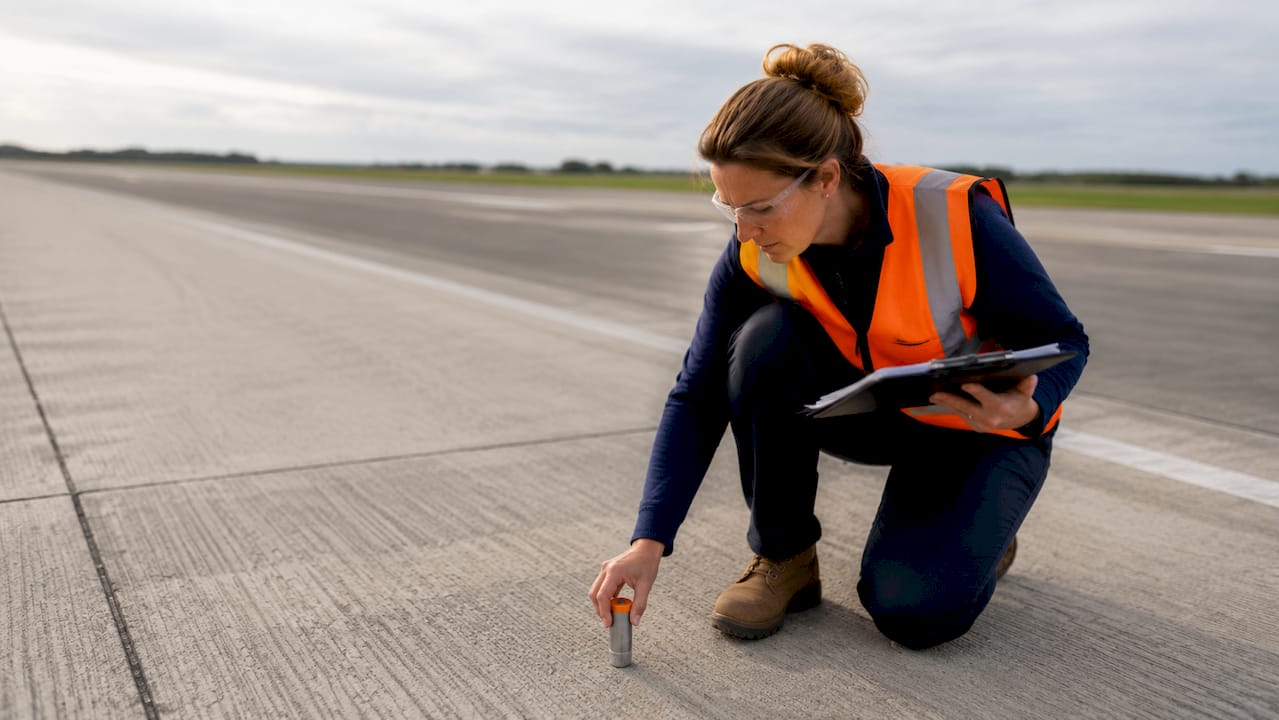
Concrete traffic durability and trafficability are related but not the same. Durability describes long-term resistance to wear, freeze-thaw cycles, and chemical attack. Trafficability describes the ability to carry load at a specific point in time. A mix can be highly durable yet fail trafficability requirements if it gains strength too slowly for the project schedule.
What factors influence trafficability and how are they measured?
Compressive strength development is the primary driver of early trafficability. High-early-strength formulations reach 30 MPa compressive strength within two hours, enabling rapid traffic opening on infrastructure projects like Sydney International Airport’s slab replacement program. That 30 MPa threshold is the practical benchmark for unrestricted vehicle access in most pavement applications.
Mix design variables directly control how fast that threshold is reached. The key factors are:
- Cement type and content: Higher cement content and Type III cement accelerate early strength gain.
- Water-to-cement ratio: Lower ratios produce denser paste and faster strength development.
- Aggregate size: Pervious concrete mixtures for trafficable areas use aggregate sizes between 4.75 and 12 mm to balance permeability with structural integrity.
- Supplementary cementitious materials (SCMs): Fly ash and slag at 20–30% replacement rates reduce raveling loss by 20–40% in pervious mixes.
- Curing conditions: Temperature and moisture directly control hydration rate. Cold weather slows strength gain and delays trafficability.
Site conditions introduce a second layer of trafficability assessment that many engineers underestimate. Soil trafficability depends on the ratio of soil Cone Index to Vehicle Cone Index. The soil’s penetration resistance must exceed the pressure exerted by the vehicle. When moisture rises after rain, that ratio can flip within hours, making a previously safe site impassable for heavy equipment.
| Measurement method | What it evaluates | When to use it |
|---|---|---|
| Compressive strength test (cylinder) | Early and 28-day concrete strength | Before opening to traffic |
| Cone penetrometer test | Soil Cone Index at the site | Before equipment mobilization |
| Slump test | Fresh concrete workability | At point of placement |
| Raveling loss test | Surface aggregate retention | For pervious pavement acceptance |
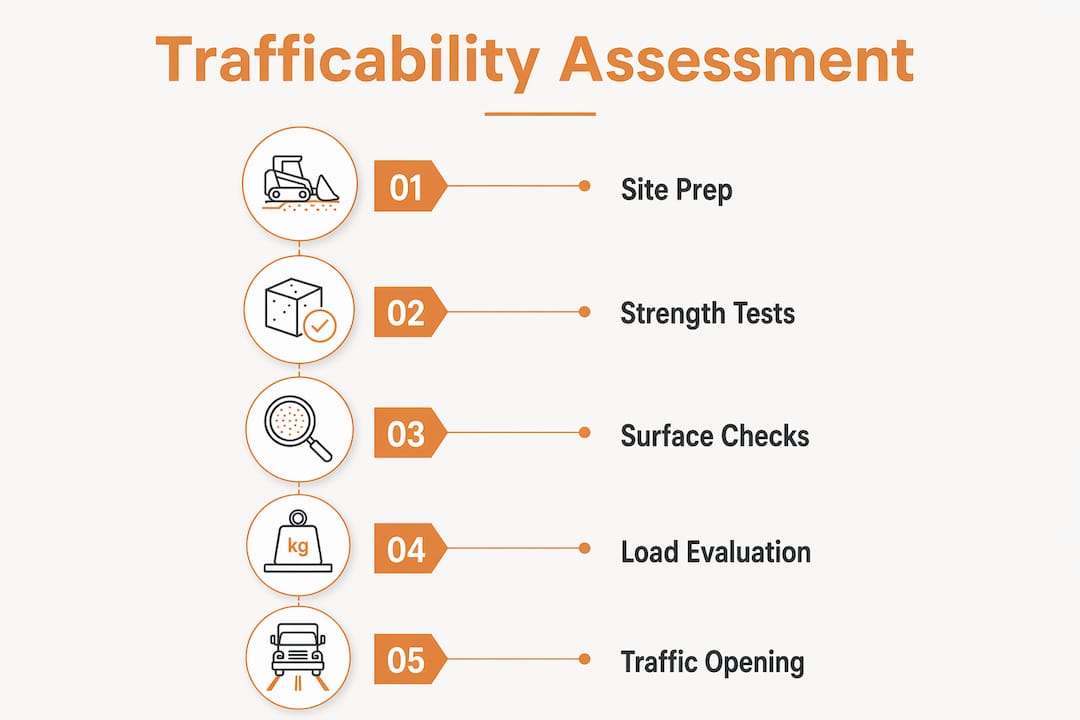
Pro Tip: Test compressive strength at 2 hours and 4 hours on fast-track mixes, not just at 24 hours. Early data lets you make real-time decisions about traffic opening without guessing.
How does concrete design affect long-term trafficability?
Slab thickness is the single most influential design variable for concrete load-bearing capacity under repeated traffic. Light vehicle traffic on residential driveways typically requires 100–125 mm of concrete. Heavy vehicle applications, including truck access and forklift lanes, require 150–200 mm or more depending on subbase quality. Undersized slabs deflect under load, and repeated deflection causes fatigue cracking long before the design life is reached.
Joint placement and spacing control where cracking occurs. Concrete shrinks as it cures, and that shrinkage creates tensile stress. Without joints, cracks form randomly and compromise trafficability. With correctly spaced joints, cracking is directed to predetermined locations that do not affect structural performance. The general rule is joint spacing in meters equal to 24–30 times the slab thickness in meters.
Turning movements deserve specific design attention. Concentrated shear stresses from turning cause more damage than straight-line traffic. Uniform slab reinforcement does not address this. High-stress zones at entry points, turning aprons, and loading docks require targeted reinforcement or increased thickness to resist the shear forces that straight-run pavement design ignores.
Key structural design practices for long-term trafficability include:
- Subbase preparation: A well-compacted, uniform subbase prevents differential settlement that cracks slabs from below.
- Load distribution rings: In manhole and utility applications, load distribution rings spread traffic forces across the chamber wall, enabling Class E traffic loading compliance.
- Reinforcement placement: Steel mesh or fiber reinforcement controls crack width and maintains aggregate interlock across joints.
- Edge thickening: Slab edges carry disproportionate load when vehicles track near the perimeter. Thickening edges by 25–50% reduces edge cracking.
| Design element | Light vehicle application | Heavy vehicle application |
|---|---|---|
| Slab thickness | 100–125 mm | 150–200 mm+ |
| Joint spacing | 3–4 m | 4–6 m |
| Reinforcement | Steel mesh (F72) | Steel mesh (F82) or fiber |
| Subbase depth | 100 mm compacted | 150–200 mm compacted |
Pro Tip: Always specify subbase compaction to 95% standard Proctor density. A strong slab on a weak subbase will fail in fatigue. The subbase is half the structural system.
What material innovations enable early and sustainable trafficability?
High-early-strength concrete is the most direct tool for accelerating trafficability on time-critical projects. These mixes use low water-to-cement ratios, Type III cement, and chemical accelerators to reach structural strength in hours rather than days. The Sydney International Airport slab replacement project demonstrated that 30 MPa within two hours is achievable at scale, allowing runway sections to return to service within a single overnight maintenance window.
SCMs improve both early trafficability and long-term concrete traffic durability when used correctly. Fly ash and slag slow early strength gain slightly but produce a denser, less permeable paste at 28 days. The trade-off is manageable on projects where traffic opening can be scheduled 24–48 hours after placement. On projects requiring 2-hour access, SCMs are typically limited to 15–20% replacement to preserve early strength.
- Select the right cement type. Type III cement gains strength faster than Type I/II. Use it when traffic opening within 4–6 hours is required.
- Use chemical accelerators selectively. Calcium chloride accelerates strength gain but increases corrosion risk in reinforced slabs. Non-chloride accelerators are the safer choice for reinforced applications.
- Apply curing compounds immediately. Evaporative moisture loss in the first 24 hours is the most common cause of surface weakness and delayed trafficability.
- Specify surface finish for load tolerance. Broom and brushed concrete finishes improve traction and reduce surface abrasion under repeated traffic compared to smooth trowel finishes.
- Use precast elements where immediate trafficability is critical. Trafficable precast concrete tanks are engineered for truck traffic immediately after backfill, eliminating the curing wait entirely.
Pro Tip: On fast-track projects, pour test cylinders and cure them alongside the slab, not in a lab. Lab-cured cylinders overestimate in-place strength when site temperatures are low.
How to assess and manage trafficability risks on site
Early traffic opening protocols must be tied to verified strength data, not elapsed time alone. Temperature, humidity, and mix variability all affect when the concrete actually reaches the required threshold. Opening to traffic at 24 hours because “that’s the standard” without testing is how surface damage happens on otherwise well-designed slabs.
Heavy vehicle traffic causes accelerated surface stress that leads to cracking and potholes faster than standard use. Active traffic management during the first 7 days after placement is the most cost-effective protection you can apply. Restricting heavy equipment to designated haul routes, using timber mats over fresh concrete, and prohibiting turning movements on new slabs all reduce early damage risk.
Soil and environmental monitoring must run in parallel with concrete monitoring. Moisture fluctuations can quickly degrade site trafficability, turning a stable subgrade into a soft failure zone within hours of heavy rain. A site that passed the Cone Index test on monday may not pass on friday after a wet week.
Practical risk management steps for construction teams:
- Establish minimum compressive strength thresholds before any vehicle access, verified by field-cured cylinders.
- Monitor soil moisture and Cone Index at subbase level throughout the construction period.
- Designate and mark traffic routes for heavy equipment to prevent uncontrolled loading on new concrete.
- Schedule proactive joint sealing within 30 days of placement to prevent water infiltration that weakens the subbase.
- Document all traffic events and any surface distress observations for warranty and maintenance planning.
Key Takeaways
Concrete trafficability is a two-phase performance property requiring verified compressive strength, correct slab design, and active site management to protect surfaces from placement through service life.
| Point | Details |
|---|---|
| Trafficability definition | Controlled traffic is permitted within 30 minutes of placement; unrestricted traffic requires verified strength. |
| Strength threshold | 30 MPa compressive strength within 2 hours is the benchmark for rapid traffic opening on infrastructure projects. |
| Design variables | Slab thickness, joint spacing, and targeted reinforcement at turning zones determine long-term load performance. |
| SCM benefits | Fly ash or slag at 20–30% replacement reduces raveling loss by 20–40% in trafficable pervious concrete. |
| Site risk management | Soil Cone Index must exceed Vehicle Cone Index; moisture changes can reverse a safe site rating within hours. |
Why trafficability deserves more respect than it gets
Most engineers I work with treat trafficability as a checkbox: hit 28-day strength, open to traffic, done. That framing misses the two biggest failure modes I see repeatedly on commercial and infrastructure projects.
The first is early damage from premature loading. A slab that reaches 28-day design strength is not the same as a slab that was protected during the first week. Surface abrasion and plastic deformation in the first 72 hours create micro-cracks that accelerate long-term deterioration. Integrated design of slab, joints, and SCMs is what prevents this, not just hitting a strength number.
The second failure mode is ignoring the subgrade. I have seen well-designed 150 mm slabs fail within two years because the subbase was never properly compacted or moisture-tested. The concrete was fine. The system failed. Trafficability is a system property, not a concrete property alone.
My recommendation for any project with heavy vehicle access: specify field-cured cylinder testing at 2 hours, 4 hours, and 24 hours on fast-track mixes. Require Cone Index testing on the subbase before and after any rain event. And treat the first 7 days of traffic management as part of the structural design, not an afterthought. The projects that hold up longest are the ones where the engineer stayed involved through the first week of operations.
— Vic
Professional concreting built for traffic demands
VW Concreting has delivered driveways and slabs across Melbourne designed to handle real traffic loads, from residential vehicles to commercial equipment. With over 145 projects completed since 2001, the team understands how mix selection, slab thickness, and joint placement work together to produce surfaces that perform from day one.
Whether you need a fast-track commercial slab, a reinforced driveway for heavy vehicle access, or a complete concreting solution tailored to your site conditions, VW Concreting brings the technical knowledge and hands-on experience to get it right. Contact the team to discuss your project requirements and get a design that meets your trafficability specifications.
FAQ
What is the standard definition of concrete trafficability?
Concrete trafficability is the capacity of concrete to permit controlled traffic without surface damage within 30 minutes of placement, and uncontrolled traffic without damage thereafter, per the 2025 Uniform Standard Specifications for Public Works Construction.
What compressive strength is needed before opening to traffic?
The standard benchmark for unrestricted vehicle access is 30 MPa compressive strength. High-early-strength mixes can reach this threshold within two hours on fast-track infrastructure projects.
How do you measure trafficability on a construction site?
Trafficability is measured by testing compressive strength of field-cured cylinders for the concrete, and by comparing soil Cone Index to Vehicle Cone Index for the subgrade. Both must meet minimum thresholds before traffic is permitted.
How does slab thickness affect concrete load-bearing capacity?
Slab thickness directly controls how much load the concrete can carry before deflecting and cracking. Light vehicle applications require 100–125 mm, while heavy vehicle applications typically require 150–200 mm or more depending on subbase conditions.
Can concrete be trafficable immediately after placement?
Precast concrete elements engineered with high-strength mixes and reinforcement can be rated for truck traffic immediately after backfill. Cast-in-place concrete requires a curing period and verified strength testing before any vehicle access is permitted.
Leave A Comment