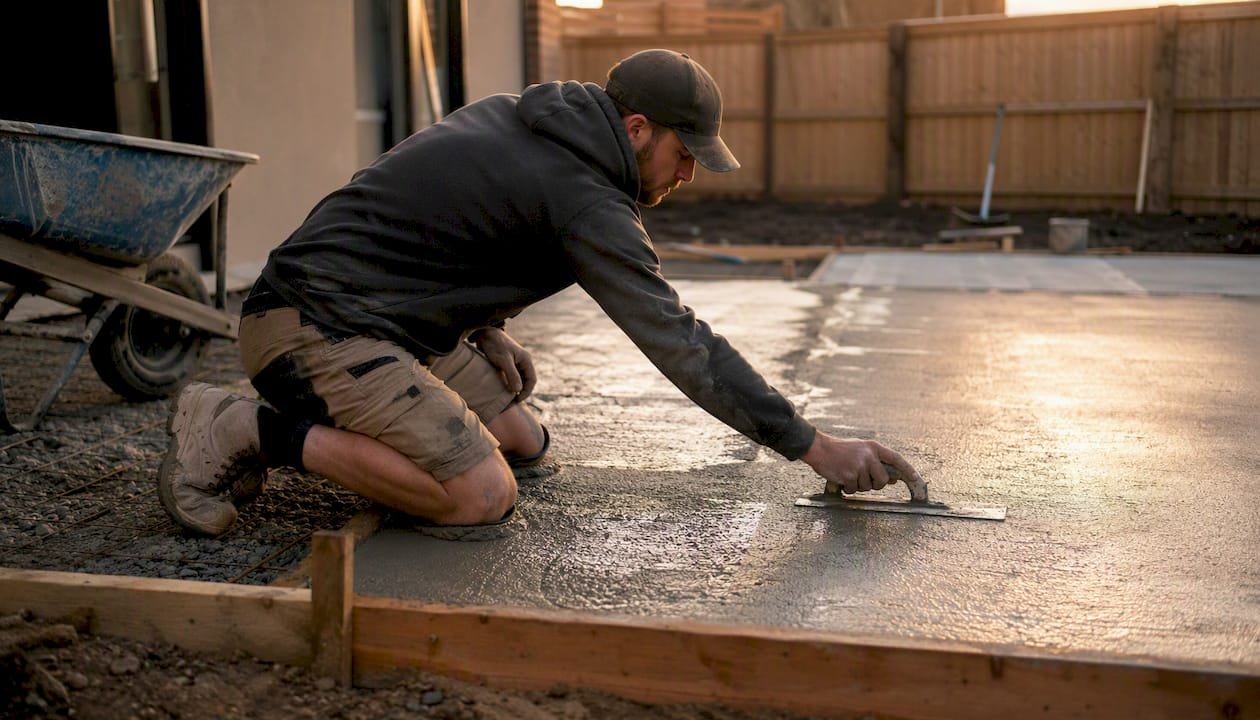
For most Melbourne driveways, slabs, and retaining walls, cast-in-place (poured) concrete is the strongest practical choice. It delivers a monolithic, load-bearing surface that can last 25–50 years when built correctly, adapts to any site shape, and costs less to maintain over its lifetime than asphalt or pavers. The term “precast concrete construction” is widely used in search, but what most Melbourne homeowners and builders actually need is on-site poured concrete, where ready-mix is delivered to your property, placed into formed shapes, and cured in place. That is the subject here, and it is what VW Concreting installs across Melbourne every day.
The core advantages of poured concrete for residential and commercial projects:
- Durability and lifespan: a lifespan of multiple decades with proper subbase and reinforcement
- Monolithic structural strength: no joints between units, continuous load distribution
- On-site finish flexibility: broom, exposed aggregate, colored, stamped
- Lifecycle cost value: lower maintenance costs offset higher upfront investment
- Custom dimensions: forms built to any curve, slope, or site constraint
Table of Contents
- What makes poured concrete perform so well on site?
- Breaking down the key benefits: strength, finishes, cost, and maintenance
- How a poured concrete driveway or slab gets installed
- What are the real trade-offs with poured concrete?
- Which projects are the best fit for poured concrete?
- How do you vet a concreting contractor before signing?
- How VW Concreting applies these standards in Melbourne projects
- Why subbase preparation determines whether your slab lasts
- How does poured concrete compare to precast concrete?
- What are the environmental benefits of on-site poured concrete?
- Where poured concrete delivers the most value
- Key Takeaways
- The case for poured concrete is stronger than most people realize
- VW Concreting: Melbourne’s poured concrete specialists
What makes poured concrete perform so well on site?
Ready-mix concrete arrives from a batch plant with a precisely controlled water-to-cement ratio and any admixtures the job requires. For Melbourne’s variable weather, that typically means air-entraining agents and water reducers mixed in before the truck leaves the plant. You cannot replicate that consistency with a site mixer on a residential driveway.
Once placed, poured concrete behaves as a single continuous element. Reinforcement (rebar or welded wire mesh) handles tensile stress that concrete alone cannot resist, while the monolithic pour distributes loads across the whole slab rather than concentrating them at joints. Strength develops through a chemical hydration process: concrete reaches most of its design strength in the first week and attains full design strength after about four weeks. That curing window is where most long-term failures either start or are prevented.
Key process factors that determine performance:
- Ready-mix batching with specified admixtures for local conditions
- Reinforcement type, spacing, and cover depth
- Subgrade compaction before any concrete is placed
- Curing method and duration (wet curing, curing compounds, or curing blankets)
Breaking down the key benefits: strength, finishes, cost, and maintenance
Durability. A correctly built concrete slab driveway following ACI residential guidance lasts 25–50 years. Most early failures trace to thin slabs, poor subgrade compaction, or incorrectly placed control joints — not the material itself. Specify a minimum 4-inch slab over a compacted base, and those failure modes largely disappear. Specify a minimum 4-inch slab over a compacted base, and those failure modes largely disappear.
Structural strength. Residential driveways typically call for 3,000–4,000 psi mix designs. For heavy vehicles, the mix strength and slab thickness should be increased accordingly. The concrete itself is rarely the weak link; the subbase and reinforcement are.
Finishes and design flexibility. Broom finish is the standard for driveways because it costs less and delivers reliable slip resistance. Exposed aggregate adds texture and visual appeal at a moderate cost premium. Colored and stamped finishes are achievable on-site and dramatically change the look of a property, though they add to both the upfront price and the sealing maintenance schedule.
Cost and lifecycle value. Concrete costs more to install than asphalt upfront, but it outlasts asphalt by decades and requires far less ongoing work. Seal every 3–5 years, repair cracks promptly when they are hairline-width, and avoid de-icing salts in the first two winters while the surface fully cures.
Lifecycle note: Concrete driveways commonly last 25–50 years. Asphalt typically requires resurfacing every 12–20 years, making concrete the lower total-cost option over a 40-year horizon for most residential properties.
How a poured concrete driveway or slab gets installed
The installation sequence matters as much as the mix design. Here is what a professional crew does, step by step:
- Crushed stone base placed and compacted in lifts for drainage and load distribution. Proper compaction is the single most important factor for long slab life.
Pro Tip: On pour day, watch the bleed water. Finishing the surface before bleed water evaporates traps water in the top layer, weakening the surface and causing dusting or scaling within a few years. Experienced crews wait for the sheen to disappear before any finishing tool touches the concrete.
What are the real trade-offs with poured concrete?
Poured concrete is not the right choice for every situation, and a good contractor will tell you that upfront.
- Cure time: the slab is out of service for 7–10 days for vehicles. Plan around it.
- Weather sensitivity: curing problems from heat, wind, or rain in the first week reduce surface strength. Pros schedule pours around forecasts and use curing blankets or temporary shade when conditions are marginal.
- Formwork and labor intensity: complex shapes require more setup time and skilled labor, which shows up in the quote.
- Limited DIY feasibility: ready-mix trucks deliver large volumes fast. Without a crew, you cannot place and finish a full driveway before the concrete stiffens.
Mitigation strategies contractors use:
- Plasticizers and water reducers to extend workability in hot weather
- Pump trucks for difficult access sites
- Pre-pour checklists to prevent cold joints (where fresh concrete meets partially set concrete)
- Curing blankets and misting systems in hot or windy conditions
Pro Tip: Ask your contractor for a concrete placement plan before the pour. It should specify the pour sequence, joint locations, finishing method, and curing approach. Any crew that cannot produce one is improvising.
Which projects are the best fit for poured concrete?
Poured concrete makes the most sense when:
- The site has custom dimensions, curves, or integrated steps that modular units cannot match
- Heavy vehicle loads require a monolithic slab with engineered reinforcement
- Variable grades or slopes need a formed solution built to the exact site geometry
- Aesthetic finishes (exposed aggregate, color, stamp) are part of the brief
- Budget decisions prioritize lifecycle value over the lowest upfront cost
Consider alternatives or specialist advice when dealing with extreme retained heights (generally above 1.5 meters for residential walls), very restricted site access that prevents ready-mix delivery, or highly variable soil conditions that require a geotechnical engineer’s input. For retaining walls specifically, site constraints and retained height drive the system selection more than any other factor. VW Concreting’s retaining wall site planning guide covers Melbourne-specific considerations in detail.
How do you vet a concreting contractor before signing?
A contractor who cannot answer these questions specifically is not ready for your project.
Questions to ask on every quote:
- What slab thickness and PSI are you specifying, and why?
- What is the base depth and compaction method?
- What reinforcement type, spacing, and cover depth are you using?
- What admixtures will be in the mix, and why those for current conditions?
- What is your curing method and how long will you maintain it?
- What is your weather contingency plan?
What a strong contractor provides:
- Written concrete placement plan covering pour sequence, joint locations, and curing
- Documented portfolio of driveways, slabs, and retaining walls with project photos
- Public liability insurance and workers’ compensation certificates on request
- Warranty or workmanship guarantee in writing
- References from recent local projects
Red flags: vague specs (“standard concrete”), quotes that omit base or reinforcement line items, cash-only payment terms, and no portfolio. Payment schedule norms for Melbourne residential work typically run 10–20% deposit, progress payments tied to milestones, and final payment on completion. For guidance on choosing the right concreting services in Melbourne, VW Concreting’s contractor guide covers what to verify before you sign.
How VW Concreting applies these standards in Melbourne projects
VW Concreting has been operating in Melbourne since 2001 and has completed over 145 projects across driveways, slabs, retaining walls, and outdoor construction. Every poured concrete project starts with a site assessment and a written placement plan that specifies slab thickness, PSI rating, reinforcement layout, and curing method before a single truck is booked.
A typical residential driveway project runs: site excavation and subgrade compaction, 100mm compacted crushed rock base, 100mm slab at 32 MPa (approximately 4,640 psi) with SL72 mesh, broom or exposed aggregate finish, control joints cut within the same day, and a 7-day wet cure. Retaining wall projects follow a similar documented approach, with poured wall services across suburbs including Truganina, Werribee, Sunbury, and Mount Cottrell.
“Every project we deliver comes with a concrete placement plan, documented specs, and a workmanship guarantee. Our portfolio of over 145 completed Melbourne projects is available to view before you commit to anything.” — VW Concreting
Why subbase preparation determines whether your slab lasts
The subbase is where most concrete failures actually begin. A slab sitting on poorly compacted or unstable fill will crack, settle, and heave regardless of the mix design above it. Excavate to the full required depth, remove any organic material or soft spots, and compact the subgrade to design density before placing base stone.
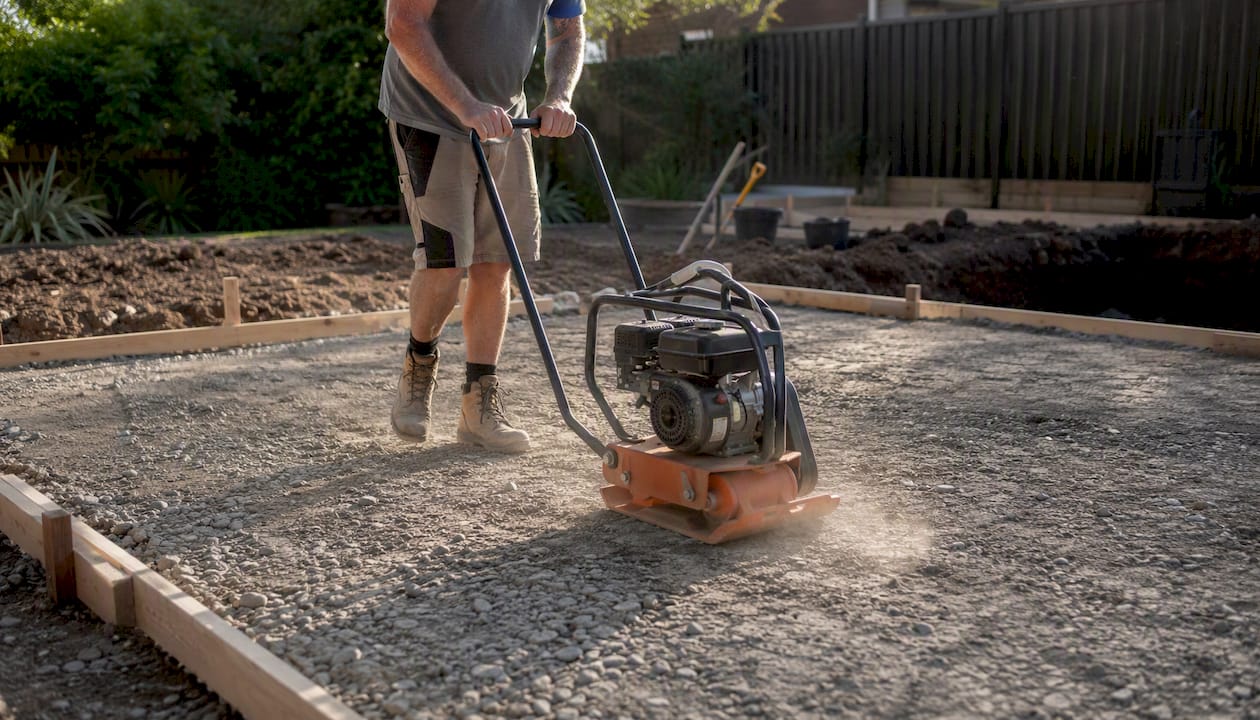
Crushed rock base (typically 100mm for residential driveways) is then placed and compacted in lifts. This layer does two things: it distributes loads from the slab into the subgrade, and it provides drainage that prevents water from softening the soil beneath the concrete. Skipping or shortcutting this step is the single fastest way to shorten a slab’s life. VW Concreting’s site preparation best practices guide details the Melbourne-specific approach to subgrade assessment and base construction.
How does poured concrete compare to precast concrete?
The term “precast” technically refers to factory-manufactured concrete elements (panels, beams, pavers) produced off-site and assembled on location. For residential driveways, slabs, and most retaining walls in Melbourne, poured (cast-in-place) concrete is the standard approach. Here is how the two compare for the work most homeowners and builders actually need:
| Factor | Poured (cast-in-place) | Precast / modular units |
|---|---|---|
| Design flexibility | High: any shape, curve, or slope | Limited to available mold sizes |
| Structural continuity | Monolithic, no inter-unit joints | Joints between units |
| Site customization | Full: integrated steps, drains, slopes | Restricted by unit dimensions |
| Weather dependency | Higher: curing window critical | Lower: arrives cured |
| Typical applications | Driveways, slabs, retaining walls | Pavers, garden edging, some walls |
| Finish options | Broom, exposed aggregate, color, stamp | Fixed at manufacture |
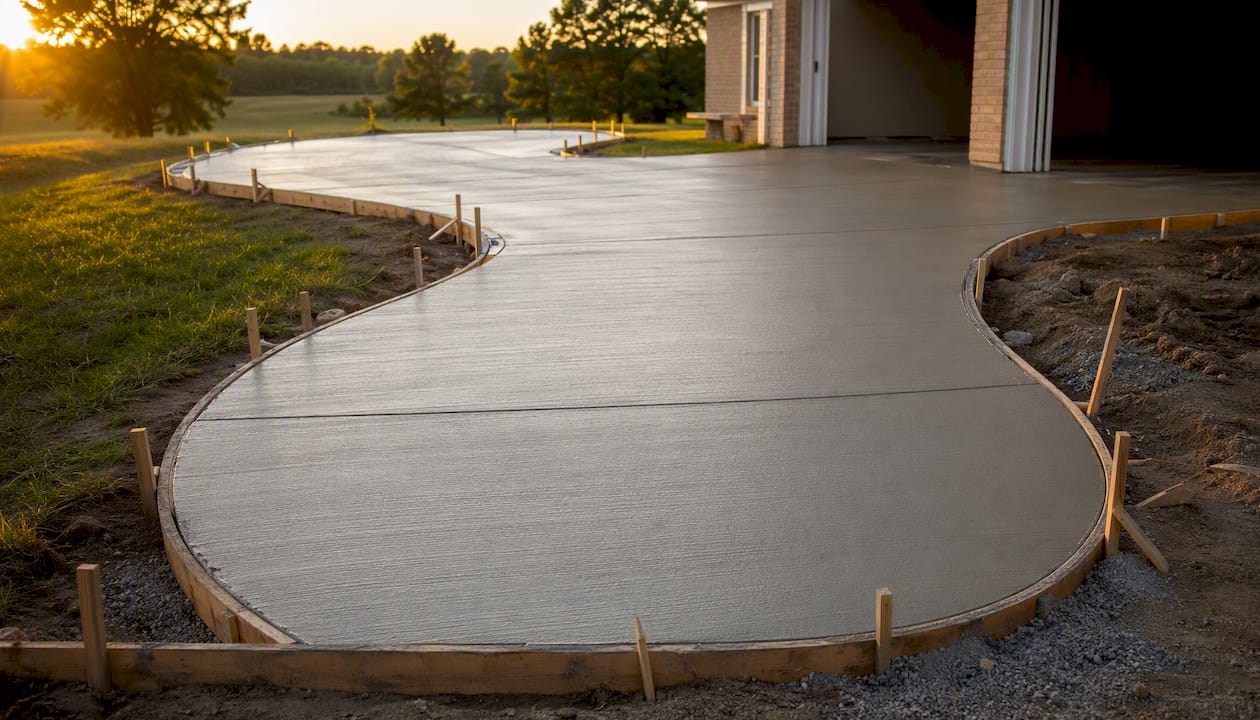
Cast-in-place construction offers greater design flexibility for complex sites, while precast units suit repetitive modular applications. For most Melbourne residential projects, poured concrete wins on customization, structural continuity, and finish range. The precast vs. poured comparison is worth reviewing if you are deciding between the two for a specific application.
What are the environmental benefits of on-site poured concrete?
Poured concrete has a meaningful sustainability case when the project is managed well. Ready-mix batching reduces material waste compared with site mixing, where over-ordering and spillage are common. Modern admixtures allow lower water-cement ratios, which means less cement per cubic meter for the same strength, and cement production is the largest energy input in concrete manufacturing.
Concrete’s thermal mass also contributes to energy efficiency in structures: slabs and walls absorb heat during the day and release it slowly, reducing temperature swings in adjacent spaces. At end of life, concrete is fully recyclable as crushed aggregate for road base or new concrete production. Specifying locally sourced ready-mix reduces transport emissions compared with shipping precast elements from distant factories.
Where poured concrete delivers the most value
The applications where cast-in-place concrete consistently outperforms alternatives:
- Residential driveways: — monolithic strength, finish flexibility, 25–50 year lifespan
- Concrete retaining walls: — custom heights and curves, rigidity for soil retention
For decorative outdoor areas where modular flexibility matters more than monolithic strength, pavers or exposed aggregate finishes on a poured base often combine the best of both approaches.
Key Takeaways
Poured concrete is the most practical and durable choice for Melbourne driveways, slabs, and retaining walls when installed with correct subbase preparation, reinforcement, and curing.
| Point | Details |
|---|---|
| Lifespan and durability | Correctly built poured concrete driveways last 25–50 years; subbase and reinforcement determine longevity. |
| Specify the right mix | Demand 3,000–4,000 psi minimum for residential driveways; 4,000+ psi for heavy vehicle loads. |
| Subbase is non-negotiable | Compacted subgrade and crushed rock base prevent settling, cracking, and premature failure. |
| Vet your contractor | Require a written placement plan, documented PSI and reinforcement specs, and a workmanship guarantee. |
| VW Concreting | Over 145 Melbourne projects since 2001, with placement plans and workmanship guarantees on every job. |
The case for poured concrete is stronger than most people realize
The conventional wisdom is that poured concrete is just “the standard option.” That undersells it. For a Melbourne driveway or slab, poured concrete is the only approach that gives you a truly monolithic surface, full finish flexibility, and a lifespan that can outlast the mortgage. The trade-offs (cure time, weather sensitivity, formwork) are real, but every one of them is manageable with a competent crew and a proper placement plan.
What most homeowners get wrong is treating the concrete itself as the main variable. The mix design matters, but the subbase, the reinforcement, and the curing practice are where the outcome is actually decided. A 4,000 psi mix poured onto a poorly compacted subgrade will fail faster than a 3,500 psi mix over a correctly built base. Spend your vetting time on those details, not on the brand of cement.
If a contractor cannot hand you a written placement plan before the pour, that is your answer about their process.
VW Concreting: Melbourne’s poured concrete specialists
VW Concreting has delivered driveways, slabs, and outdoor concrete projects across Melbourne since 2001. More than 145 completed projects, a documented placement plan on every job, and a workmanship guarantee mean you know exactly what you are getting before the truck arrives.
Whether you need a plain concrete driveway, an exposed aggregate finish, a garage slab, or a poured retaining wall, VW Concreting provides written specifications, a photo portfolio of completed work, and a clear quote that covers subbase, reinforcement, and curing. No vague line items, no surprises on pour day. Contact VW Concreting for a quote on your next concrete project.
Leave A Comment