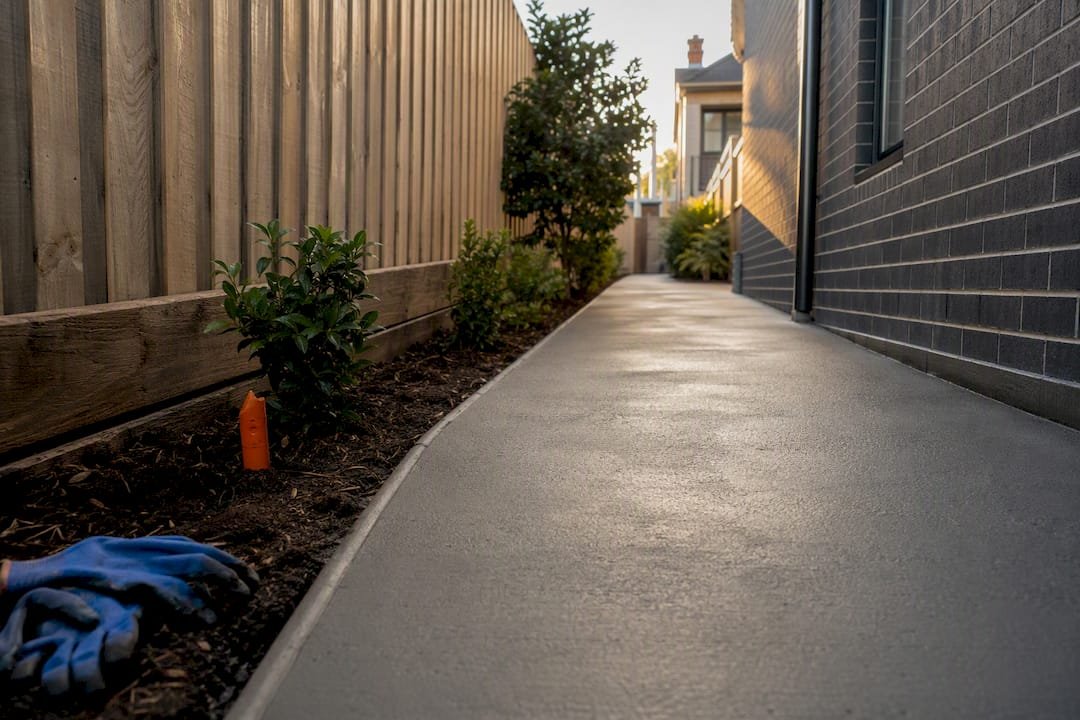
Most Melbourne homeowners pay between $79 and $170 per square metre for a new concrete path, depending on finish, with plain broom-finish concrete at the low end, and exposed aggregate or stamped patterns pushing the top. That range only holds if access is easy and the job clears a minimum size. Small jobs, tricky access, reactive clay soils, and council footpath rules can all push the final number well past the headline figure, so treat the ranges below as a starting point, not a quote.
TL;DR:
- The final concrete path cost is heavily influenced by finish type, with plain/broom finishes generally costing $79 to $160 per square metre, and decorative options reaching $170.
- Access challenges, soil type, and minimum job charges can significantly increase overall costs beyond the standard per-square-metre rates.
- Hidden expenses such as removal of old paths, utility locating, drainage, and council fees often cause the final bill to surpass initial estimates if not clarified upfront.
- Proper site assessment, including soil testing and access evaluation, before quoting can prevent scope gaps and mid-job cost increases.
- Book a detailed site visit and obtain an itemized, scope-verified quote to ensure accurate pricing and avoid surprises during construction.
Table of Contents
- Concrete Path Cost Melbourne: Price Per Square Metre By Finish
- What Drives The Price Up Or Down?
- How Much Does A Concrete Path Actually Cost? Three Real Examples
- Site Prep, Council Rules, and the Hidden Costs That Surprise People
- How Do You Get an Accurate Concrete Path Quote?
- Why Thorough Site Assessment Beats a Cheap Quote
- Ready for a Concrete Path Quote That Won’t Change Later?
- Sources
Concrete Path Cost Melbourne: Price Per Square Metre By Finish
The finish you choose does more to move the price than almost anything else in the job. Melbourne pricing guides consistently show plain and broom-finish concrete running $79 to $160 per square metre, with coloured and oxide finishes sitting a step above that, and exposed aggregate or stamped decorative patterns landing in the $110 to $170 per square metre bracket once standard inclusions are factored in.
Here’s roughly how that breaks down by finish type:
- Plain/broom finish: $79 to $160/m². The workhorse option for side paths, service walkways, and anywhere durability matters more than looks.
- Coloured or oxide finish: Typically $10 to $50/m² above plain concrete, depending on pigment intensity and coverage.
- Exposed aggregate: $110 to $170/m². Costs more because of the extra labour in washing, sealing, and exposing the stone.
- Stamped or patterned concrete: Similar range to exposed aggregate, though intricate patterns or multiple colour bands push toward the top.
Those figures usually include the concrete mix itself, basic base preparation, and edge forming. What they usually don’t include: removing an old path, hauling away spoil, fixing drainage problems under the slab, or dealing with tree roots. Ask your concreter to spell out inclusions and exclusions line by line, because “per square metre” means different things to different contractors.
One regional wrinkle worth knowing: inner-city suburbs often run 15 to 25% higher than growth-corridor areas for identical specifications, mostly down to parking restrictions, narrower access, and more time spent protecting nearby landscaping. Quoted prices should already include GST, but it’s worth confirming that explicitly, especially with smaller operators who sometimes quote trade prices without it.
What Drives The Price Up Or Down?
Size and thickness set the baseline, but they’re rarely what separates a cheap quote from an expensive one. A standard path usually has a typical thickness; paths carrying vehicle weight require increased thickness. The real swing factors are usually elsewhere.
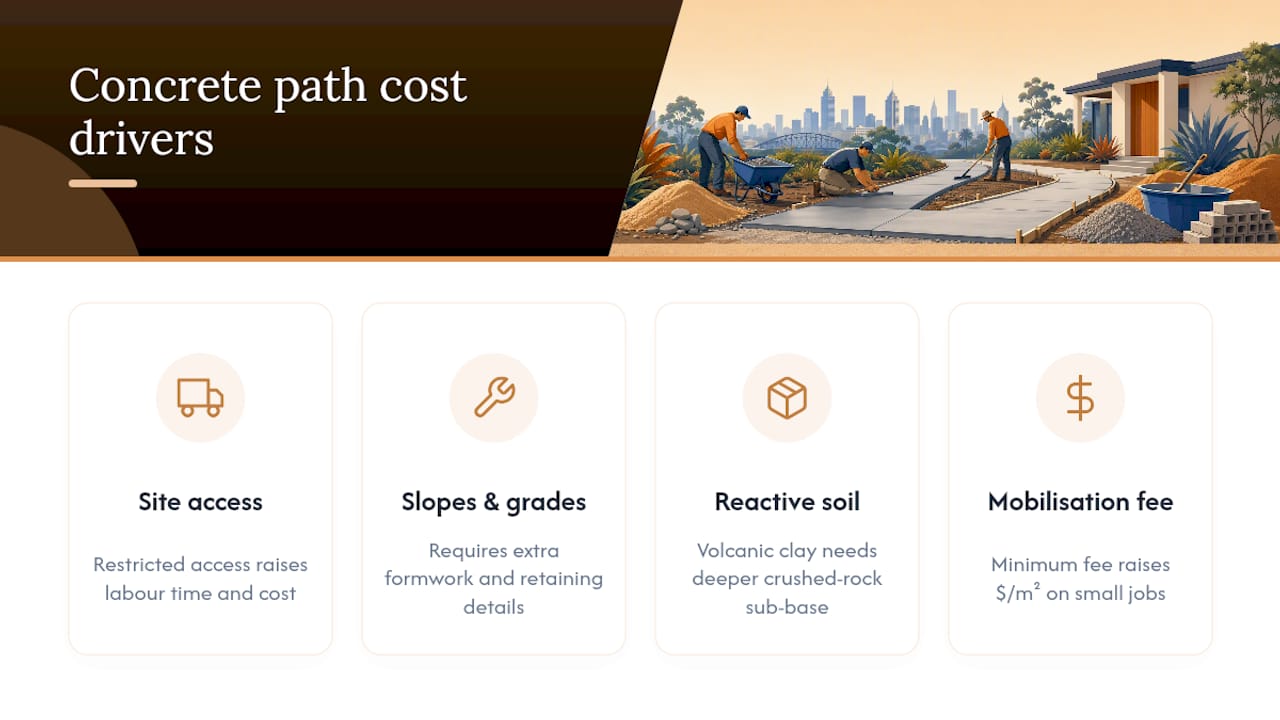
Access tops the list. If a concrete truck can back straight up to the site, you’re paying standard rates. If the crew has to wheelbarrow mix through a side gate or around the back of the house, labour time and cost both climb, sometimes substantially, because every load takes longer and needs more hands.
Slopes and grades add complexity too. A path that steps down a hillside needs formwork adjustments and sometimes retaining details that a flat run never sees. Soil type matters just as much: parts of Melbourne’s west and north sit on reactive Newer Volcanic clay that demands a deeper crushed-rock sub-base to stop the slab cracking or heaving later. That extra excavation and material adds real dollars before a single truck of concrete arrives.
Then there’s the job most homeowners underestimate: minimum charges. Concreters carry fixed costs for mobilising a truck, crew, and equipment regardless of job size, so a 10 square metre path can cost nearly as much per metre as a 40 square metre one because that fixed cost gets spread over less area.
Pro Tip: Always ask for the minimum job fee upfront, separate from the per-square-metre rate. A quote that only gives you a $/m² figure without disclosing a mobilisation minimum is the fastest way to get blindsided on a small job.
How Much Does A Concrete Path Actually Cost? Three Real Examples
Numbers mean more with a real path attached to them. Here’s how the math plays out for three common Melbourne scenarios.
- Small side path (1m × 8m, 8m²): At a typical plain finish price per square metre, the raw material and labour math suggests a certain cost. But most contractors apply a minimum job charge for anything under roughly 30 to 50m², so the realistic total often lands significantly higher. This is exactly where a per-square-metre rate misleads people.
- Standard front path (1.2m × 12m, about 14.4m²): Plain finish at a typical price per square metre averages to a cost estimate. Switch to a coloured finish at a higher price per square metre and the same path costs more. Still likely to sit near or above the minimum job threshold, so expect the quote to reflect actual scope rather than a flat multiplication.
- Long garden path with removal (1.5m × 25m, 37.5m²) in exposed aggregate: At a typical price per square metre, that’s a concrete work estimate alone. Add demolition and disposal of an old path, commonly at an additional moderate cost depending on volume and access, and the realistic total is substantially higher.
Take your own path’s length and width, multiply for square metres, apply the relevant per-m² figure, then check whether the result clears typical minimum job territory. If it doesn’t, call a concreter and ask directly rather than trusting the arithmetic.
Site Prep, Council Rules, and the Hidden Costs That Surprise People
The quote you get before excavation starts is only ever an estimate of what a contractor expects to find. What actually shows up in the ground is where budgets get tested.
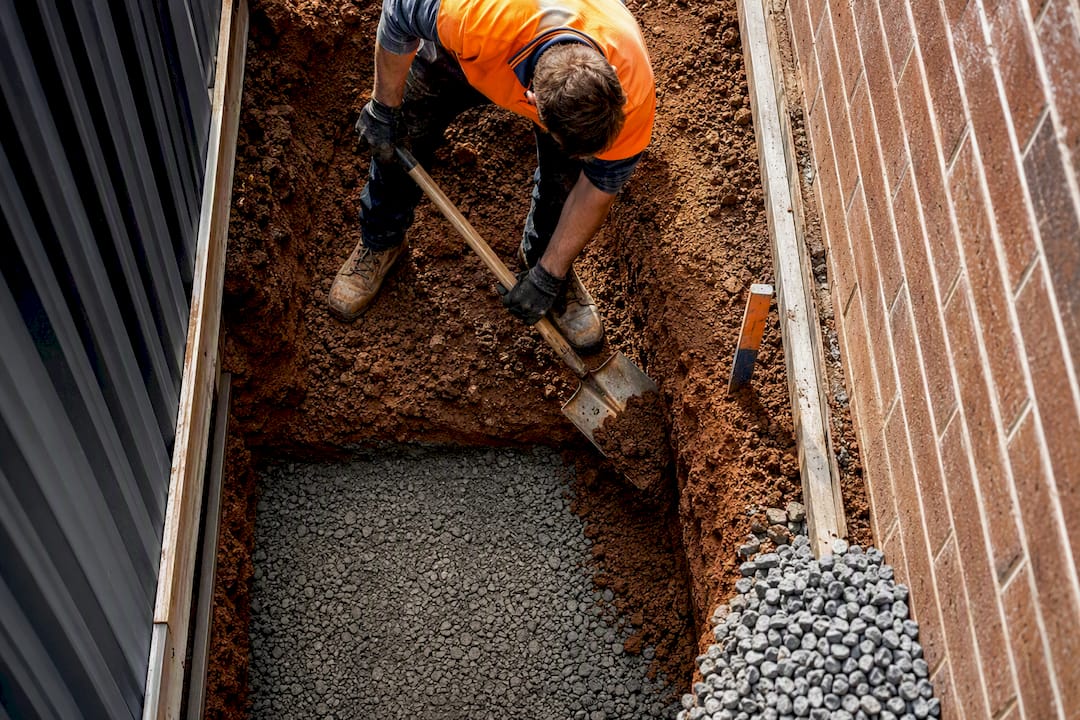
Reactive clay soils, common across Melbourne’s western and northern suburbs, often require a deeper crushed-rock sub-base than a standard job to stop the slab moving with seasonal soil swelling. That’s extra excavation and extra material, and it’s rarely visible until someone starts digging.
Council involvement is the other wildcard. Any path connecting to a public footpath, nature strip, or crossover typically falls under local council specifications for thickness, finish, and approval, and that can mean permit fees and mandatory inspections before and after the pour. Every council in Melbourne has its own version of these rules, so what applies in one municipality won’t necessarily match the next suburb over.
Other line items that catch homeowners off guard:
- Removing and disposing of an existing path or slab, often billed separately from the new install.
- Locating buried utilities before excavation, particularly on older properties with undocumented plumbing or electrical runs.
- Drainage corrections if water currently pools where the new path will sit.
- Permit and inspection fees tied to any council-controlled frontage work.
None of these are exotic. They’re common enough that a good contractor should be asking about them before quoting, not discovering them mid-job.
How Do You Get an Accurate Concrete Path Quote?
A fair comparison between two Melbourne concrete path quotes only works if both contractors priced the same scope. Use this checklist before you sign anything:
- Confirm slab thickness and sub-base depth in writing, not just a verbal assurance.
- Ask whether reinforcement (mesh or fibre) is included and what triggers the choice.
- Get the finish specified precisely, including sealing if it’s a decorative surface.
- Check whether sawcuts for control joints are included and where they’ll be placed.
- Ask directly about site access and whether that affects the price quoted.
- Confirm removal and disposal of existing concrete is either included or itemised separately.
- Verify licensing and insurance, and ask for a copy if you haven’t worked with the contractor before.
- Get the payment schedule and warranty terms in writing before the deposit is paid.
A detailed written scope is the single fastest way to spot a lowball quote hiding a scope gap.
Pro Tip: If one quote comes in noticeably lower than others for the same path, check the sub-base depth and reinforcement spec first. That’s almost always where the missing cost is buried.
Most straightforward paths run two to five business days from the start of excavation to a fully cured, walkable surface, though full structural cure takes closer to 28 days. From accepted quote to job completion, expect one to three weeks depending on how booked the contractor’s schedule is and whether council permits are involved.
Why Thorough Site Assessment Beats a Cheap Quote
Founded in 2001 and having completed over 145 projects across Melbourne, VW Concreting has seen most of the ways a concrete path quote goes wrong after the fact. It’s almost never the concrete itself. It’s the access nobody measured properly, the clay sub-base nobody tested, or the council spec nobody checked before pricing the job.
A thorough pre-quote site visit that includes a basic soil probe and an honest access assessment catches these issues before they become a mid-job variation. That’s the difference between a quote you can trust and one that grows once the excavator arrives. For readers who want the technical detail behind proper preparation, our guide on site preparation best practices covers what a compliant sub-base actually requires.
— Vic
Ready for a Concrete Path Quote That Won’t Change Later?
VW Concreting prices Melbourne concrete paths the way this article recommends you shop for one: with a real site visit before a number ever gets written down. Every quote includes a scope walkthrough, an access and soil check, a realistic timeline, and itemised costs, so there’s no vague per-square-metre figure hiding a mobilisation fee or a sub-base surprise.
What sets a VW Concreting quote apart from a phone-in estimate is straightforward: site testing before pricing, help navigating council paperwork when a path connects to a public footpath or crossover, and a workmanship guarantee backing the finished job. If you’re weighing a plain path against something like an exposed aggregate finish, our team can walk you through both during the same site visit.
Ready to get a number you can actually rely on? Visit our driveways and slabs page to request a site visit and get a written, itemized quote for your concrete path.
Sources
The cost ranges in this article draw from multiple Melbourne and Australian pricing guides, cross-checked against contractor-facing technical sources. Key references include Melbourne concreting cost benchmarks, a general concrete pathway pricing guide, installed walkway cost data, technical notes on reactive clay pavement design, and council footpath and crossover requirements from Yarra City Council as one example of local rules.
Council specifications vary by municipality, so always check your own local council’s footpath and frontage requirements before finalizing a project budget.
- Concreting Cost Melbourne 2026: $79–$160/sqm
- Pavement design for reactive clay soils — SiteGeo
- Road and footpath opening — Yarra City Council (example of council requirements)
Leave A Comment