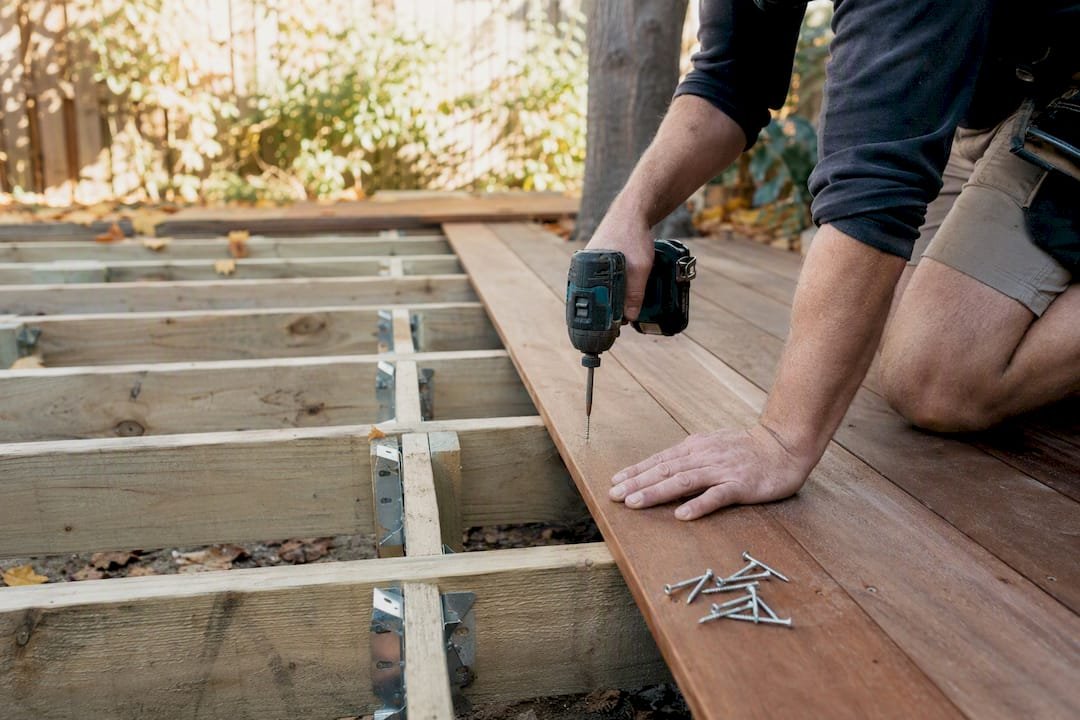
Most Melbourne homeowners land somewhere between $250 and $600 per square metre installed, which puts a typical 30 square metre deck at roughly $8,000 to $18,000. The board you pick matters less than you’d think. Height, slope, and site access swing the final number far more than whether you choose treated pine or hardwood. This guide breaks down material pricing, the drivers that actually move quotes, and how to compare builder proposals without getting burned.
TL;DR:
- The biggest cost drivers after material choice are deck height, site conditions, and the complexity of features like stairs and balustrades.
- Structural requirements for higher decks, such as safety barriers and deeper footings, can increase the cost by 30 to 60 percent.
- Common deck sizes in Melbourne typically cost between $8,000 and $18,000, with those over one meter high usually more expensive due to permit and barrier requirements.
- Maintenance costs significantly influence long-term ownership, with timber decks requiring ongoing oiling and sanding, while composite decks need minimal upkeep.
- Homeowners should request itemized, fixed-price quotes that specify all site-specific factors to avoid unexpected costs during the project.
Table of Contents
- Timber Decking Cost Melbourne: Material-By-Material Pricing
- What Actually Drives Your Deck Quote Higher
- How Much Do Common Deck Sizes Actually Cost in Melbourne?
- Timber vs. Composite: The 10-Year Ownership Cost
- Getting Accurate Quotes Without Getting Burned
- Do You Need a Permit for a Raised Deck in Melbourne?
- Why Timber Decking Prices Have Shifted in Melbourne
- The Publisher’s Take: Why Fixed-Price Quoting Matters
- Get a Fixed-Price Decking Quote From VW Concreting
- Sources
Timber Decking Cost Melbourne: Material-By-Material Pricing
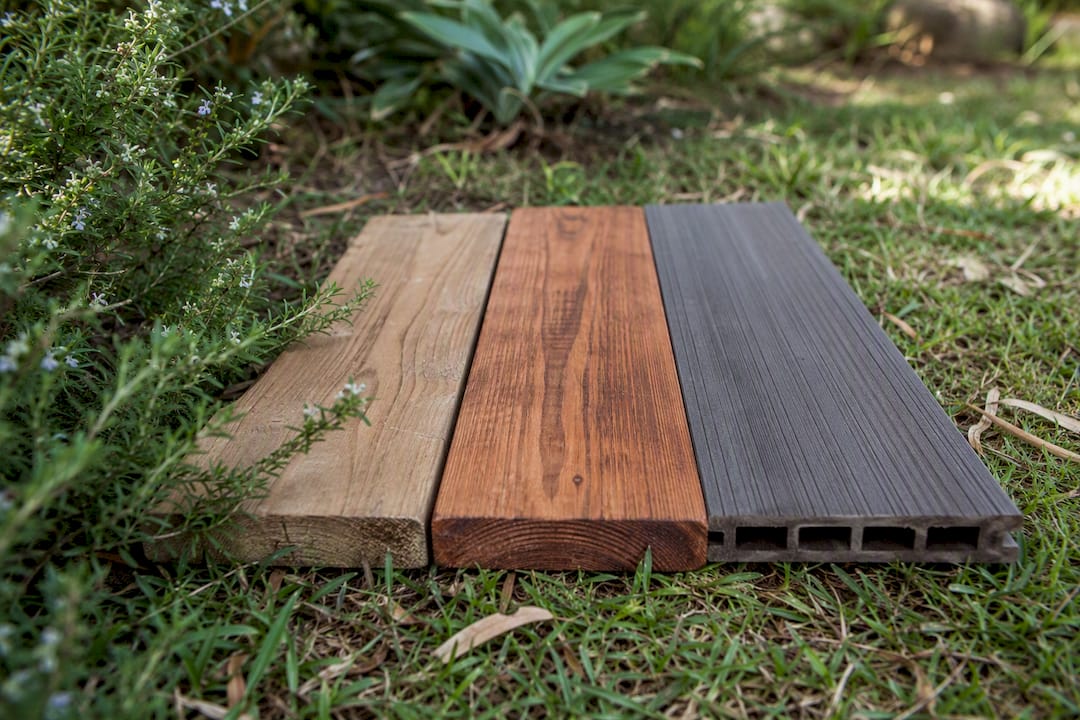
Board choice sets your baseline, but it’s rarely the biggest line item on the invoice. Melbourne pricing splits into three tiers, and the gap between them is wider than most first-time deck owners expect.
Treated pine sits at the affordable end, typically running $190 to $370 per square metre installed, according to Melbourne decking cost data. Common hardwoods like Merbau and Spotted Gum push that up to roughly $315 to $580 per square metre, and composite decking lands in a similar band at $295 to $580 per square metre. Converted for a US-style frame of reference, those figures translate to roughly $18 to $54 per square foot, which tracks reasonably close to the $30 to $60 per square foot averages reported for US deck installations.
- Treated pine: cheapest upfront, needs annual oiling to stop grey-out and splinter, lifespan shortens fast if maintenance lapses.
- Merbau and Spotted Gum: premium look and better durability, but hardwood needs oiling every 12 to 18 months and occasional sanding every few years.
- Composite: highest upfront cost in most cases, wipes clean, never needs oiling, though some boards get noticeably hot underfoot in direct summer sun.
Pro Tip: Don’t judge a quote purely on the $/m² rate for boards. A cheap treated pine deck with poor footings can cost more over ten years than a well-built hardwood one, once you factor in re-oiling, sanding, and eventual board replacement.
Termite resistance is the other quiet factor. Merbau and composite both resist termites well, while treated pine relies entirely on its chemical treatment holding up over decades. If your block backs onto bushland or you’ve had termite issues nearby, that’s worth weighing against the sticker price alone. For a deeper look at how these materials perform in local conditions, see this guide to decking materials used in outer Melbourne builds.
What Actually Drives Your Deck Quote Higher
Board price is the easy number. The real budget swings come from structural decisions that have nothing to do with timber species.
Height is the single biggest lever. Once a deck sits above roughly one metre off the ground, you typically trigger safety barrier requirements, deeper footings, longer support posts, and often a set of stairs. That combination commonly adds 30 to 60 percent to the per-square-metre cost compared to a low-set deck, according to Melbourne deck builder pricing data.
Site conditions run a close second. Sloped blocks, restricted rear-yard access for machinery, and reactive clay soils all push footing and labor costs up, sometimes substantially, because the crew needs extra time, extra concrete, or hand-dug piers instead of machine-bored ones.
- Balustrades and railings: typically priced per linear metre, and required on most decks over 1m high.
- Stairs: priced per step, with cost climbing further if a landing or turn is needed.
- Site prep and demolition: removing an old deck or leveling an overgrown yard adds a separate line item most quotes list before the build even starts.
- Footings: deeper or more numerous footings on sloped or clay-heavy sites raise both material and labor time.
Pro Tip: Ask every builder to itemize height-related extras, footings, stairs, and balustrades as separate lines rather than folding them into one lump sum. That’s the only way to compare two quotes for what’s actually the same job. Site prep quality also shapes long-term durability, which this guide to concreting site preparation covers in more detail.
How Much Do Common Deck Sizes Actually Cost in Melbourne?
Numbers help more than percentages when you’re staring at a blank budget spreadsheet. Here’s how three common deck sizes typically shake out, based on current Melbourne pricing.
These bands reflect standard supply-and-install pricing for Melbourne decking projects, and a medium 30 square metre build commonly falls in the $8,000 to $18,000 range once you account for typical site conditions, per local decking cost benchmarks.
Notice how the same 30 square metre footprint can cost twice as much depending on whether it’s low-set or raised. That gap is almost entirely footings, barriers, and stairs, not the timber itself. A handful of factors push any of these totals toward the top of the range: heritage overlay requirements, extensive subsurface drainage on wet clay blocks, or built-in seating and planter boxes integrated into the deck frame. Suburbs with steeper terrain or tighter rear access, common across parts of inner and hilly Melbourne, also tend to sit toward the higher end of each band.
Timber vs. Composite: The 10-Year Ownership Cost
Upfront price only tells half the story. Maintenance is where timber and composite decking really diverge, and it’s the number most homeowners forget to budget for.
- Treated pine: annual oiling plus periodic sanding, often totaling a few hundred dollars a year in materials and time.
- Hardwood (Merbau/Spotted Gum): oiling every 12 to 18 months, sanding every 3 to 5 years to restore the surface.
- Composite: occasional wash-down, no oiling or sanding required at all.
Composite typically costs more to install because it demands more precise fixing and hidden-fastener systems, but the lower ongoing upkeep narrows that gap over time. If you tally ten years of oiling and sanding on a hardwood deck against composite’s near-zero maintenance bill, composite often becomes cost-competitive by year six or seven, sometimes earlier if you value your own weekend time.
Getting Accurate Quotes Without Getting Burned
A quote is only useful if it’s comparing apples to apples. Most homeowners get two or three numbers back that look wildly different, not because one builder is ripping them off, but because they scoped the job differently.
- Request identical scope. Specify the same footprint, height, board grade, and balustrade style across every quote request.
- Ask for itemized line items. Footings, stairs (priced per step), balustrades (priced per linear metre), and removal of any existing structure should each appear separately, mirroring the itemized cost breakdowns used in detailed project estimating.
- Push for a fixed-price contract. This protects you from cost blowouts once the crew digs into the site and finds something unexpected, like rock or old concrete footings.
- Check licensing and insurance. Any builder unwilling to produce current public liability cover or a builder’s license is a red flag, full stop.
- Get at least three quotes. Fewer than that and you have no real basis for comparison; more than four usually just wastes everyone’s time.
Pro Tip: When comparing height measurements between quotes, confirm builders are measuring from the same reference point, ground level versus finished deck height can differ by 10 to 15 centimeters and quietly shift which barrier requirements apply. For footing specifics that affect both cost and longevity, this timber deck footings guide is worth a read before you sign anything.
Do You Need a Permit for a Raised Deck in Melbourne?
Most raised decks in Melbourne require a building permit, and the trigger point is typically height above ground level combined with proximity to boundaries. Once a deck exceeds roughly one metre, a compliant safety barrier becomes mandatory under Australian building standards, and that barrier isn’t optional trim, it’s a structural and legal requirement inspected before sign-off.
Permit costs vary by council and project complexity, but budget for a separate line item beyond the build itself. Factor in the time this adds to your project too. Permit approval can take anywhere from a couple of weeks to over a month depending on your council’s current workload and whether your design needs an engineer’s structural certification, which raised decks over a certain height usually do.
Balustrade costs themselves are typically priced per linear metre and vary based on material, timber, glass, or steel infill each carry different price points. Glass balustrades sit at the premium end but preserve sightlines, while timber balustrades blend with the deck itself and cost less. Either way, if your deck design is anywhere near the one metre threshold, ask your builder upfront whether a permit is needed and get that cost quoted separately rather than discovering it mid-project.
Why Timber Decking Prices Have Shifted in Melbourne
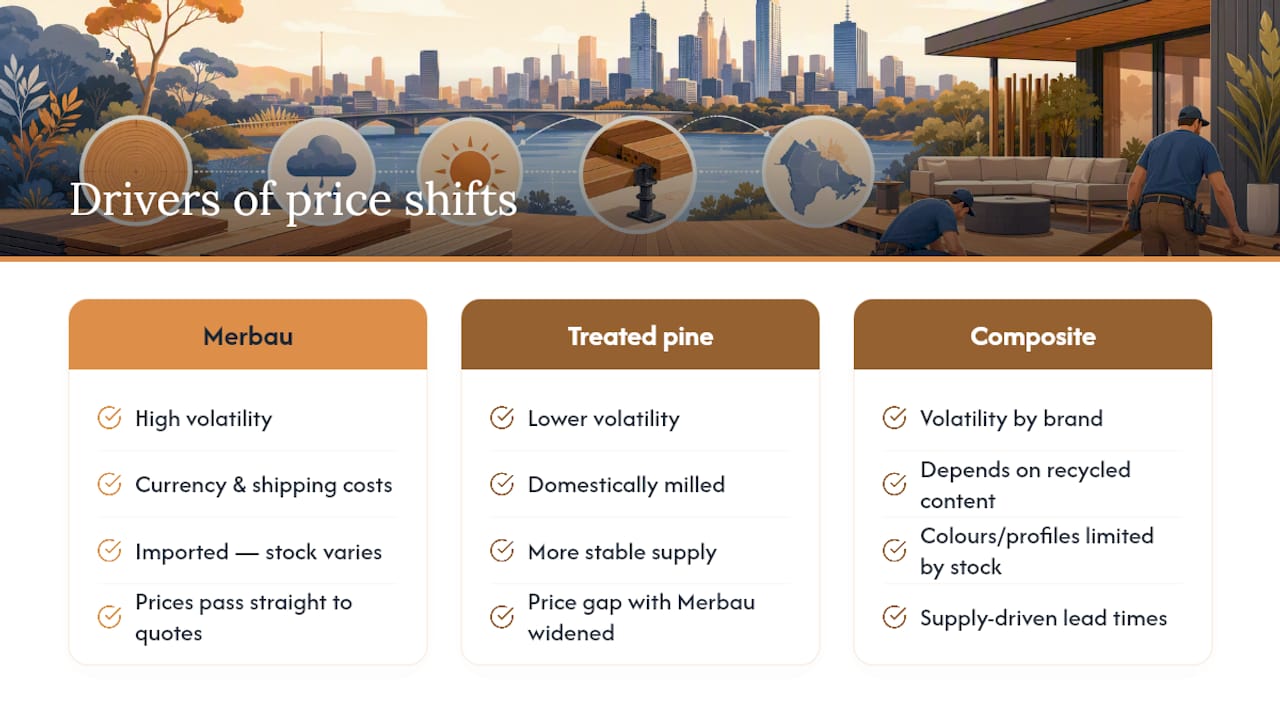
Timber pricing hasn’t stayed flat, and if you got a quote a couple of years ago, don’t assume it still holds. Hardwood species like Merbau are imported, which means currency shifts and shipping costs directly affect what your builder pays at the timber yard, and that gets passed straight through to your quote.
Seasonal demand plays a role too. Spring and early summer are peak deck-building months in Melbourne, everyone wants outdoor space ready before the warmer months, and builders with full calendars often price slightly higher or push start dates further out. Booking a build in late autumn or winter can sometimes work in your favor on both price and availability, even though it feels like an odd time to think about decking.
Treated pine tends to be less volatile than imported hardwood since it’s domestically milled, which is part of why the price gap between pine and Merbau has widened rather than narrowed in recent years. Composite pricing depends heavily on the brand and its recycled-content ratio, and supply availability for specific colors or profiles can shift depending on manufacturer stock levels. If your project has a hard deadline, lock in your material order early rather than assuming your preferred board will be sitting in stock when the crew is ready to start.
The Publisher’s Take: Why Fixed-Price Quoting Matters
Since 2001, VW Concreting has completed more than 145 projects across Melbourne, and the pattern we see most often is homeowners fixating on board price while the real budget risk sits in footings, drainage, and site prep. We handle decking alongside the groundwork itself, footings, drainage, site leveling, which removes the coordination gap that opens up when a homeowner hires a decking specialist and a separate excavator and hopes the two schedules line up.
— Vic
Get a Fixed-Price Decking Quote From VW Concreting
VW Concreting prices decking projects across Melbourne with fixed-price quoting, so the number you sign off on is the number you pay, no surprise footing costs halfway through the build. Because we handle site prep, footings, and drainage in-house rather than subcontracting them out, you get one accountable team instead of two separate trades pointing fingers if something doesn’t line up.
If you’re planning a low-set or raised timber deck and want a quote that accounts for your actual site, slope, access, and soil included, reach out through our decking services page for a fixed-price assessment. We’ll walk the site, scope the footings properly the first time, and give you a number you can actually plan a budget around.
Sources
- Deck Builders VIC | The Quote Yard
- Decking Cost Melbourne 2026: $190–$370/sqm
- Cost to install wood decking — Homewyse
- Decks
Leave A Comment