

Edge forms in concreting are structural molds that define slab geometry, resist lateral concrete pressure, and protect slab edges from damage during curing. The role of edge forms in concreting goes far beyond simple boundary marking. These components directly determine whether a finished slab meets dimensional tolerances, resists moisture ingress, and survives decades of load cycling without edge failure. For construction professionals and site managers working to Australian standards in 2026, understanding edge formwork is not optional. It is the foundation of every durable concrete slab.
What are the structural and functional roles of edge forms in concreting?
Edge formwork serves three primary roles: defining geometric dimensions and verticality, containing lateral fresh concrete pressure to prevent blowouts, and protecting slab edges from early cracking, spalling, and moisture ingress. Each function is load-bearing in its own right. Fail at any one of them and the slab edge becomes a liability.

Defining geometry and verticality
A slab edge that is out of plumb or dimensionally inconsistent creates compounding problems. Subsequent trades, including tilers, framers, and waterproofers, all reference the slab perimeter. An edge that wanders by even 10 mm forces costly remedial work downstream. Laser levels and builder’s levels are the standard verification tools during form setup, and they must be used before the first cubic meter of concrete is placed.
Containing lateral hydrostatic pressure
Fresh concrete behaves like a dense fluid. Lateral hydrostatic pressure can reach 23–24 kN/m² per meter of slab edge depth depending on mix design and pour rate. That figure is not theoretical. It is the force your edge forms must resist without deflecting. A form that bows under this pressure produces a curved slab edge that requires grinding, patching, or full replacement.
Protecting against defects and moisture
Edge detailing is a complete process involving physical formwork, reinforcement cover, and moisture and termite barriers to safeguard the slab perimeter over its service life. Inadequate edge detailing is recognized as the leading cause of defects in Australian construction slabs. Honeycombing, spalling, and moisture ingress all originate at the slab perimeter when formwork fails to contain concrete properly during placement and early curing.
- Edge forms prevent concrete bleed and slurry loss at slab boundaries
- They maintain cover to reinforcement at the slab perimeter
- They support moisture and termite barrier termination details
- They define thickened edge beams where ground-bearing slabs require them
How is edge formwork correctly installed and braced on a construction site?
Correct installation sequencing is the single biggest variable site managers control. Edge formwork installation must happen immediately after subbase preparation and before reinforcement placement. Installing forms after steel is placed makes accurate pinning and bracing nearly impossible without disturbing bar positions.
Standard installation sequence
- Complete subbase compaction and blinding layer. Forms set on uncompacted fill will shift under concrete load.
- Set out slab perimeter using survey pegs or laser. Confirm dimensions against the structural drawing before driving a single pin.
- Pin forms to subbase at 600 mm centers. Steel pins driven at opposing angles resist both vertical and lateral movement.
- Install diagonal bracing at 600–900 mm spacing. Diagonal bracing at these centers prevents board bowing under wet concrete loads. Forms pinned without diagonal bracing bow consistently, requiring remedial grinding after the pour.
- Verify verticality with a laser or builder’s level. Check every 3 meters along the form run, not just at corners.
- Confirm reinforcement cover before pour commences. The edge form sets the reference for bar spacers at the slab perimeter.
Adjusting bracing for concrete mix and pour rate
Rapid pours with high slump concrete demand enhanced bracing. Diagonal stakes at 600–900 mm spacing are the minimum standard when pour rates exceed one meter of depth per hour. Slower pours with stiffer mixes allow slightly wider bracing centers, but the 900 mm maximum should never be exceeded regardless of mix design. Commercial steel self-supporting systems rated to 450 mm depth reduce bracing requirements on deeper edge beams, which is a meaningful advantage on commercial slabs.
Pro Tip: Apply release agent to form faces before placing reinforcement, not immediately before the pour. This gives the agent time to cure into a thin film and prevents excess oil from contaminating the concrete surface or bonding zones.
Stripping timing and form removal
Stripping too early is the most common site error at slab corners. Edge forms should be stripped only after concrete reaches at least 50% of its 28-day compressive strength. Site cube tests or maturity monitoring provide the data to make that call with confidence. Guessing based on elapsed time alone produces spalled corners and structural weakness that no amount of patching fully corrects.
What types of edge forms are used in construction?
Material choice directly affects form deflection, surface finish quality, and how many times a form can be reused. Timber, plywood including HDO overlays, steel, and plastic are the four standard categories, each with distinct performance characteristics.
| Material | Typical application | Reuse potential | Surface finish |
|---|---|---|---|
| Sawn timber | Residential slabs, simple geometry | Low (3–5 uses) | Rough, requires treatment |
| Plywood (standard) | Residential and light commercial | Medium (10–15 uses) | Smooth with release agent |
| HDO plywood | Architectural finishes, exposed edges | High (20+ uses) | Excellent, near-form quality |
| Steel | Commercial, repetitive geometry | Very high (100+ uses) | Consistent, dimensional accuracy |
| Plastic/composite | Curved edges, decorative profiles | Medium (varies) | Good, profile-dependent |
Steel forms provide superior dimensional accuracy and are the standard choice on commercial projects where edge geometry repeats across multiple pours. HDO plywood, which is high-density overlay plywood with a resin-impregnated face, delivers near-steel surface quality at lower upfront cost. It is the preferred choice for exposed architectural slab edges where finish matters as much as geometry.
Plastic and composite forms handle curved geometry that timber and steel cannot match without custom fabrication. They are common on driveways, paths, and decorative slabs where radius edges are specified. The trade-off is lower stiffness, which means bracing requirements increase for plastic forms used on deeper pours.
Formwork design requires balancing stiffness and cost. Pour rate and slump must factor into bracing sizing. The misconception that forms are merely temporary constructs leads directly to deflection failures and expensive remedial work.
What are common challenges with edge forms and how can site managers mitigate them?
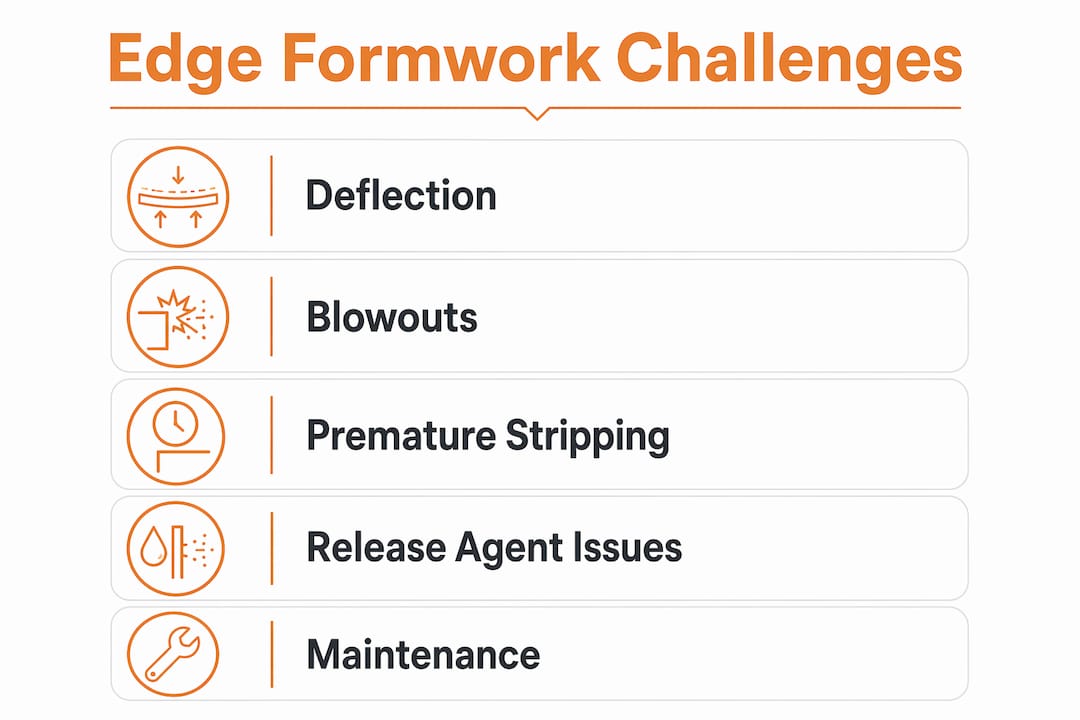
Edge form failures cluster around four causes: deflection under hydrostatic pressure, blowouts at pin locations, premature stripping damage, and release agent contamination. Each is preventable with correct practice.
Deflection and blowouts
Form deflection under lateral fresh concrete pressure is the leading cause of slab edge failures on site. A form that bows even 5 mm produces a visible bulge that reads as a defect on every subsequent inspection. Blowouts at pin locations occur when pins are spaced too widely or driven into soft subbase material. The fix is simple: tighter pin spacing and diagonal bracing installed before concrete placement, not after a problem appears.
- Check pin penetration depth before the pour. Pins driven less than 150 mm into compacted subbase pull out under load.
- Never rely on adjacent formwork panels to brace each other. Each panel needs independent bracing.
- Inspect forms immediately after the first cubic meter is placed. Early deflection is correctable. Late deflection is not.
Release agent use and contamination
Excessive release agent compromises subsequent concrete surface treatments and coatings. A thin, even film is the target. Heavy application runs down the form face, pools at the base, and contaminates the concrete surface layer. This creates adhesion failures when sealers, coatings, or toppings are applied later. Use a pump sprayer set to a fine mist, not a brush or roller loaded with oil.
Pro Tip: After stripping, clean form faces with a stiff brush and water before recoating with release agent. Concrete residue left on form faces transfers to the next pour as surface blemishes and accelerates form degradation.
Reuse and maintenance
Careful cleaning, recoating, and dry storage prolong formwork life significantly. Reusing formwork through gentle stripping and maintenance reduces material waste and controls project budgets, which matters in a 2026 materials cost environment where timber and steel prices remain elevated. A plywood form stripped carefully and stored flat lasts two to three times longer than one ripped off with a wrecking bar and stacked wet.
Key takeaways
Edge formwork is the single most controllable factor in slab edge quality, and correct bracing, sequencing, and stripping timing determine whether a slab edge lasts decades or fails within years.
| Point | Details |
|---|---|
| Three core functions | Edge forms define geometry, resist hydrostatic pressure, and protect slab edges from cracking and moisture. |
| Bracing is non-negotiable | Diagonal bracing at 600–900 mm centers prevents deflection under wet concrete loads. |
| Sequence before steel | Install edge forms after subbase prep and before reinforcement to maintain accuracy and cover. |
| Strip at 50% strength | Removing forms before concrete reaches half its design strength causes spalling and corner damage. |
| Material choice matters | Steel and HDO plywood deliver the best dimensional accuracy and reuse value for commercial work. |
Why edge form rigidity changed how I think about formwork
Site managers often treat formwork as a consumable. You buy it, use it once, and throw it away. That mindset is expensive and it produces mediocre slab edges. After working on concrete projects across Melbourne, the pattern is consistent: the slabs that generate callbacks and defect claims almost always have edge form failures at their root. Not mix design issues. Not curing failures. Edge form failures.
The most instructive lesson I have seen repeated is this: a crew that installs bracing correctly and verifies verticality before the pour never needs to grind a slab edge. A crew that skips the diagonal bracing because the pour looks manageable spends two days grinding and patching after the fact. The labor cost of remediation always exceeds the cost of correct installation by a factor of three or more.
Formwork design requires balancing stiffness and cost, and that balance shifts with every pour. A slow residential pour with a stiff mix is forgiving. A fast commercial pour with a 120 mm slump mix is not. The site manager who understands that distinction and adjusts bracing accordingly is the one whose slabs pass inspection on the first walkthrough.
Treat edge formwork as a structural element, not a temporary boundary marker. The concrete remembers every decision you made before the pour. The slab edge is where those decisions become visible.
— Vic
Professional edge formwork on your next Melbourne project
Com has completed over 145 concreting and outdoor construction projects across Melbourne since 2001. Every slab starts with correctly installed, braced, and verified edge formwork because that is where slab quality is won or lost.

Whether you are planning a new driveway, a ground-bearing slab, or a large commercial pour, the team at Com applies the same attention to edge detailing on every job. Explore our driveways and slabs work to see how proper formwork practice translates into finished results. For a full picture of what professional concreting services in Melbourne look like from set-out to strip, get in touch with the Com team today.
FAQ
What is the primary role of edge forms in concreting?
Edge forms define slab edge geometry, contain lateral hydrostatic pressure from fresh concrete, and protect slab edges from cracking, spalling, and moisture ingress. All three functions are active simultaneously during every pour.
How far apart should edge form bracing be spaced?
Diagonal bracing should be spaced at 600–900 mm centers. Rapid pours with high slump concrete require bracing at the tighter 600 mm spacing to prevent form deflection and blowouts.
When should edge forms be removed after a concrete pour?
Edge forms should be stripped only after concrete reaches at least 50% of its 28-day compressive strength, confirmed by site cube tests or maturity monitoring. Stripping earlier causes spalling and structural weakness at corners.
What edge form material gives the best finish quality?
HDO plywood and steel edge forms produce the best surface finish. Steel delivers consistent dimensional accuracy on commercial projects, while HDO plywood suits architectural exposed edges at lower upfront cost.
Why does excessive release agent cause problems?
Excessive release agent pools at the form base and contaminates the concrete surface layer. This creates adhesion failures when sealers or coatings are applied later, and it leaves staining that affects the final slab appearance.
Leave A Comment