
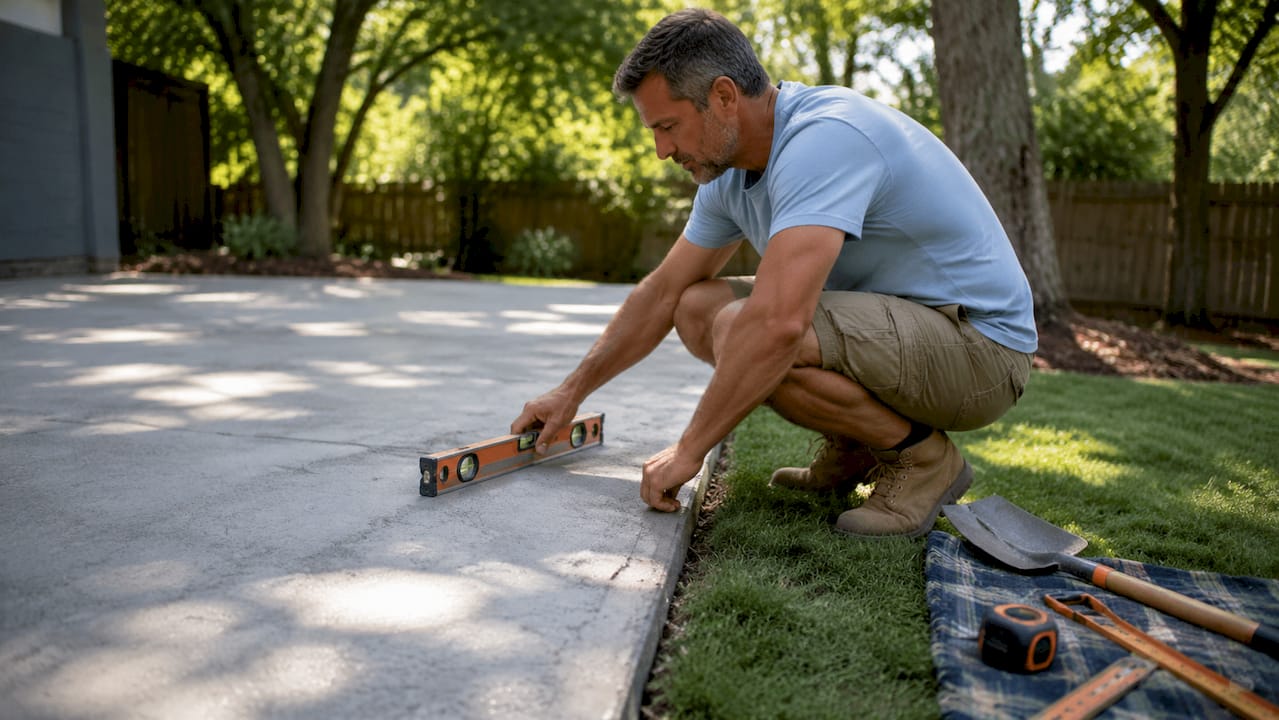
Proper drainage is the single most important factor in outdoor concrete longevity. Water that pools on or beneath a concrete surface causes cracking, erosion, and structural failure far faster than any flaw in the concrete mix itself. Patios, driveways, and slabs all face the same threat: water with nowhere to go. Drainage is the first consideration for any concrete installation, more critical than mix design or finish quality. Understanding why outdoor concrete needs drainage is the first step toward protecting your property from expensive, preventable damage.
Why does outdoor concrete need drainage?
Outdoor concrete needs drainage because water is its primary enemy. Concrete is porous and allows water to penetrate through to the subgrade beneath. When that subgrade becomes saturated, it shifts, compresses unevenly, and erodes. The concrete slab above then loses its support and begins to crack, settle, or heave.
The industry term for managing this threat is surface water management, which covers everything from slope grading to installed drain systems. Most homeowners think of concrete as a solid, waterproof barrier. It is not. Water infiltrates through surface pores, control joints, and any existing cracks, reaching the soil below within hours of heavy rain.
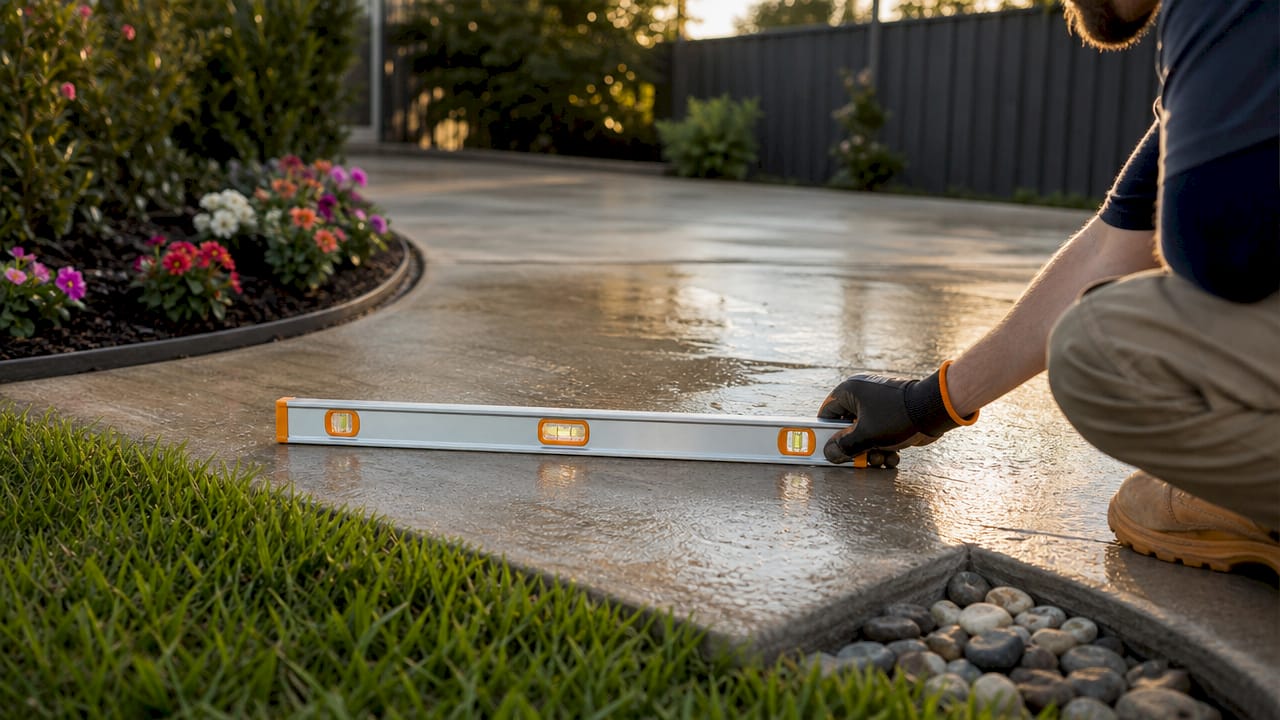
The consequences compound quickly. A slab that settles even slightly creates low spots where water pools. Those pools accelerate further infiltration. Left unaddressed, the cycle produces visible cracking, uneven surfaces, and eventually full slab replacement. Getting drainage right from the start is the only way to break that cycle.
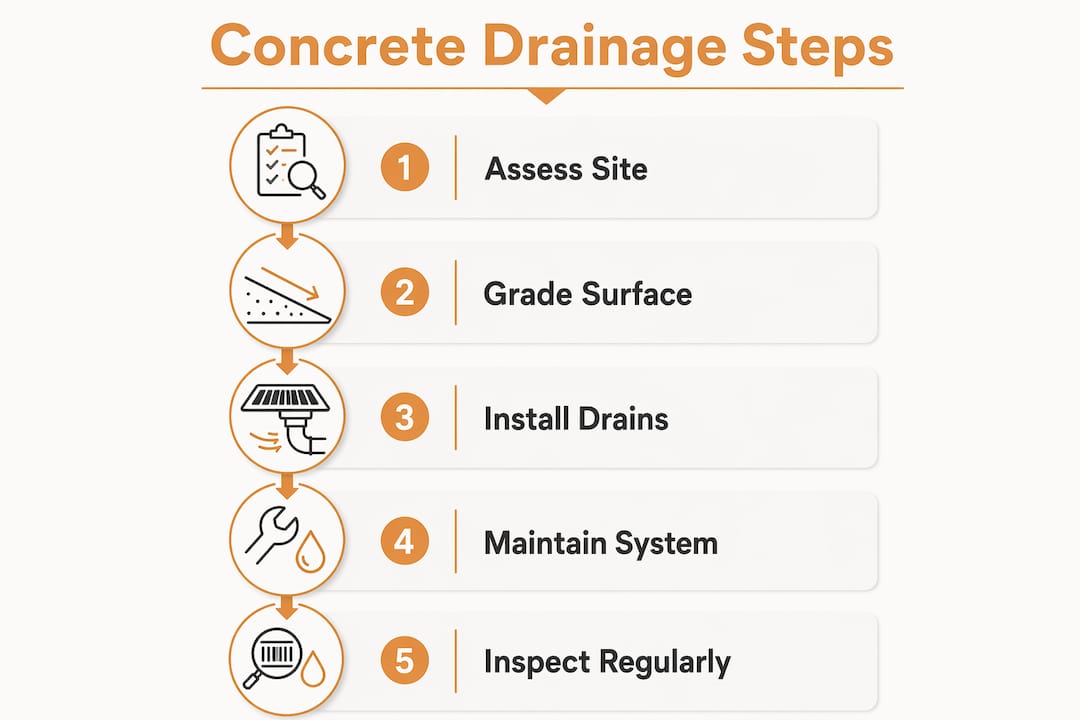
How does water damage outdoor concrete structures?
Water damages concrete through four distinct mechanisms, each one capable of causing serious structural harm on its own.
- Freeze-thaw cracking: Water that enters concrete pores expands by roughly 9% when it freezes. That expansion forces the pore walls apart. Repeated freeze-thaw cycles widen those gaps into visible cracks, especially in Melbourne’s cooler months.
- Subgrade erosion: Poor subgrade compaction combined with water infiltration washes fine soil particles away from beneath the slab. Voids form. The slab then bridges those voids until it cracks under load.
- Hydrostatic pressure: Soil saturation creates hydrostatic pressure that pushes against foundation walls and adjacent slabs. That lateral force causes longitudinal cracking and slab shifting that looks like a material defect but is actually a drainage failure.
- Surface pooling: Standing water softens the soil directly beneath the slab edge, causing differential settlement. One side of a patio or driveway sinks while the other stays level, creating a trip hazard and a drainage trap.
The financial cost of ignoring these mechanisms is significant. Addressing patio drainage problems typically costs between $730 and $2,485, with severe cases exceeding $4,000. That figure covers repair work alone, not the disruption of tearing out and replacing a failed slab. Proactive drainage planning costs a fraction of that amount.
Pro Tip: If you notice longitudinal cracks running parallel to a slab edge, check the drainage around that edge first. Those cracks almost always reflect soil movement from water saturation, not a problem with the concrete itself.
What are common drainage issues with outdoor concrete?
Most concrete drainage failures trace back to a small set of recurring problems. Recognizing them early saves significant repair costs.
- Insufficient slope. A concrete slab needs a minimum fall of 1/8 inch per foot away from structures to shed water effectively. Slabs poured flat, or sloped toward a building, trap water against the foundation.
- Blocked drains. Linear trench drains and area drains collect debris with every rainfall. Drainage systems require ongoing maintenance because debris and dirt blockages frequently impair their function within seasons. A blocked drain is worse than no drain because it creates a false sense of security.
- Roof runoff overload. Concentrated roof water can overwhelm slab drainage when downspouts discharge directly onto a concrete surface. A correctly sloped patio still fails if a downspout dumps 50 gallons per minute onto one corner.
- Soil saturation from adjacent areas. Garden beds, lawns, and retaining walls adjacent to concrete slabs can channel water toward the slab rather than away from it. This is a common oversight in residential landscaping design.
- Undersized or absent drainage systems. Many older residential concrete installations were poured without any formal drainage infrastructure. The slab relied entirely on slope, which degrades as soil settles over time.
Pro Tip: Walk your property during heavy rain and watch where water flows. That 10-minute observation tells you more about your drainage problems than any dry-weather inspection.
Learning how to prevent driveway cracks starts with identifying these drainage failure points before they cause visible damage.
Which drainage solutions best protect outdoor concrete?
The right drainage solution depends on the size of the surface, the volume of water it receives, and the existing site conditions. The table below compares the most common options.
| Solution | Best for | Key advantage | Maintenance need |
|---|---|---|---|
| Surface grading | All slabs | Low cost, no moving parts | Re-grading every 5–10 years |
| Linear trench drain | Driveways, pool surrounds | Handles high water volume | Clear debris seasonally |
| Area drain | Patios, low points | Discreet, easy to retrofit | Clear grate monthly |
| Precast concrete channel | Commercial, heavy traffic | Long service life | Inspect annually |
| Polymer concrete drain | Residential and commercial | Lightweight, corrosion-resistant | Inspect annually |
Surface grading is the foundation of any drainage plan. A correctly graded slab directs water away from structures and toward permeable ground or a collection point. No other system compensates for a slab that slopes the wrong way.
Linear trench drains run across the full width of a driveway or patio edge and intercept water before it reaches the slab surface or building foundation. They are the most effective solution for high-volume runoff situations.
Precast concrete drainage systems reduce whole-life costs by minimizing maintenance and improving structural integrity. Polymer concrete variants offer the same durability with less weight, making them easier to install in residential settings.
- Gutters and downspouts must be part of the drainage plan. Redirecting downspouts to discharge onto lawn or into a stormwater connection removes the single largest source of concentrated runoff on most residential properties.
- Permeable pavers adjacent to concrete slabs reduce total runoff volume by allowing water to infiltrate through the paving surface rather than running across it.
- French drains installed at the perimeter of a slab intercept subsurface water before it saturates the subgrade.
Pro Tip: When installing a new patio or driveway, ask your contractor to confirm the finished slope with a digital level before the pour. Correcting slope after the concrete sets requires grinding or full replacement.
Integrating drainage into the overall outdoor design is a core principle behind concrete in outdoor rooms, where water management and aesthetics need to work together.
How can homeowners maintain effective concrete drainage?
Maintenance is what separates a drainage system that lasts 20 years from one that fails in five. Proper drainage systems fail quickly if not kept clear of debris. The good news is that most maintenance tasks take less than an hour and require no special tools.
- Inspect after every major storm. Walk the perimeter of all concrete surfaces and check for pooling water, new cracks, or drain grates covered in debris. Catching a blocked drain the day after a storm prevents weeks of water damage.
- Clean drain grates monthly during wet seasons. Leaf litter, soil, and organic debris accumulate faster than most homeowners expect. A clogged grate turns a functioning drain into a decorative feature.
- Clear gutters and redirect downspouts twice a year. Spring and fall cleaning prevents the roof runoff overload that overwhelms even well-designed slab drainage.
- Repair small cracks immediately. Cracks under 1/4 inch are easily repairable with polyurethane or epoxy filler, but they signal active water infiltration. Leaving them open accelerates subgrade erosion.
- Schedule a professional drainage assessment every three to five years. Soil settles, grades shift, and drainage infrastructure ages. A professional eye catches problems that routine inspection misses, particularly changes in slab slope.
Property managers overseeing multiple sites benefit from a written inspection schedule tied to seasonal maintenance. Documenting drain locations, last cleaning dates, and any observed pooling creates a baseline that makes problems easier to identify over time. Landscaping integrates with concreting in ways that directly affect drainage performance, so any landscaping changes near concrete surfaces warrant a drainage review.
Key takeaways
Outdoor concrete fails primarily because of water, and proper drainage is the most effective way to prevent that failure from the start.
| Point | Details |
|---|---|
| Drainage outranks mix quality | Poor drainage causes more concrete failures than any flaw in the concrete mix itself. |
| Water damages through four paths | Freeze-thaw cycles, subgrade erosion, hydrostatic pressure, and surface pooling all destroy concrete over time. |
| Repair costs escalate fast | Drainage repairs range from $730 to over $4,000; proactive drainage planning costs far less. |
| Maintenance is non-negotiable | Even well-designed drainage systems fail within seasons without regular debris clearing and inspection. |
| Small cracks are early warnings | Cracks under 1/4 inch are repairable but signal active water infiltration that needs immediate attention. |
Drainage first: what 20 years of concrete work taught me
Most homeowners focus on the finish. They want to know if the surface will be brushed, exposed aggregate, or stenciled. That is understandable. But after seeing hundreds of concrete installations across Melbourne, the ones that fail almost always fail for the same reason: nobody thought seriously about where the water was going to go.
The concrete mix is rarely the problem. I have seen premium mixes crack within two years because the slab was poured flat against a building with no drainage outlet. I have also seen basic concrete slabs hold up for 30 years because the site was graded correctly and the drains were kept clear. The difference is water management, not material quality.
The misconception I encounter most often is that concrete is waterproof. Homeowners pour a slab, see water bead on the surface after sealing, and assume the drainage question is solved. It is not. Water still finds its way through joints, edges, and surface pores. The subgrade beneath is always at risk.
My honest advice: treat drainage as a design requirement, not an afterthought. Before any concrete is poured, confirm the slope, identify where runoff will go, and install the drain infrastructure to handle the worst rainfall your site receives. The cost of getting it right upfront is a fraction of what you will spend fixing it later.
— Vic
Outdoor concrete drainage services in Melbourne
VW Concreting has completed over 145 projects across Melbourne, and drainage planning is built into every one of them. Whether you are installing a new driveway, a backyard slab, or a full outdoor entertaining area, the team at VW Concreting designs the surface grade and drainage infrastructure before the first concrete is poured.
If you are dealing with pooling water, cracked slabs, or a concrete surface that has never drained properly, VW Concreting’s driveways and slabs service covers drainage assessment, corrective grading, and full installation. The team works across residential and commercial properties throughout Melbourne, bringing the same attention to water management that has kept their projects performing for decades. Contact VW Concreting to arrange an on-site assessment.
FAQ
Why does outdoor concrete crack without proper drainage?
Water infiltrates concrete pores and the subgrade beneath, causing soil erosion and freeze-thaw expansion that splits the slab. Poor drainage accelerates this process by keeping the subgrade saturated.
What is the minimum slope for a concrete patio to drain correctly?
A concrete patio needs a minimum fall of 1/8 inch per foot away from structures. Flatter surfaces trap water and create the pooling conditions that lead to subgrade erosion and cracking.
How much does it cost to fix concrete drainage problems?
Patio drainage repairs typically range from $730 to $2,485, with severe cases exceeding $4,000. Early intervention when cracks are still under 1/4 inch wide keeps repair costs at the lower end of that range.
What is the best drainage system for a residential concrete driveway?
A linear trench drain installed at the base of the driveway, combined with correct surface grading, handles the highest water volumes and protects both the slab and the adjacent foundation.
How often should concrete drainage systems be cleaned?
Drain grates should be cleared monthly during wet seasons, and a full drainage inspection should be scheduled every three to five years. Debris blockages can impair drainage function within a single season if left unaddressed.
Leave A Comment