
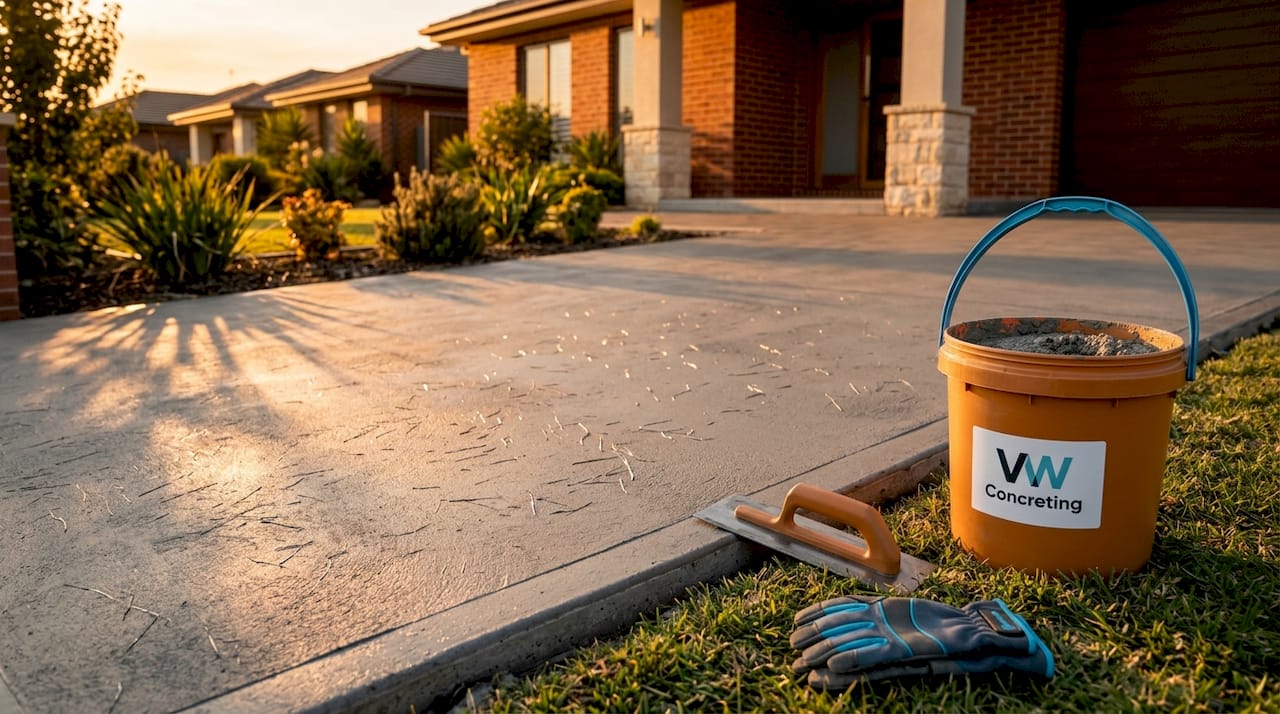
Fiber reinforcement in driveways is defined as the integration of polypropylene, macro synthetic, or glass fibers into the concrete mix to create an internal crack-control network that improves durability and toughness across the entire slab. The role of fiber reinforcement in driveways goes beyond simple crack prevention. It changes how concrete behaves under load, during curing, and over decades of weather exposure. VW Concreting has seen firsthand how fiber-reinforced slabs outperform unreinforced concrete in Melbourne’s variable climate, where summer heat and occasional frost cycles put real stress on residential surfaces. Understanding how fibers work, how they compare to steel mesh, and where they fall short gives homeowners and developers the knowledge to make smarter decisions before the first truck of concrete arrives.
How does fiber reinforcement work in concrete driveways?
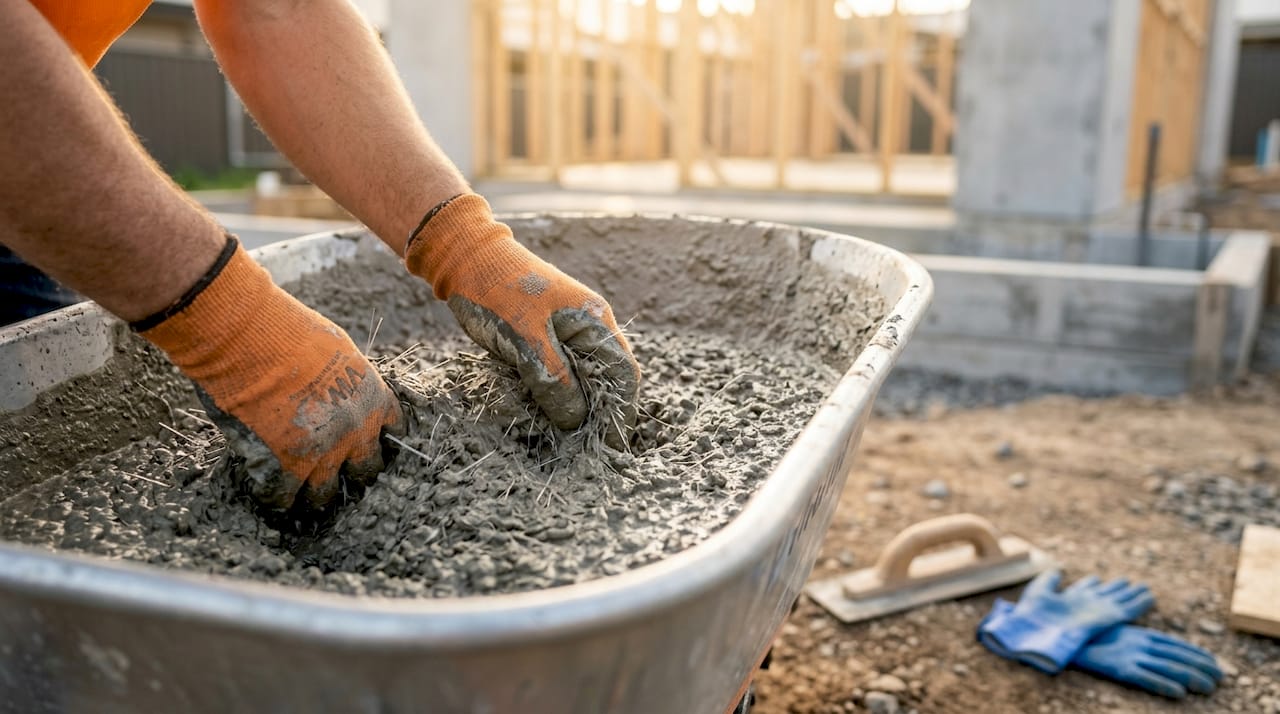
Fiber reinforcement works by distributing millions of individual fibers uniformly throughout the concrete matrix, forming a three-dimensional internal network that resists the formation and spread of cracks. When concrete shrinks during curing, those fibers hold the paste together at a microscopic level, limiting crack width and preventing small surface fractures from growing into structural failures.
Two fiber categories dominate residential driveway applications. Micro fibers, typically polypropylene, target plastic shrinkage cracking during the first 24 hours after placement. Macro synthetic fibers, which are thicker and longer, provide post-crack toughness and residual load capacity once the concrete has hardened. Both types are compatible with standard ready-mix trucks and conventional finishing equipment, which means no special machinery is required on site.
The strength gains from fiber reinforcement are measurable and significant. Polypropylene fiber dosed at 0.5 to 1.0 kg per cubic meter boosts compressive strength by 77%, tensile strength by 65%, and flexural strength by 40% in road pavement applications. Those numbers matter because flexural strength is the property most relevant to driveways, where slabs must resist bending under vehicle loads without snapping.
Specific fiber brands like REGEN Fiber also improve internal moisture control during curing, which reduces surface defects and supports faster form removal. That translates to a cleaner finished surface and a shorter construction window, both of which matter when you are working around a household’s daily schedule.
Pro Tip: Select micro fibers for new pours where plastic shrinkage is the primary concern, and specify macro synthetic fibers when the driveway will carry heavier vehicles like trailers or delivery trucks. Mixing both types in one pour is also a recognized practice for comprehensive crack control.
Key fiber performance characteristics to understand:
- Crack width control: Fibers limit crack widths to hairline levels rather than preventing all cracking.
- Omnidirectional reinforcement: Unlike steel mesh, fibers reinforce in every direction simultaneously.
- Dosage sensitivity: Too little fiber underperforms; too much can affect workability and finishing.
- ASTM C1116 compliance: Specify fibers that meet this standard to confirm performance consistency.
Fiber reinforcement versus traditional steel mesh and rebar
The comparison between fiber reinforcement and steel mesh is one of the most misunderstood topics in residential concrete construction. The two systems do different jobs, and treating them as direct substitutes in all situations leads to either over-engineered or under-designed driveways.
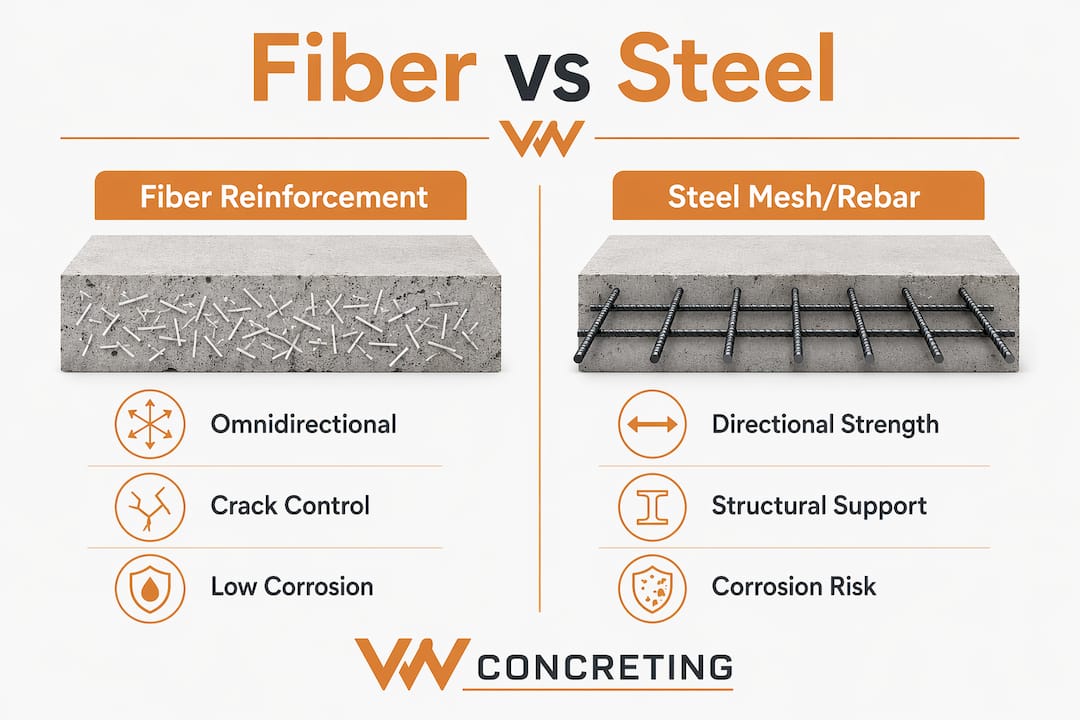
Fibers distribute reinforcement omnidirectionally, preventing micro-cracks and improving surface durability, but they do not provide the tensile structural strength that steel rebar delivers. Steel rebar is engineered to carry loads across a span, which is why it remains mandatory in driveways that cross drainage culverts, bridge soft spots, or support concentrated loads from heavy equipment.
Macro synthetic fibers can replace traditional steel mesh in pavement slabs like driveways, car parks, and access roads where the primary goal is crack control rather than structural load transfer. This substitution simplifies logistics significantly. There is no mesh to cut, position, or support on chairs, and no risk of mesh sitting too low in the slab where it provides no benefit.
| Reinforcement type | Primary function | Corrosion risk | Installation complexity | Best application |
|---|---|---|---|---|
| Polypropylene micro fiber | Plastic shrinkage control | None | Low (added to mix) | All residential slabs |
| Macro synthetic fiber | Post-crack toughness | None | Low (added to mix) | Driveways, car parks |
| Welded wire mesh | Shrinkage crack control | High (if cover is poor) | Moderate | Light-duty slabs |
| Steel rebar | Structural load capacity | High in coastal/salt environments | High | Structural spans, heavy loads |
| GFRP rebar | Structural load capacity | None | Moderate | Coastal, de-icing salt exposure |
GFRP (glass fiber reinforced polymer) rebar deserves specific attention for Melbourne properties near coastal zones or areas where de-icing salts are used. GFRP rebar offers corrosion resistance that steel cannot match, avoiding the rust-related spalling that shortens driveway service life in aggressive environments. GFRP does have lower stiffness than steel, so engineers design around that by adjusting bar spacing rather than treating it as a direct one-for-one swap.
The most durable residential driveways often use a hybrid approach: macro synthetic fibers for crack control throughout the slab combined with rebar at specific stress points like edges, corners, and areas near tree roots. This combination addresses both shrinkage behavior and structural demand without over-relying on either system.
Pro Tip: If your contractor proposes removing steel mesh entirely and replacing it with fiber, ask specifically whether the driveway has any structural spans or concentrated load points. Fiber is the right call for crack control on a standard slab-on-grade. It is not a substitute for rebar where genuine structural capacity is needed.
Key considerations for effective fiber reinforcement in driveways
Fiber reinforcement performs well only when the rest of the driveway design is sound. Driveways fail mostly due to subgrade issues, not lack of reinforcement alone. Fibers cannot compensate for a poorly compacted base, inadequate drainage, or a slab that is too thin for the loads it carries.
Here are the critical factors that determine whether a fiber-reinforced driveway succeeds or fails:
-
Subgrade preparation. Compact the subgrade to at least 95% standard Proctor density. Soft spots beneath the slab create differential settlement that no amount of fiber can prevent. A well-prepared crushed rock base distributes loads evenly and prevents the pumping action that destroys slab integrity over time.
-
Slab thickness. Residential driveways carrying standard passenger vehicles need a minimum of 100mm of concrete. Driveways that will see SUVs, trailers, or light commercial vehicles should be specified at 125mm. Fiber reinforcement works best when slab thickness is matched to the actual load demand rather than treated as a cost-cutting measure.
-
Control joint placement. Joints must be cut or formed at intervals no greater than 24 to 30 times the slab thickness. For a 100mm slab, that means joints every 2.4 to 3.0 meters. Fiber reinforcement limits crack width but does not eliminate the need for planned joints. Skipping joints is one of the most common causes of uncontrolled cracking in residential concrete.
-
Fiber dosage accuracy. Specify the dosage in kilograms per cubic meter and confirm it with the batch plant before the pour. Under-dosing is common when fiber is added informally on site rather than batched at the plant.
-
Environmental exposure. In areas with freeze-thaw cycles or exposure to de-icing salts, specify air-entrained concrete alongside fiber reinforcement. Fiber alone does not address freeze-thaw durability. The driveway concrete specification guide from VW Concreting covers these exposure categories in practical detail.
-
Curing. Apply curing compound or wet curing immediately after finishing. Fiber reinforcement reduces plastic shrinkage cracking, but inadequate curing still causes surface crazing and long-term strength loss.
Pro Tip: Ask your concrete supplier to confirm fiber compliance with ASTM C1116 or AS 3600 before the pour. Fibers that meet these standards have documented performance data. Generic or unspecified fibers may look identical but deliver inconsistent results.
What are the benefits and limitations of fiber reinforced driveways?
Fiber reinforced driveway advantages are real and well-documented, but they come with specific boundaries that homeowners need to understand before committing to a specification.
The core benefits of fiber reinforcement include:
- Reduced cracking. Fibers control both plastic shrinkage and drying shrinkage cracking, which are the two most common defects in residential concrete slabs.
- Improved toughness. Post-crack residual strength means the slab continues to hold together even after a crack forms, rather than separating into loose sections.
- Faster construction. Eliminating steel mesh placement reduces labor time and removes a step that often delays pours when mesh delivery is late or positioning is incorrect.
- No corrosion. Synthetic and glass fibers do not rust, which eliminates the spalling caused by corroding steel mesh near the slab surface.
- Better surface quality. Fibers that support internal moisture control during curing reduce bleed water channels and surface defects, producing a cleaner finish.
- Cost efficiency. Reduced steel mesh requirements lower material and labor costs on standard residential slabs.
The limitations are equally worth knowing:
- Polypropylene fibers at higher dosages can reduce concrete permeability, which matters if you specified a permeable driveway for stormwater management.
- Fiber reinforcement does not replace structural rebar where load transfer across a span is required.
- Surface fibers can appear as fine fuzz on the finished slab. This is cosmetic and burns off quickly, but it surprises homeowners who are not warned in advance.
- Not all fiber products are equal. Specifying by brand and ASTM compliance rather than by generic description protects against inconsistent performance.
Key takeaways
Fiber reinforcement improves driveway durability by controlling cracking and increasing toughness, but it works only as part of a complete design that includes proper base preparation, correct slab thickness, and planned control joints.
| Point | Details |
|---|---|
| Fibers control cracking, not structure | Use macro synthetic fibers for crack control; retain rebar where structural load capacity is needed. |
| Dosage determines performance | Specify polypropylene fiber at 0.5 to 1.0 kg per cubic meter and confirm compliance with ASTM C1116. |
| Base prep is non-negotiable | Fiber reinforcement cannot compensate for a poorly compacted subgrade or inadequate drainage. |
| Hybrid systems outperform single solutions | Combining macro synthetic fibers with rebar at stress points delivers the most durable residential driveway. |
| Corrosion-free options exist | GFRP rebar paired with synthetic fibers eliminates rust-related spalling in coastal or salt-exposed environments. |
What I’ve learned from fiber reinforced driveways in Melbourne
The biggest misconception I encounter is that adding fibers to the mix is a shortcut that makes everything else less important. Homeowners sometimes hear “fiber reinforced” and assume the driveway is now bulletproof regardless of what goes underneath it. That is not how concrete works.
What fibers genuinely do is give the slab a fighting chance when minor stress occurs, which it always does. Concrete shrinks. Ground moves. Temperature cycles. Fibers mean those inevitable stresses produce hairline cracks that stay hairline, rather than growing into the kind of damage that requires grinding, patching, or full replacement within five years.
The projects I have seen fail were not fiber failures. They were base failures, drainage failures, or joint failures where the fiber was doing its job perfectly but had no foundation to work with. Reinforcement addresses cracking but cannot fix poor base or drainage. That sentence should be printed on every concrete delivery docket.
My recommendation for any homeowner or developer is to treat fiber reinforcement as one layer of a complete system. Specify the right fiber type and dosage for your driveway’s function. Invest in proper base preparation. Plan your joints. And work with a contractor who can explain why each decision was made, not just what was done. That combination produces driveways that look good and perform well for decades.
— Vic
Build your driveway right with VW Concreting
VW Concreting has delivered over 145 concrete projects across Melbourne since 2001, including fiber-reinforced driveways specified for long-term durability and clean aesthetics. The team works with polypropylene and macro synthetic fiber systems, selecting the right product and dosage for each site’s load requirements, exposure conditions, and finish goals. Every project starts with proper base preparation and a concrete specification matched to the actual demands of the driveway, not a one-size-fits-all approach. If you are planning a new driveway or replacing an existing slab, explore VW Concreting’s driveway and slab projects to see the quality of work delivered across Melbourne’s residential and commercial properties.
FAQ
What is the role of fiber reinforcement in a concrete driveway?
Fiber reinforcement controls plastic and drying shrinkage cracking by forming an internal network within the concrete matrix, improving toughness and limiting crack width. It does not replace structural rebar but significantly extends the service life of standard residential slabs.
Can fiber reinforcement replace steel mesh in a driveway?
Macro synthetic fibers can replace welded wire mesh in slabs-on-grade where the goal is shrinkage crack control rather than structural load transfer. Steel rebar is still required at edges, corners, and any location where the slab spans a soft spot or carries concentrated loads.
How much fiber should be added to driveway concrete?
Polypropylene fiber dosed at 0.5 to 1.0 kg per cubic meter delivers measurable improvements in compressive, tensile, and flexural strength for pavement applications. Always confirm the dosage with the batch plant and specify ASTM C1116 compliance before the pour.
Does fiber reinforcement prevent all driveway cracks?
Fiber reinforcement reduces crack frequency and limits crack width but does not eliminate cracking entirely. Properly placed control joints, a compacted subgrade, and correct slab thickness are all required alongside fiber to prevent driveway cracks effectively.
Is fiber reinforcement worth the cost for a residential driveway?
Yes, for most residential driveways the cost of adding fiber to the mix is modest compared to the labor savings from eliminating steel mesh and the long-term benefit of reduced cracking and maintenance. The return on investment is strongest in driveways exposed to temperature variation, heavy vehicle use, or coastal conditions.
Leave A Comment