
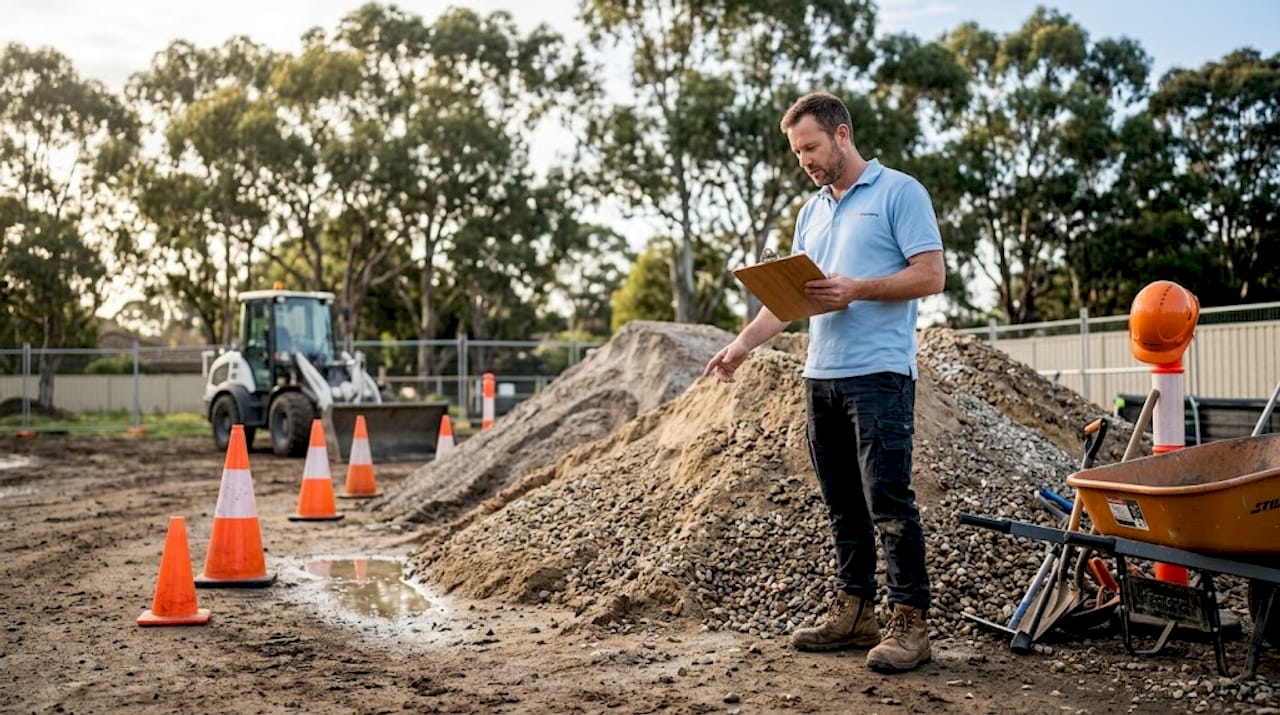
Aggregate makes up 60 to 75% of concrete volume — yet most project conversations treat it as background noise. Understanding what is aggregate in concrete is not an academic exercise. It is a practical lever that directly controls your mix’s strength, workability, durability, and cost. Get aggregate selection wrong and you face slump variability on pour day, permeability issues a few years later, and a very avoidable conversation with your client. This guide covers what aggregates are, how they are classified, why grading matters more than most project managers realize, and how to apply that knowledge on Melbourne construction sites.
Table of Contents
- What is aggregate in concrete? Defining fine and coarse aggregates
- How aggregate type and grading influence concrete strength and workability
- The role of aggregate grading in concrete durability and permeability
- Australian standards and quality control for aggregate in concrete projects
- Practical tips for project managers: choosing and managing aggregates on Melbourne construction sites
- Rethinking aggregate as more than just filler: an expert view
- Enhance your Melbourne projects with VW Concreting’s expert services
- Frequently asked questions
Key Takeaways
| Point | Details |
|---|---|
| Aggregate’s vital role | Aggregates form 60–75% of concrete, shaping its strength and durability. |
| Grading matters | Continuous and well-graded aggregates improve workability and compressive strength significantly. |
| Durability depends on grading | Proper aggregate grading reduces permeability, enhancing concrete lifespan. |
| Australian standards guide quality | AS 1141.22 defines rigorous aggregate testing to ensure project compliance. |
| Practical management tips | Regular grading checks prevent workability issues and support consistent concrete quality. |
What is aggregate in concrete? Defining fine and coarse aggregates
Aggregate is granular material combined with hydraulic cement and water to produce concrete or mortar. That definition sounds simple, but the practical implications are significant. Aggregate is not a single material. It is a category that includes sand, gravel, crushed stone, recycled concrete, and even manufactured crushed fines, each with different particle shapes, surface textures, and mechanical properties.
The most important classification for procurement and mix design is the division by particle size. A 4.75 mm sieve is the dividing line. Materials that pass through it are classified as fine aggregate — primarily natural sand or manufactured sand. Materials retained on it are classified as what is coarse aggregate — gravel, crushed basalt, or crushed limestone being the most common in Melbourne.
Here is a quick breakdown of typical aggregate materials used in concrete:
- Fine aggregate: Natural river sand, crusher dust, manufactured sand (particle size below 4.75 mm)
- Coarse aggregate: Crushed basalt, gravel, crushed limestone, recycled crushed concrete (particle size above 4.75 mm)
- Recycled aggregate: Crushed demolition concrete, glass cullet, reclaimed gravel (variable sizing)
- Heavyweight aggregate: Steel shot, iron ore fines (used in radiation-shielding concrete)
Understanding this classification matters because concrete performance factors like load transfer, shrinkage, and water demand are all tied to the proportion and type of aggregate in your mix. Choosing the right combination starts with knowing which category you are working with.
How aggregate type and grading influence concrete strength and workability
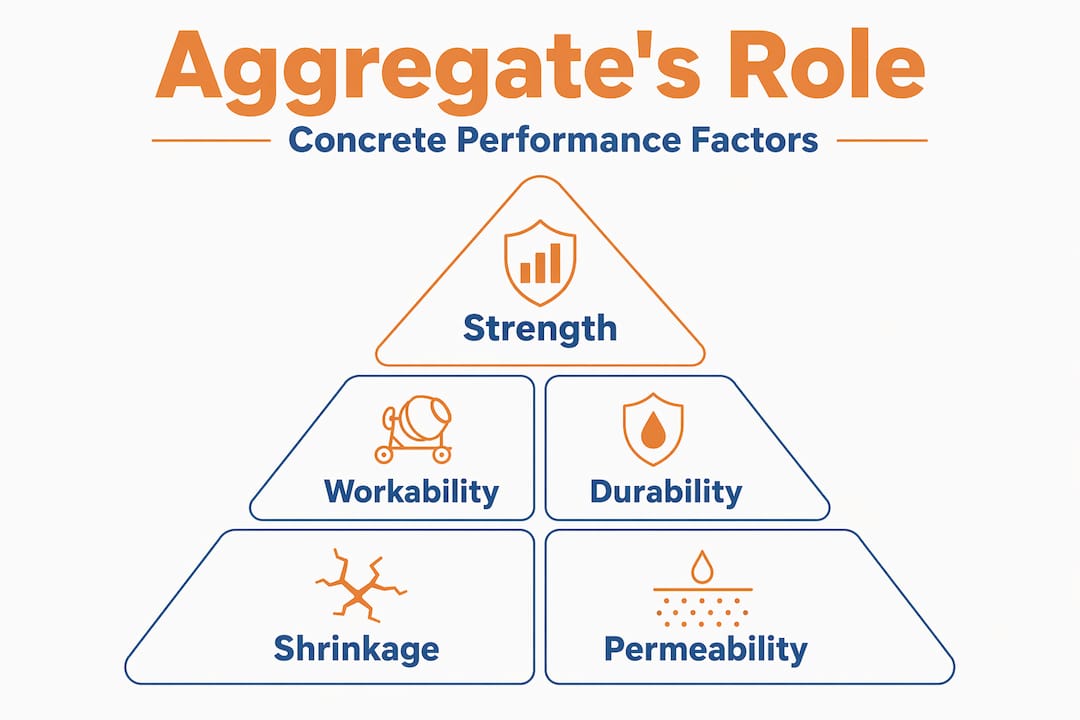
Knowing what aggregates are leads directly to the question every project manager should be asking: which types produce the best concrete, and why?
The answer comes down to grading, which refers to the distribution of particle sizes within an aggregate sample. A well-graded aggregate contains a balanced range of sizes, so smaller particles fill the gaps between larger ones. This reduces void space, improves particle packing, and ultimately cuts the amount of cement paste needed to bind everything together.
Research confirms the performance gap is significant. Continuous combined grading has been shown to achieve compressive strengths up to 114 MPa and slump values up to 90 mm — both substantially higher than mixes using narrower, less continuous aggregate fractions. Those are not marginal gains. They represent the difference between a mix that flows well and places easily and one your crew is fighting on site.
Here is how different grading approaches compare in practice:
| Grading type | Compressive strength | Workability (slump) | Void content |
|---|---|---|---|
| Continuous combined grading | High (up to 114 MPa) | High (up to 90 mm) | Low |
| Single fraction coarse only | Moderate | Low | High |
| Fine fraction only | Moderate | Very low | Moderate |
| Gap-graded | Variable | Moderate | Moderate to high |
The practical takeaway from this is important. Mixes using only smaller aggregate fractions consistently show reduced slump and worse workability. When you see your crew adding water on pour day because the mix feels stiff, the root cause is often a grading problem, not a dosing problem.
Key factors that aggregate type and grading control:
- Compressive strength: Better packing reduces voids and increases the load-bearing matrix
- Slump and workability: Continuous grading improves particle flow without extra water
- Cement efficiency: Less void space means less paste needed, reducing cement content and cost
- Shrinkage: Higher aggregate volume and better packing reduce drying shrinkage cracking
Pro Tip: Monitor your aggregate grading curves from each delivery before adjusting water content or admixture doses. A drop in slump is more often a grading shift than a batching error.
The role of aggregate grading in concrete durability and permeability
Strength and workability get most of the attention in mix design. Durability is often where projects quietly fail years later.
Aggregate grading controls the pore structure of hardened concrete. When aggregate is poorly graded and voids are not efficiently packed, the cement paste has to fill those gaps. The result is a more porous matrix with connected capillary channels. Water, chlorides, and carbon dioxide find those channels and begin the slow work of corrosion and degradation.
Well-graded aggregates reduce porosity and permeability, which directly improves durability and corrosion resistance. Open-graded mixes — which intentionally leave void space, used in drainage concrete — behave differently and serve specific purposes. But for structural slabs, driveways, retaining walls, and footing pours, you want a closed, dense matrix.
The practical implications for Melbourne projects include:
- Chloride ingress: Poor grading increases permeability, allowing salt water or deicing compounds to reach reinforcement faster
- Carbonation depth: High porosity accelerates carbonation, reducing the passive oxide layer protecting rebar
- Freeze-thaw resistance: Dense, low-permeability concrete resists internal pressure from ice crystal expansion
- Sulfate attack: Lower permeability reduces exposure of cement compounds to sulfate-bearing groundwater or soils
For applications like concrete durability in structural work, aggregate grading is not a secondary concern. It is built into the design criteria. A retaining wall or structural slab that fails at 12 years instead of 40 is a direct consequence of decisions made at aggregate selection.
Australian standards and quality control for aggregate in concrete projects
In Melbourne, selecting aggregate is not purely a judgment call. Australian standards define how aggregates must be tested and what results determine their suitability.
AS 1141.22 covers aggregate strength testing by measuring the percentage of fines produced when a sample is subjected to a defined load, using a 10% dry mass threshold under both wet and dry conditions. The wet and dry distinction is critical. Some aggregates perform well when dry but degrade significantly when wet, making them unsuitable for applications exposed to moisture, which covers most outdoor Melbourne pours.
A practical quality control process for a Melbourne project site looks like this:
- Request test certificates from your supplier for each aggregate batch, covering sieve analysis, particle shape, and AS 1141.22 strength results
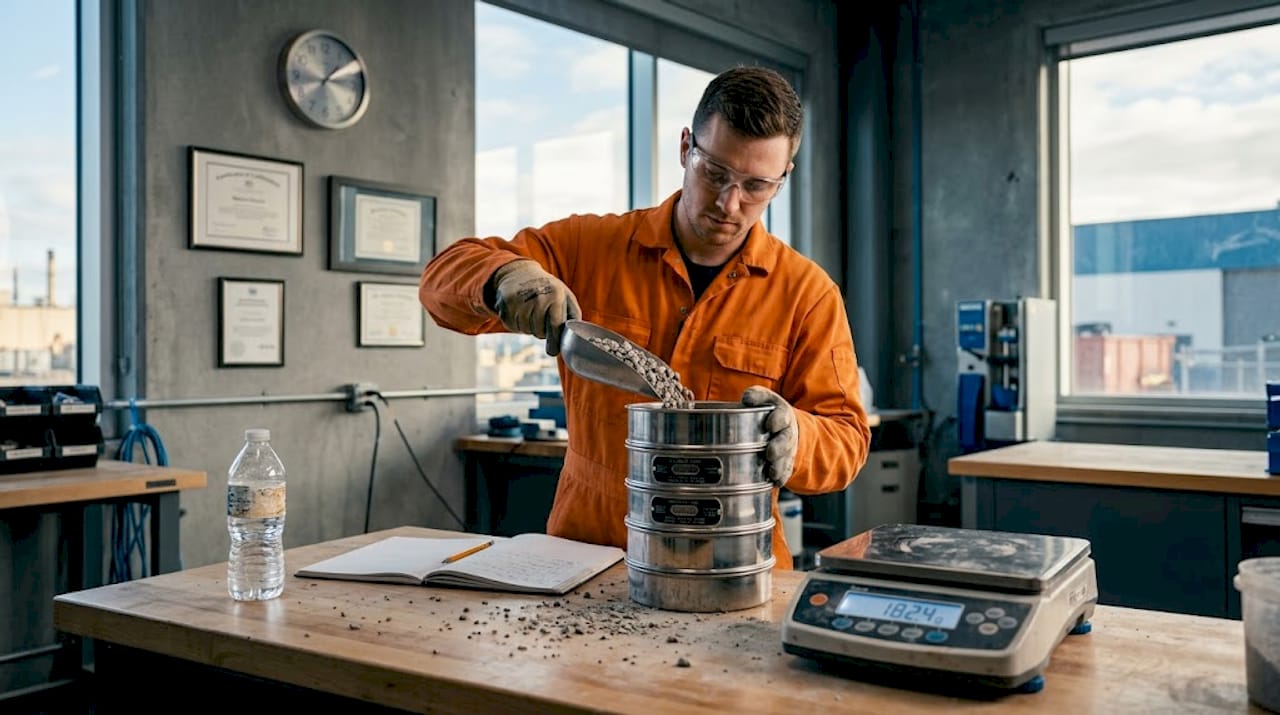
- Conduct on-site sieve analysis on representative samples from each delivery, particularly for projects with tight mix design specifications
- Compare grading curves against your specified envelope — any delivery falling outside the target range should be quarantined before batching
- Assess wet and dry strength values separately, especially for aggregates going into exposed or submerged applications
- Document test results per pour to create a traceable quality record, useful if durability or strength disputes arise later
For aggregate quality control to function properly, the testing process needs to be consistent, not just done once at project start. Quarries can deliver varying material from the same source depending on extraction zone and processing.
Pro Tip: Build aggregate sampling requirements into your supplier contract from the start. Expecting a supplier to retroactively provide documentation after a pour is already placed puts you in a weak position if issues surface.
Practical tips for project managers: choosing and managing aggregates on Melbourne construction sites
With the standards framework understood, let’s move to the decisions you actually make week to week on site.
Slump variability on site is frequently caused by inconsistent aggregate grading before any strength issue becomes apparent. This means your first signal of a mix problem will show up at the truck chute, not the break cylinder. Catching it there requires you to be watching grading data, not just trusting the batch plant.
Practical strategies that work on Melbourne sites:
- Run weekly sieve checks on stockpiles. Stockpiles segregate as they are drawn down from the top, so a grading that passed at delivery can shift significantly by week three of use
- Do not adjust water content for low slump without first checking aggregate grading. Adding water to fix a workability problem caused by grading shifts the water-cement ratio and compromises strength
- Specify combined grading from your supplier. Ask whether they can screen and blend fractions to deliver a continuous grading envelope. Some Melbourne suppliers do this as standard; others need it requested explicitly
- Keep fine and coarse aggregates in separate stockpiles and blend proportionally at the batch plant rather than relying on a pre-blended delivery that has segregated in transit
- Coordinate on managing aggregates on-site with your concrete supplier early, especially when exposed aggregate finishes are involved, because surface appearance is directly tied to aggregate consistency
Pro Tip: When sourcing from suppliers who offer combined grading options, ask for sieve curves for each combined fraction delivery. Comparing those to your target gradation envelope takes ten minutes and can prevent a day’s worth of workability problems.
Rethinking aggregate as more than just filler: an expert view
After two decades of working on Melbourne concrete projects, one pattern stands out clearly. The project managers who treat aggregate as a commodity — order it by price, assume it’s consistent, and only pay attention when something goes wrong — are the same ones dealing with rework, mix disputes, and shrinkage cracking that should have been avoidable.
Aggregate is not simply filler. It forms the structural skeleton of every concrete element you build. Load transfer in a slab happens through the aggregate matrix. Shrinkage is resisted by it. The paste binds to it, but the aggregate is doing the structural heavy lifting. Treating it as a pass-through procurement item is the equivalent of specifying rebar by weight rather than grade.
There is also a sustainability argument that does not get enough air. When aggregate is selected and graded strategically, the resulting packing efficiency reduces the cement content needed for the same strength outcome. Less cement means lower embodied carbon per cubic meter. In a construction environment where sustainability credentials are increasingly tied to project procurement, that is a quantifiable advantage you are leaving on the table if you treat aggregate as an afterthought.
The uncomfortable truth is that aggregate variability is one of the leading causes of inconsistent project results, and it is one of the most controllable variables on site. It does not require expensive technology or complex systems. It requires disciplined sampling, clear supplier communication, and the awareness that what looks like a batching problem or a placing problem often started at the aggregate stockpile.
Enhance your Melbourne projects with VW Concreting’s expert services
Understanding aggregate selection is one thing. Having a concreting team that applies that knowledge on every pour is another. At VW Concreting, we have been delivering quality concrete across Melbourne since 2001, and aggregate management is part of how we maintain consistency across every project we take on.
Whether you are planning comprehensive concreting projects or scoping out driveway and slab concreting for a development, our team brings the mix design knowledge and quality control discipline that keeps projects on schedule and on spec. If you are still working through choosing concreting services in Melbourne, we are happy to walk you through what separates a quality concrete partner from a volume supplier. Reach out to VW Concreting before your next project kicks off and get aggregate and mix design right from day one.
Frequently asked questions
What types of materials are considered aggregate in concrete?
Aggregate materials in concrete include granular materials such as sand, gravel, crushed stone, and recycled concrete that form the bulk of any concrete mix. The specific materials chosen affect strength, workability, and long-term durability.
How does aggregate grading affect concrete workability?
Continuous aggregate grading improves particle packing and fluid behavior, increasing slump significantly compared to mixes relying on narrower or single-fraction aggregate. Poor grading is one of the most common but overlooked causes of low slump on pour day.
Why is aggregate quality testing important in Melbourne projects?
AS 1141.22 testing measures aggregate strength under wet and dry conditions, ensuring materials meet mechanical thresholds before use. Skipping it exposes projects to aggregate failures that show up in the finished structure, not the batch ticket.
What common issues arise from poor aggregate management on construction sites?
Grading inconsistencies in stockpiles typically show up as slump variability before any compressive strength issue emerges, often prompting water additions that silently reduce strength. Catching grading drift early is far cheaper than fixing concrete that has already cured with a compromised water-cement ratio.
How can project managers improve aggregate selection and use?
Consistent sieve analysis of deliveries, supplier coordination on combined grading targets, and adherence to Australian testing standards give you the control needed to optimize concrete performance. Starting those conversations with suppliers at contract stage, not during the pour, is what separates proactive project management from reactive problem-solving.
Leave A Comment