
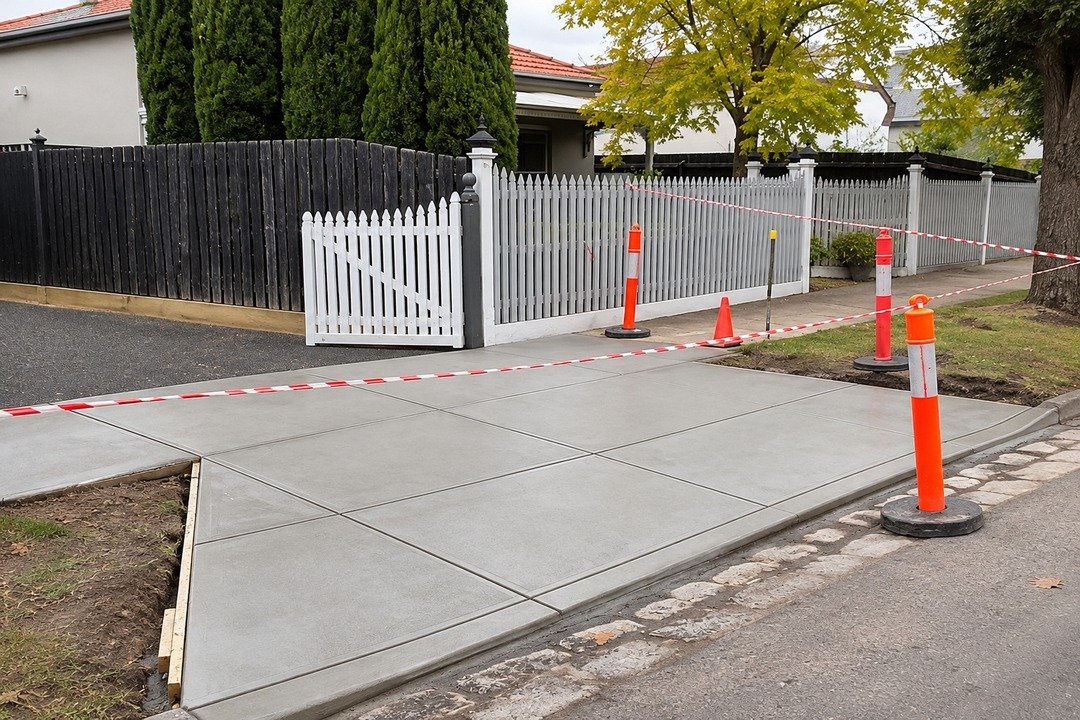
A damaged, uneven or outdated vehicle crossover can make entering and leaving your property difficult. Because a crossover connects your private driveway to the public road, replacing one involves more than simply removing old concrete and pouring a new surface.
For Melbourne homeowners, the project may involve council requirements, existing footpaths, kerbs, drainage, nature strips and underground services. Understanding these considerations before work begins can make the process much smoother.
Whether your existing crossover has deteriorated or you are upgrading your driveway access, careful planning is the key to achieving a practical and suitable result.
What Is a Vehicle Crossover?
A vehicle crossover is the section that connects a property’s driveway or accessway to the road. It commonly crosses the footpath, nature strip and kerb area within the road reserve.
This means a crossover is different from the driveway itself. The driveway generally sits within the property, while the crossover provides the connection to the street.
Because part of this area sits within the road reserve, replacement work can be subject to council approval and specific construction requirements.
When Should You Replace a Crossover?
There are several reasons a homeowner may consider replacement.
Cracking, movement, uneven surfaces and deterioration can make an old crossover difficult to use and can affect the appearance of the property’s frontage. A crossover may also need to be replaced if the driveway is being redesigned or the existing access no longer suits the property.
In some situations, homeowners may want to widen, relocate or modify an existing crossover. These changes can have additional approval requirements, so they should be discussed with the relevant council before construction.
For anyone researching Crossover Replacement Services Melbourne, the condition of the existing crossover and the reason for replacement should be assessed before deciding on the new design.
Check Council Requirements First
This is one of the most important parts of a crossover project.
Requirements are not identical across every Melbourne municipality. For example, Moonee Valley requires approval before a crossover is constructed, modified or relocated, while Yarra requires a permit before work begins on a permanent vehicle crossing.
Other councils may have their own requirements covering dimensions, materials, inspections, drainage, footpaths and construction standards.
If the property is on or near a major road, additional planning considerations may also apply. Victorian Government guidance notes that altered access to certain Transport Zone 2 roads can be referred to the relevant transport authority.
The safest approach is to check the requirements of your local council before demolition or construction starts.
Assess the Existing Site
A proper site assessment should look at more than the concrete surface.
Existing kerbs, footpaths, drainage pits, utility covers, street trees, nature strips and service locations can all affect the proposed crossover.
Some councils specifically require site plans and information about nearby utilities, trees and drainage infrastructure as part of the application process. Yarra City’s crossover requirements, for example, call for detailed plans showing nearby infrastructure and proposed levels.
Levels are particularly important because the crossover needs to provide a practical transition between the road, footpath and driveway.
Removing the Old Crossover
Replacement usually begins with removing the existing structure and preparing the area for the new installation.
Depending on the condition and design, this can involve demolition, removal of old concrete, excavation and preparation of the base. Existing materials may also need to be disposed of appropriately.
If the crossover is being relocated rather than replaced in the same position, the old access may need to be removed and the road reserve reinstated. Some Victorian councils specifically require redundant crossovers to be removed and associated kerb, channel or nature-strip areas reinstated.
Choosing the Right Finish
Concrete is a common crossover material in Melbourne, but the permitted finish may depend on the council and location.
Some councils allow options such as plain or exposed aggregate concrete, while others have specific requirements for colour, texture or finish. Mornington Peninsula Shire, for example, notes that crossover materials and finishes are subject to council approval and specifications.
For this reason, it is better to choose the finish after checking the applicable requirements rather than assuming that any decorative concrete finish will be accepted.
The crossover should also work visually with the driveway and the home’s frontage. A consistent transition can create a cleaner overall appearance.
Pay Attention to Drainage and Levels
Water management is another important consideration.
The crossover should work with existing drainage rather than obstructing the flow of stormwater. Depending on the property and local infrastructure, drainage pits, kerb channels or culverts may need to be considered.
Some councils specifically assess stormwater flow and drainage as part of crossover applications.
Accurate levels can also help create a smoother connection between the driveway and street while reducing potential problems around water movement.
Coordinate the Crossover With Your Driveway
If you are replacing both the crossover and driveway, planning them together can produce a more cohesive result.
Consider the driveway width, vehicle access, surface finish, colours and where the driveway meets the garage or carport. The crossover should provide a natural continuation of the access route rather than looking like a separate piece of concrete.
This is particularly useful when upgrading an older driveway at the same time as replacing a damaged crossover.
Choose a Contractor Carefully
When comparing contractors for Crossover Replacement Services Melbourne, ask what is included in the project.
A useful quotation should clearly explain demolition, excavation, preparation, concrete, reinforcement where applicable, finishing, clean-up and any reinstatement work. It should also be clear about council-related responsibilities.
Do not assume that a planning or building approval automatically covers crossover work. Some councils require a separate vehicle crossing permit even when other approvals exist.
A contractor familiar with crossover work should understand that the project involves both the private driveway and the public road interface.
Final Thoughts
Replacing a crossover is a practical upgrade that can improve access and the appearance of your property’s frontage. However, because the work often involves the road reserve, it needs more planning than a standard driveway project.
Check your local council requirements, assess existing levels and infrastructure, choose an appropriate finish and make sure the crossover works with the rest of the driveway.
With the right preparation, crossover replacement in Melbourne can be approached as a coordinated project rather than simply replacing an old concrete surface.
Why Choose VW Concreting?
At VW Concreting, we provide residential concreting solutions across Melbourne and surrounding suburbs, including Truganina, Werribee, Hoppers Crossing, Rockbank and Sunbury.
Our services include exposed aggregate, slate-look concrete and outdoor concrete surfaces.
We help homeowners explore suitable finishes for their properties, whether they’re planning a new driveway or improving an existing outdoor area.
Looking for a reliable concrete driveway service in Melbourne?
Contact VW Concreting today to discuss your project and request a free quote.
Call: 0410 718 900
Leave A Comment