
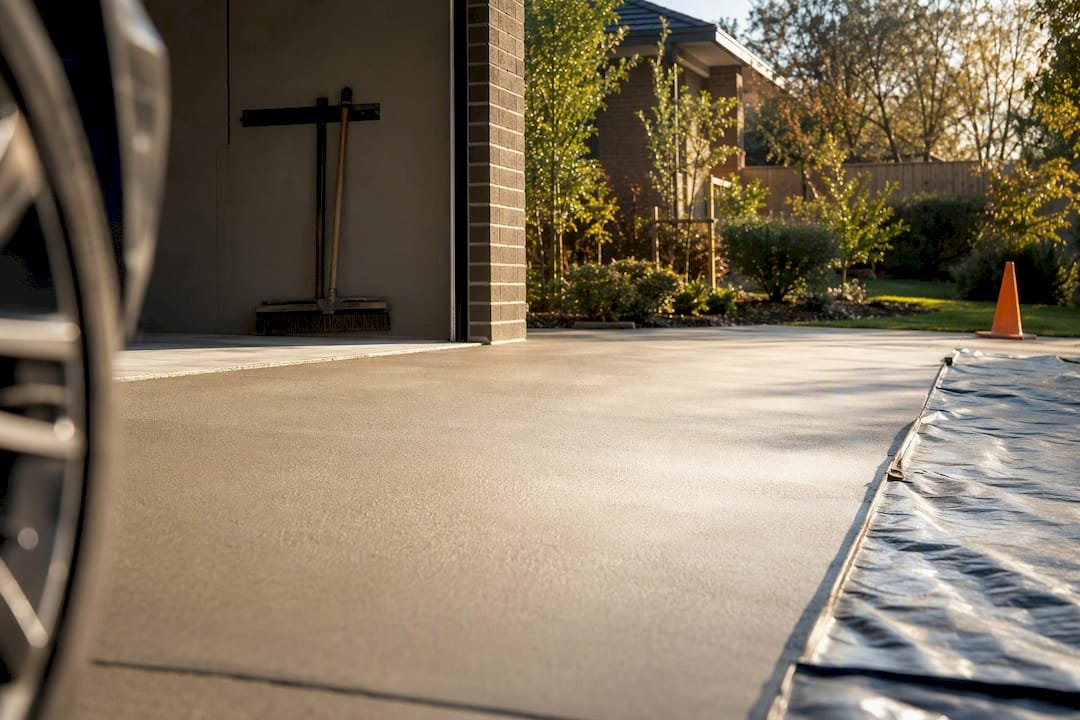
Keep foot traffic off a new slab for the first 24 hours, then walk on it freely after 24 to 48 hours. Passenger cars and light SUVs can typically drive on it after 7 days under normal conditions. Heavy vehicles, RVs, and moving trucks need the full 28 days, which is also when the concrete hits its full design strength.
TL;DR:
- Light foot traffic and bicycles can usually be tolerated after two to three days, but heavy vehicles require at least 28 days to reach full strength.
- The concrete reaches roughly 65 to 70% of its strength by day 7, making it generally safe for passenger cars with careful, single passes.
- Cold or hot weather can significantly delay curing; maintaining temperatures above 50°F is essential during the first week to avoid permanent damage.
- Applying excessive loads or parking heavy vehicles early can cause internal cracking, edge failures, or permanent depressions, often requiring costly repairs.
- Proper curing methods like water spraying or curing compounds are vital for structural integrity, with sealing before full cure risking discoloration or weakness.
Table of Contents
- How Long Does Concrete Driveway Curing Time Actually Take?
- When Can Specific Vehicles and Activities Use the Driveway?
- What Changes Concrete Curing Time on Your Site?
- How Do You Properly Cure a New Concrete Driveway?
- What Happens If You Drive on Concrete Too Soon?
- How Do You Know Your Driveway Is Ready?
- How Contractors Handle Concrete Curing on the Job
- A Contractor’s Take on Concrete Curing Time
- Sources
How Long Does Concrete Driveway Curing Time Actually Take?
Curing isn’t drying. It’s a chemical reaction called hydration, and it keeps building strength for weeks after the surface looks and feels solid. That distinction trips up more homeowners than anything else about a new driveway.
The strength curve isn’t a straight line. Concrete gains strength fast at first, then the rate slows dramatically as it approaches full design strength at 28 days. Here’s roughly what a standard 3,000 PSI mix looks like on a normal schedule:
- Day 1: About 16% of final strength. Surface is set but fragile. No foot traffic, no leaning ladders against it.
- Day 2: Around 30% of final strength. Careful foot traffic is generally fine.
- Day 7: Roughly 65 to 70% of final strength. This is the point most contractors clear passenger cars for a single, careful pass.
- Day 14: Strength gain slows but continues climbing past 80%. The slab handles daily driving well, though edges are still catching up.
- Day 28: Full design strength. This is the number stamped on the mix ticket and the benchmark everyone in the trade works from.
A few things shift that timeline. A thicker slab (say, 5 inches versus the standard 4) holds moisture longer and can be marginally slower to cure at the surface, even though it’s stronger overall. Mix design matters too. A driveway poured with a higher water content or without accelerants will lag behind these numbers, especially in cool weather.
Think about it in terms of real situations. Moving day furniture dollies on day 3? Fine, that’s light foot traffic. Mowing the lawn and rolling the mower across the edge on day 5? Also fine. A moving truck backing in on day 10? That’s the mistake that cracks driveways.
When Can Specific Vehicles and Activities Use the Driveway?
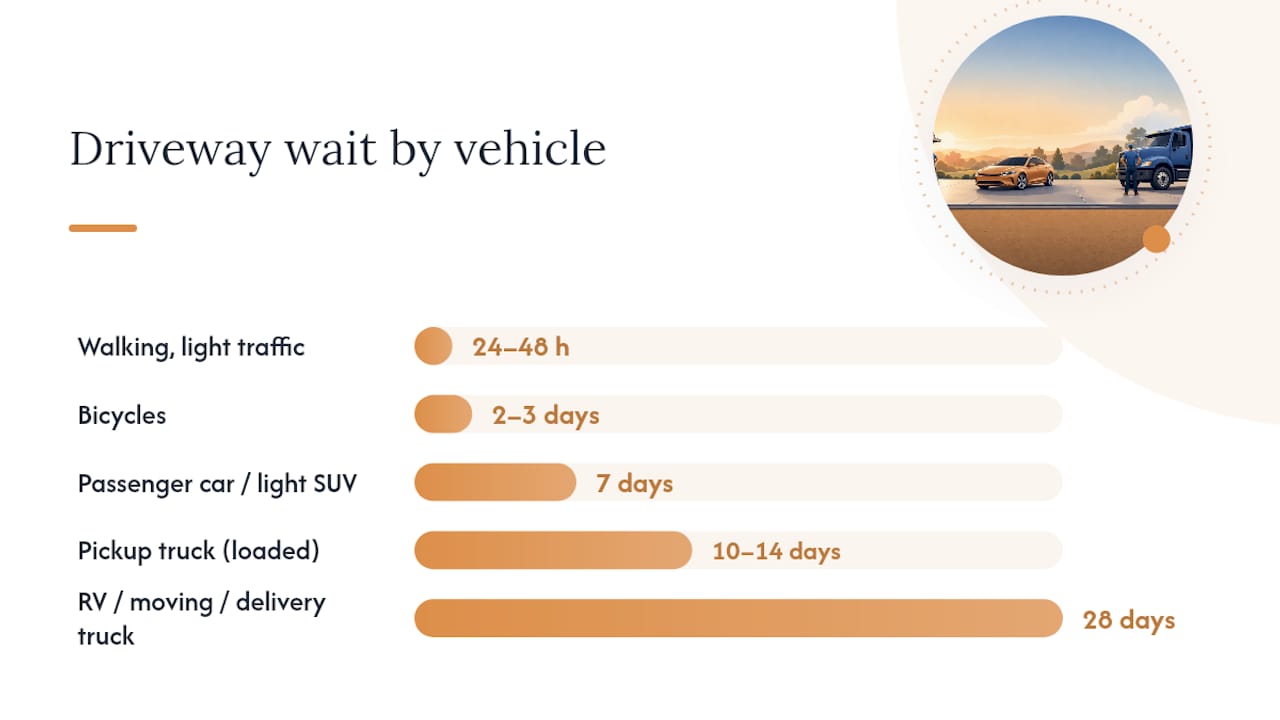
Not all loads are equal, and treating a bicycle the same as a delivery truck is where people get into trouble. Weight, tire contact area, and whether the vehicle is moving or parked all change how much stress hits the slab.
Bikes and lightweight foot traffic are the most forgiving. A loaded moving truck idling in one spot for twenty minutes is the least forgiving, because sustained point load on a still-curing slab is worse than a quick drive-over.
| Activity or vehicle | Minimum wait | Typical weight range | Key precaution |
|---|---|---|---|
| Walking, light foot traffic | 24–48 hours | Lightweight | Avoid dragging or twisting shoes on the surface |
| Bicycles | 2–3 days | Lightweight bike plus rider | Don’t kickstand-park directly on fresh joints |
| Push mower | 3–5 days | Moderate bike weight | Skip if the slab still shows a slightly darker, damp finish |
| Passenger car or light SUV | 7 days | Approximately 3,000 lbs | Single pass only; avoid parking in the same spot repeatedly |
| Pickup truck (loaded) | 10–14 days | Around 5,000 lbs | Keep tires away from edges and slab joints |
| RV, moving truck, delivery truck | 28 days | Heavy vehicles | Wait for full cure; edges may need extra time beyond 28 days |
One detail most guides skip: a 4-inch residential slab built for passenger cars might handle a single pass fine at 7 days, but repeated parking near the edge, or a loaded pickup sitting there overnight, will often cause edge spalling unless the slab and the base underneath were specifically designed to carry that load. If a heavy delivery is a one-time event, lay plywood sheets across the path to spread the weight instead of letting tires bear down on a single line.
What Changes Concrete Curing Time on Your Site?
Temperature runs the whole show. Hydration is a chemical process, and like most chemical processes, it slows down when it’s cold and speeds up when it’s hot, sometimes too fast for its own good.
- Warm weather (70 to 85°F): Curing tracks close to the standard schedule, but watch for fast surface drying that outpaces the strength gain underneath.
- Hot, dry, or windy conditions: Surface moisture can evaporate faster than hydration can use it, leaving a weak, dusty top layer. Evaporation-retardant sprays applied right after finishing head this off.
- Cool weather (50 to 65°F): Add extra days before hitting any of the milestones above. A slab that reaches 65% strength in 7 days at 75°F might take 10 to 12 days at 55°F.
- Near or below freezing: ACI 308 guidance recommends maintaining temperatures above 50°F during early curing whenever possible, because a freeze event in the first week can permanently reduce the concrete’s strength ceiling.
Mix water content matters more than most homeowners realize. A wetter mix pours easier but cures weaker and slower. A properly compacted, uniform base underneath the slab also speeds up safe usability, since a soft or uneven subgrade lets the slab flex under load long before it’s structurally ready to.
How Do You Properly Cure a New Concrete Driveway?
Curing methods exist for one reason: keep the slab hydrated and at a stable temperature long enough for the chemistry to finish its job. Skip this step and every strength number above becomes optimistic guesswork.
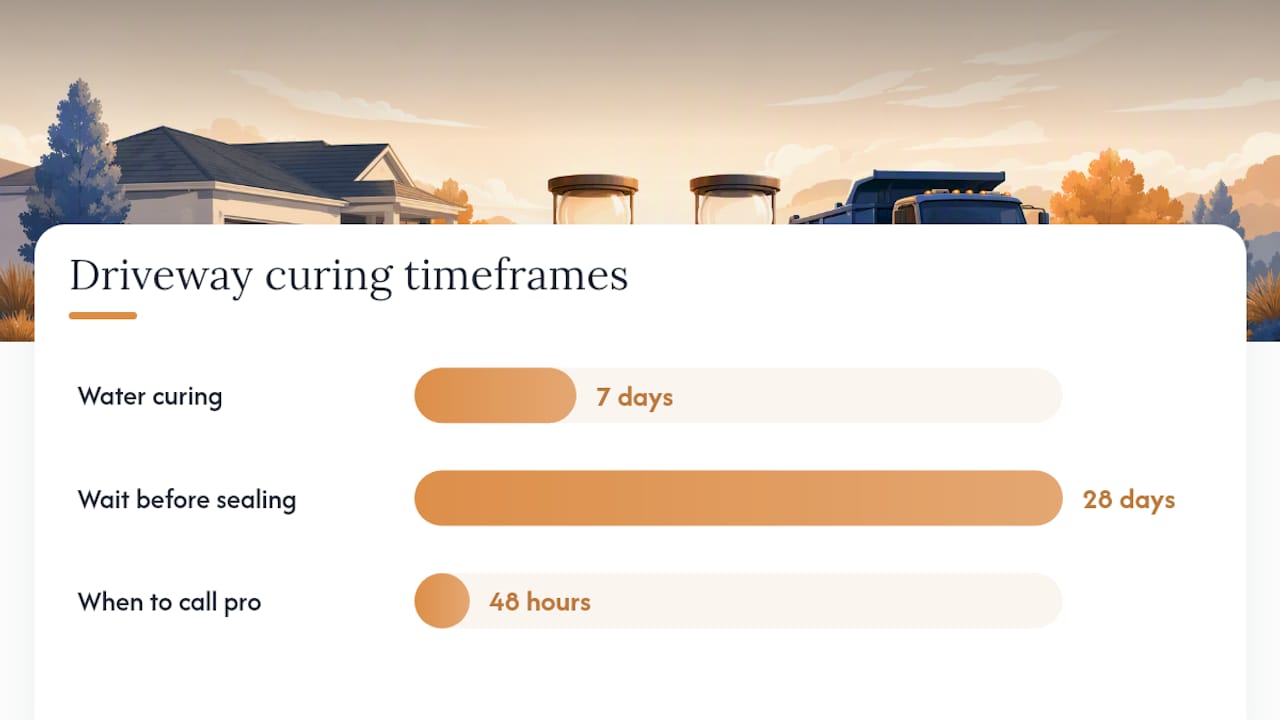
- Water curing. Lightly mist the surface with a garden hose two to four times a day for the first 7 days, especially in hot or dry weather. Don’t blast it with a pressure washer, just enough to keep the surface damp without pooling.
- Cure-and-seal compounds. A sprayed-on membrane locks moisture in without the daily hose routine. These are typically applied within hours of finishing, and if a separate decorative sealer is planned later, most manufacturers recommend waiting the full 28 days so the sealer doesn’t trap uncured moisture underneath.
- Cold-weather protection. Insulated curing blankets and, on larger commercial pours, temporary heaters keep the slab above that 50°F threshold. Wet weather concreting procedures matter just as much here, since rain and cold often show up together.
- When to call a pro. If you’re staring at cracked forms, standing water, or a freeze warning within 48 hours of a pour, that’s not a DIY judgment call anymore.
Pro Tip: If you’re applying a sealer, check the label for “cure time before sealing,” not just “dry time.” Sealing too early is one of the most common mistakes homeowners make on a brand-new driveway; for detailed guidance on timing and sealing, see our pool curing time: what homeowners need to know resource.
If you’re planning the pour itself and want the mix and thickness matched to how you’ll actually use the driveway, our residential driveway concrete specification guide breaks down what to ask for before the truck shows up.
What Happens If You Drive on Concrete Too Soon?
The damage from early loading isn’t cosmetic. It’s structural, and it’s usually permanent.
- Edge and corner failures. Edges cure slower than the main slab body and can take up to 30 days to reach comparable durability, which is exactly why tire contact near the perimeter is the most common failure point.
- Internal cracking. A crack you can’t see is worse than one you can. Loading a slab before it’s ready can cause internal cracking that doesn’t show up until months later, and by then it’s a structural issue, not a cosmetic one.
- Permanent depressions. A tire that sits in one spot on a still-curing slab can leave a shallow but permanent low point.
- Sealer imprints. Sealing too early, before the slab has fully cured, can trap moisture and cause discoloration or a hazy finish that no amount of reapplication fixes.
The frustrating part is that repair rarely means a patch job. Internal cracking and edge failure from early loading typically mean cutting out and replacing the damaged section, which costs more than the week or two of patience would have.
How Do You Know Your Driveway Is Ready?
Skip the guesswork with a five-minute check before you drive on it for the first time.
- Look for uniform color. Dark, damp patches mean the slab hasn’t fully cured yet, even if the calendar says it should be ready.
- Check for soft spots. Press a thumb or a small tool into an inconspicuous corner. It should feel like stone, not like firm clay.
- Tap-test the edges. A hollow or dull sound near joints and corners can signal the perimeter isn’t matching the main slab’s strength.
- Review your temperature log. No freeze events in the first 7 days, and consistent conditions above 50°F, are a good sign the schedule tracked normally.
- Ask for a strength test if unsure. A field-cured cylinder break test can confirm actual PSI, which matters most before heavy loads.
Roughly 65 to 70% of design strength arrives by day 7, which is the number behind the standard one-week rule for cars. If your slab hasn’t hit that visually and physically, give it more time.
How Contractors Handle Concrete Curing on the Job
Professional crews treat curing as part of the install, not an afterthought once the truck leaves.
Documenting the pour date, weather conditions, and curing method isn’t paperwork for its own sake. It’s the record that protects a warranty claim if a client drives on the slab early or a freeze event hits during the first week.
Contractors sequence the job around the cure, not the calendar. That means protecting fresh concrete from foot traffic with barricades, controlling evaporation on hot days with retardant sprays, and switching to insulated blankets the moment overnight temperatures threaten to dip near freezing.
Pro Tip: Ask your contractor what curing method they used and when it was applied. A clear answer, with dates, is a good sign you’re dealing with a crew that treats curing as seriously as the pour itself.
If you’re not sure whether your driveway is ready for regular use, or you’re planning a new one and want the thickness and mix matched to your vehicles from day one, VW Concreting’s driveway and slab work is built around getting that specification right the first time. You can also browse recent driveway and concreting projects to see how sequencing and curing show up in finished work.
A Contractor’s Take on Concrete Curing Time
Here’s the rule I’d want a friend to remember: a week for cars, a month for anything heavy. Everything else is detail. If the weather turned cold, if you’re not sure about a soft spot, or if a heavy delivery is coming, call a professional before you gamble a few weeks of patience against a full slab replacement.
— Vic
Sources
- How Long Before You Can Drive on Concrete? – ConcreteNetwork
- When Can You Drive on Concrete? (2026 Complete Guide) – ConcreteCalculate
- How Long Before You Can Drive on Concrete? – Angi
Leave A Comment