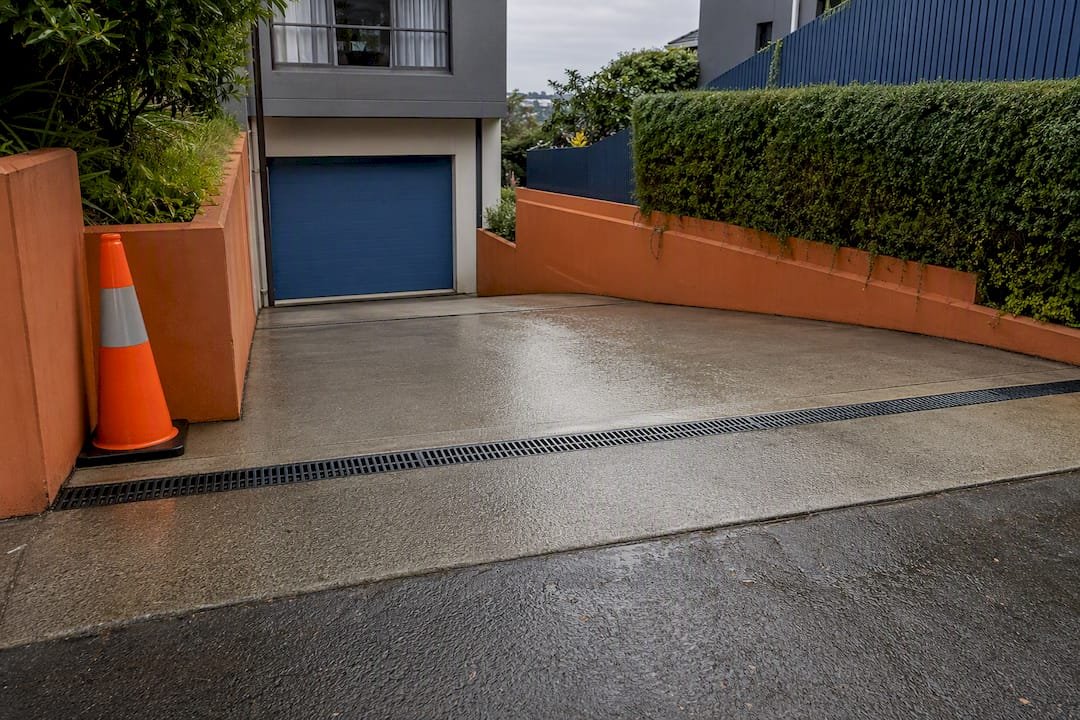
For most Melbourne homeowners, the fastest reliable fix for a slippery or bottoming-out sloping driveway is resurfacing with a high-grip finish, paired with proper drainage and a transition zone at the base. For genuinely steep grades, further measures like regrading, curving the path, or redesigning the layout are necessary. You’re looking at regrading, curving the path, or redesigning the layout entirely, and that means bringing in an experienced concreting contractor before you pour a single bag of cement.
TL;DR:
- Proper surface texture, drainage, and geometric corrections are essential for long-term steep driveway safety and traction in Melbourne’s climate.
- Materials like exposed aggregate concrete provide durability and wet-weather grip, while asphalt and loose paving struggle on steep grades.
- Accurate grade measurement and transition zones are critical at grade changes exceeding 1 in 8, requiring professional assessment and proper planning.
- Council approval is usually needed for changes involving the kerb or street edge, especially if grade alterations could cause runoff issues.
- A contractor experienced in inclined driveways will itemize drainage, transition, and surface work separately to avoid hidden costs and ensure lasting results.
Table of Contents
- Sloping Driveway Solutions Melbourne Homeowners Should Try First
- Which Materials Handle Melbourne’s Slopes Best?
- How Steep Is Too Steep for a Driveway?
- Do You Need Council Approval for Driveway Work?
- How to Choose a Contractor for a Sloping Driveway
- A Melbourne Driveway That Went From Hazard to Handled
- What Does a Sloping Driveway Fix Actually Cost in Melbourne?
- Keeping a Sloping Driveway Safe Year After Year
- Melbourne-Specific Problems: Clay Soil, Heavy Rain, and Erosion
- Why Most Driveway Advice Skips the Hard Part
- How VW Concreting Handles Sloping Driveway Projects
- Sources
Sloping Driveway Solutions Melbourne Homeowners Should Try First
Not every steep driveway needs a full rebuild. Most problems fall into one of four categories, and fixing them in the right order saves money and stops you from redoing work twice.
- Fix the surface first. If your car slides or your feet lose grip in the rain, the surface texture is usually the culprit, not the slope itself. Exposed aggregate, broom-finished concrete, and textured overlays all add mechanical grip that plain trowelled concrete lacks. Anti-slip coatings can help on existing concrete that’s gone slick with age, though they wear faster than a proper textured pour.
- Fix the geometry next. If the underside of your car scrapes at the top or bottom of the drive, no amount of surface grip will help. That’s a shape problem. Flattening the entry point, adding a transition ramp, or curving the driveway to reduce the effective slope are the standard fixes here.
- Fix the drainage. Water running down a sloped driveway during a downpour doesn’t just annoy you, it erodes the base beneath the concrete and turns the surface into a hazard within a season or two.
- Add the small stuff last. Wheel stops, grit strips near the garage entry, and a handrail beside pedestrian paths round out a driveway that’s already structurally sound.
Here’s how the fixes stack up in practice:
- Exposed aggregate resurfacing: moderate disruption (usually a few days), strong wet-weather grip, mid-range cost.
- Transition ramp or regrade: more disruption (partial demolition likely), fixes scraping permanently, higher cost.
- Channel drains and cross-fall correction: low to moderate disruption, protects the base long-term, moderate cost.
- Wheel stops and grit strips: minimal disruption, cheap, addresses only minor traction issues.
Drainage integration alongside surface and geometry work delivers the biggest overall safety gain, according to a checklist of practical steep driveway fixes that pairs traction improvements with erosion control rather than treating them as separate problems. Loose gravel might look like the cheapest option, but it migrates downhill under braking and rain within a year or two on anything steeper than a gentle slope, which is why most concreters steer clients away from it for long runs.
Pro Tip: Before you commit to a full resurface, hose down your existing driveway on a dry day and walk it in regular shoes. If you slip on dry concrete, the problem is the surface, not the slope. Save the regrade budget for a genuine geometry issue.
Which Materials Handle Melbourne’s Slopes Best?
Concrete wins on steep residential driveways, and it’s not close. The reason is control: a concreter can dial in surface texture, cross-fall, and thickness to match your exact gradient, something asphalt and loose paving can’t match on a tight urban block.
- Exposed aggregate and broom-finished concrete give the best combination of wet-weather grip and durability, and they hold that texture for decades if sealed correctly.
- Asphalt works fine on gentle slopes but struggles on steeper runs. Compacting hot mix evenly on a pronounced grade is difficult, and asphalt softens in Melbourne’s summer heat, which can make a steep surface feel greasy underfoot in January.
- Pavers offer good grip when installed correctly, but they rely entirely on a solid base and edge restraints. Skip either one and pavers creep downhill over a few wet winters, opening gaps that trap water and accelerate the problem they were meant to solve.
- Loose gravel or scoria should be avoided on anything beyond a mild slope. It looks rustic for about one season before it washes into the gutter.
One detail catches almost every homeowner off guard: sealing your driveway can make it more slippery, not less. A glossy sealer improves the look and protects against staining, but it also fills the surface texture that was giving you grip in the first place. If your contractor recommends a sealer for a sloped driveway, ask specifically for a slip-resistant or matte finish rated for outdoor foot and vehicle traffic. Combining textured or high-grip concrete with proper drainage integration is the baseline most steep-slope specifications now call for, and it’s worth checking that your quote actually reflects that pairing rather than surface work alone. VW Concreting’s exposed aggregate driveway work is built around exactly this combination for Melbourne’s climate.
How Steep Is Too Steep for a Driveway?
Slope gets measured as a percentage: rise divided by run, multiplied by 100. A driveway that climbs 1 meter over a 10-meter run is a 10% grade. Most residential driveways in Melbourne have moderate slopes, and gradients beyond typical residential ranges start raising real red flags for scraping, water runoff, and loss of traction in wet weather.
- Measure before you plan. Use a level and a tape measure, or ask your contractor to run a proper grade survey, especially near the street where councils pay closest attention.
- Add a transition zone wherever the grade changes sharply. Engineering guidance under AS 2890.1 compliance standards calls for a transition section, commonly around 2 meters long, wherever the change in grade exceeds roughly 1-in-8. Skip this and you’ll hear it every time a sedan’s bumper meets the driveway.
- Consider curving the driveway instead of running it straight up the block. A curved or angled path covers more horizontal distance for the same rise, lowering the effective grade and making the driveway more manageable for vehicles.
- Run a swept-path check if you own or expect larger vehicles. Utes, vans, and trailers need a wider turning and clearance allowance than a standard passenger swept path, and this becomes critical on longer driveways serving commercial or multi-vehicle properties.
Pro Tip: If your existing driveway scrapes every vehicle that uses it, don’t just add a ramp at the bottom. Have someone assess the whole grade profile first. A ramp fixes one bad angle; it won’t fix a driveway that’s too steep across its entire length.
Once your grade change exceeds those thresholds, or the work touches the street edge, you’re no longer in DIY territory. That’s when a proper grade assessment earns its cost many times over in avoided rework.
Do You Need Council Approval for Driveway Work?
Almost any work that touches the vehicle crossing, the kerb, or the public footpath needs council sign-off in Melbourne, and this catches more homeowners off guard than any other part of a driveway project. City of Melbourne’s vehicle crossing guidance is explicit that permission is required before altering a crossover, and it specifically flags steep angles and scraping as common driveway defects councils look for.
Before calling anyone, run through this quick check yourself:
- Measure the grade right at the property line. This is where councils look hardest.
- Walk the driveway after rain and note where water pools or runs toward a neighbor’s property.
- Check whether your existing crossover has visible scrape marks, cracking, or subsidence at the edges.
- Confirm with your local council whether your street has specific crossover width or gradient rules before you get a quote.
Runoff that drains onto a neighboring property is a genuine liability issue, not just a courtesy problem, and it’s one of the fastest ways a driveway dispute ends up in front of a building surveyor. If your project changes grade significantly near the kerb, that’s the trigger point for needing a crossover permit. Pause any DIY attempt at that stage and get documentation in place first.
How to Choose a Contractor for a Sloping Driveway
The gap between a good driveway and a bad one usually isn’t the concrete mix. It’s whether the contractor actually understood the slope before they quoted the job.
- Ask directly for photos or references from projects with a similar gradient to yours, not just a general portfolio.
- Request proof of insurance and a written guarantee covering both the surface finish and the structural base.
- Make sure the quote itemizes drainage work, transition zones, and materials separately, not lumped into one number.
- Ask whether they’ll handle council liaison for crossover or kerb changes, or whether that’s left to you.
- Treat a quote that’s dramatically lower than others, with no line-item breakdown, as a warning sign rather than a bargain.
A contractor who hesitates when you ask how they’ll handle the grade change, or who can’t point to a comparable job, probably hasn’t solved this problem enough times to get it right on the first attempt. Documented swept-path and transition calculations aren’t paperwork for its own sake. They’re what stops council from sending your application back with questions, which can add weeks to a project timeline.
Pro Tip: Ask every quoting contractor the same question: “What’s your plan for the transition at the bottom of this slope?” The ones who answer with a specific measurement have done this before. The ones who say “we’ll figure it out on site” usually haven’t.
VW Concreting’s guide to hiring an exposed aggregate contractor walks through the same checklist in more detail if you want to compare quotes side by side.
A Melbourne Driveway That Went From Hazard to Handled
One recent VW Concreting job involved a steep suburban driveway where the owners were scraping their car’s bumper on every visit and watching water sheet straight into the garage during heavy rain. The diagnosis was straightforward once we walked the site: a grade change that was too abrupt at the base, no cross-fall to move water away, and a worn surface offering almost no grip in wet weather.
The fix combined three things: exposed aggregate resurfacing for grip, a channel drain across the base to intercept runoff before it reached the garage, and a graded transition ramp to eliminate the scraping entirely. The whole job ran over about a week, most of it curing time rather than active work. The homeowners got a driveway that handles Melbourne’s wet winters without pooling and a bumper that no longer takes a hit every time they pull in.
The takeaway for anyone scoping a similar project: diagnose grade, drainage, and surface as three separate problems before you accept a quote that treats them as one.
What Does a Sloping Driveway Fix Actually Cost in Melbourne?
Budgeting for a sloped driveway project comes down to three cost drivers: how much demolition is involved, how much drainage work you need, and whether the grade requires an engineered transition.
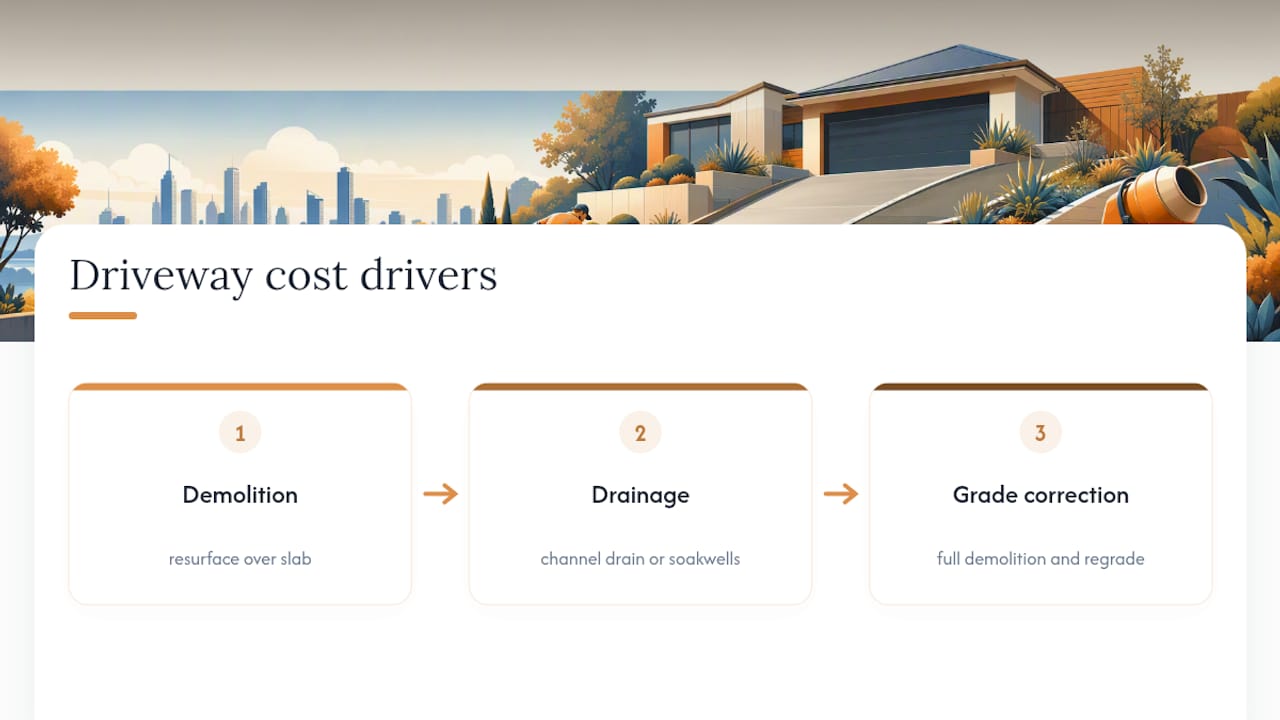
A straightforward resurface over an existing slab that’s structurally sound is the cheapest path, since you’re paying for surface preparation and a new finish rather than removal. Adding exposed aggregate or a textured broom finish costs more than plain concrete per square meter, but it’s the difference that actually solves the grip problem, so it’s rarely worth skipping to save on the finish.
Drainage work adds to the budget in proportion to how much water your site sheds. A single channel drain across a driveway base is a modest addition to a resurfacing job. A full cross-fall correction with soakwells, needed when your existing drive has no fall at all, costs more because it usually means breaking out and repouring sections rather than surfacing over them.
The biggest cost jump comes when the grade itself needs correcting. Full demolition, regrading the base, and repouring with a proper transition zone is a different scale of project than a resurface, and it’s the one area where getting a firm, itemized quote matters most. Ask your contractor to break out demolition, base preparation, drainage, and finish as separate line items so you can see exactly where your budget is going, and compare that against VW Concreting’s own site preparation guidance for what proper base work should include.
Keeping a Sloping Driveway Safe Year After Year
A sloped driveway works harder than a flat one every time it rains, which means it needs a maintenance routine that a flat driveway can mostly skip.
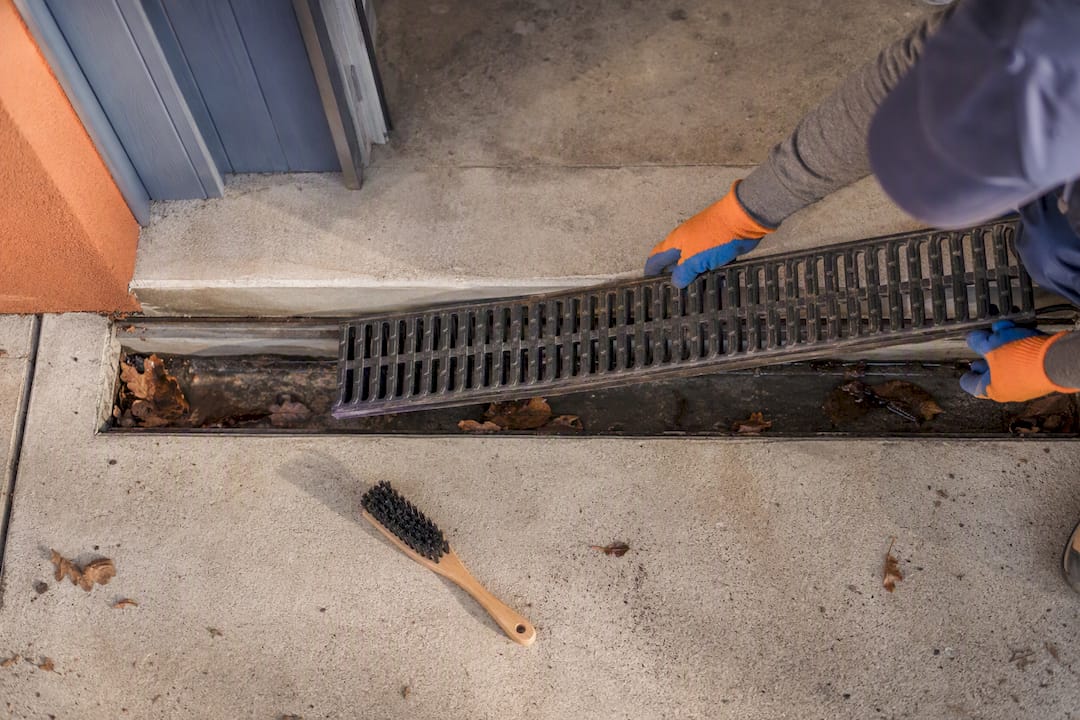
Clear channel drains and grates at least twice a year, ideally before Melbourne’s wetter months hit in autumn and again in spring. Leaf litter and dirt build up fast at the base of a slope, and a blocked drain sends water exactly where you don’t want it, pooling at the garage door or worse, undermining the base beneath the slab.
Check exposed aggregate or textured surfaces for wear where tires travel most, usually a pair of tracks running up the center of the drive. Traction wears unevenly on a slope because braking and acceleration forces concentrate there, and a resealed section that’s lost its texture becomes a slip risk faster than you’d expect.
Watch for hairline cracks near the base of the slope where water collects. Cracks that let water into the base layer are far more damaging on a sloped driveway than a flat one, since gravity pulls that water sideways under the slab rather than letting it sit and evaporate. Catching a crack early and resealing it is a fraction of the cost of repairing a washed-out base later. If your driveway is due for attention already, VW Concreting’s resurfacing guide covers what to check before deciding between a patch job and a full resurface.
Melbourne-Specific Problems: Clay Soil, Heavy Rain, and Erosion
Melbourne’s clay soils are the quiet reason a lot of sloped driveways fail years before they should. Clay expands when it’s saturated and contracts hard when it dries out, and on a slope, that movement isn’t uniform. The uphill and downhill ends of your driveway can shift at different rates, which is exactly how you end up with a crack running diagonally across an otherwise solid slab.
Heavy rain events compound the problem because a sloped driveway concentrates water flow instead of spreading it evenly, the way a flat surface does. Without a channel drain or proper cross-fall, that water finds the lowest point on your property, often the garage floor, and erodes any exposed soil along the edges of the driveway as it goes.
Erosion at the edges is a specific Melbourne headache on properties with any kind of retaining or garden bed beside the driveway. Water that isn’t captured by a drain will find the gap between concrete and garden edge and start washing soil out from underneath, which eventually undermines the slab edge itself. A retaining wall or edge restraint alongside a sloped driveway isn’t just landscaping. It’s erosion control, and it’s worth discussing with your concreter before pouring rather than after you notice the edge starting to slump. If your site has a pool or garden retaining structure nearby, this guide to retaining walls covers how those structures interact with drainage on a sloped block.
Why Most Driveway Advice Skips the Hard Part
Most guides on sloping driveways treat surface grip as the whole answer, and that’s where the conventional advice falls short. A grippy surface on a driveway that’s shedding water into your garage or scraping every car that enters hasn’t solved anything. It’s masked one symptom while the underlying grade and drainage problem keeps working against you.
What the research actually supports is treating this as three linked problems: surface, geometry, and drainage, tackled in that order of urgency but planned together from the start. Fixing traction without fixing water flow just buys you a nicer-looking surface that erodes at the edges within a few winters.
If you take one thing from this guide, prioritize getting an honest grade measurement before you spend a dollar on finish. A contractor who checks the actual percentage grade at your property line, not just eyeballs the slope, is doing the one thing that separates a driveway that lasts fifteen years from one that needs redoing at year five.
— Vic
How VW Concreting Handles Sloping Driveway Projects
VW Concreting has been solving exactly these problems since 2001, with more than 145 completed projects across Melbourne, many involving the same grade, drainage, and traction issues covered in this guide. Exposed aggregate resurfacing is one of the areas the team handles most often, precisely because it solves the wet-weather grip problem that plain concrete can’t.
A site visit starts with an honest grade assessment, not a sales pitch. You’ll get a written quote that itemizes drainage work, transition zones, and finish separately, plus council liaison handled directly if your project touches the crossover or kerb. That’s the same itemized approach covered earlier in this guide, applied to your actual property rather than a generic estimate.
If your driveway scrapes, pools water, or just feels unsafe when it rains, the next step is simple: request a site visit through the Driveways & Slabs project page and get a proper assessment before you spend money on a fix that only solves part of the problem.
Sources
- Driveway Design for Steep Slopes: Engineering for AS 2890.1 Compliance | ML Traffic Engineers
- Vehicle crossings (driveways and crossovers) | City of Melbourne
- Steep Driveway Solution & Driveway Gradient Calculator | NK
- 9 Smart Steep Driveway Solutions for Your Home
Leave A Comment