Industrial epoxy flooring in Melbourne typically installs for A$32 to A$190 per square meter, with most facility jobs landing between A$55 and A$150/m². The single biggest lever on that price is the state of your existing concrete slab and how much surface preparation it needs. Expect quotes to climb past the top end when there’s active moisture rising through the slab, heavy forklift traffic to plan for, or coving required along the walls.
TL;DR:
- Costs vary widely depending on surface preparation, moisture mitigation, and existing floor condition, with prices often exceeding A$95 per square meter for high-end systems handling heavy use.
- Proper site inspection should include moisture testing, crack repairs, and clear scope of prep work, which are often separately itemized to avoid unexpected costs.
- Budget differences between contractors mainly reflect the quality of prep, material specifications, and warranty coverage; lower quotes may omit crucial preparation steps.
- Melbourne’s climate necessitates careful planning for moisture control and temperature stability to ensure epoxy durability and longevity.
- Investing in thorough testing and quality systems typically results in lower lifecycle costs, as cheaper installations tend to fail within a few years, requiring costly re-coats or replacements.
Table of Contents
- Installed Price Bands Explained: What Each Level Actually Buys You
- What Actually Moves the Price: Prep, Moisture, Repairs, and Access
- Worked Examples: What Real Melbourne Jobs Cost
- Choosing the Right System for Your Facility
- How to Get a Quote You Can Actually Trust
- Why Trust This Guidance
- Maintenance and Lifecycle Costs of Industrial Epoxy Flooring
- Cost Differences for Various Melbourne Suppliers and Contractors
- Common Warranties or Guarantees Affecting Cost
- Impact of Melbourne’s Climate on Epoxy Cost and Performance
- The Real Lesson Buried in the Numbers
- Get an Accurate Epoxy Quote from a Melbourne Concreting Team
- Sources
Installed Price Bands Explained: What Each Level Actually Buys You
Not all “industrial epoxy” quotes are comparing the same job. A$35/m² price and a A$140/m² price on the same floor plan can represent two entirely different systems, and understanding what sits inside each band saves you from a costly mismatch six months into using the space.
At the low end, roughly A$30 to A$55 per square meter (about $2 to $3.60 per square foot in U.S. terms), you’re generally looking at a thin primer-and-seal system, or a basic epoxy coat applied over minimal grinding. It looks fine on day one. It’s not built for pallet jacks, chemical spills, or constant rolling traffic, and it tends to wear thin in high-traffic lanes within a couple of years.
The mid band, A$55 to A$95 per square meter ($3.60 to $6.15/sq ft), is where most genuine industrial jobs sit. This usually includes proper diamond grinding of the slab, a build coat of epoxy at real thickness, and a polyurethane or epoxy topcoat for abrasion resistance. It’s the sweet spot for warehouses, workshops, and busy garages that see daily vehicle or equipment movement.
At the high end, A$95 to A$150+ per square meter ($6.15 to $9.75+/sq ft), you’re paying for 100% solids high-build epoxy, often paired with a broadcast flake layer for slip resistance and a chemical-resistant polyurethane topcoat. Melbourne installers commonly price full systems in this range when the floor needs to handle forklifts, oils, acids, or constant washdown. This tier also tends to include coving, control joint detailing, and line marking as standard inclusions rather than add-ons.
What changes the unit price within any band:
- Area size. A 500 m² warehouse floor costs less per square meter than a 40 m² garage, because setup, equipment mobilization, and material wastage get spread across more floor space.
- Access. Ground-floor slabs with a roller door get a straightforward quote. Upper-level floors, tight loading docks, or spaces packed with fixed machinery add labor time that shows up in the price.
- System complexity. A single-coat epoxy takes a fraction of the labor of a multi-coat build with flake broadcast and a topcoat.
- Existing coating. Bare concrete is cheaper to prep than a slab with old, failing epoxy that has to be stripped first.
Timelines scale with the band too. A basic low-prep coat might be walkable in a day and back in light service within 48 hours.
What Actually Moves the Price: Prep, Moisture, Repairs, and Access
Substrate preparation and site conditions do more to move your final number than the epoxy product itself. A cheap resin applied over a poorly prepped slab fails fast. A quality resin applied properly holds up for a decade or more. Here’s where the money actually goes:
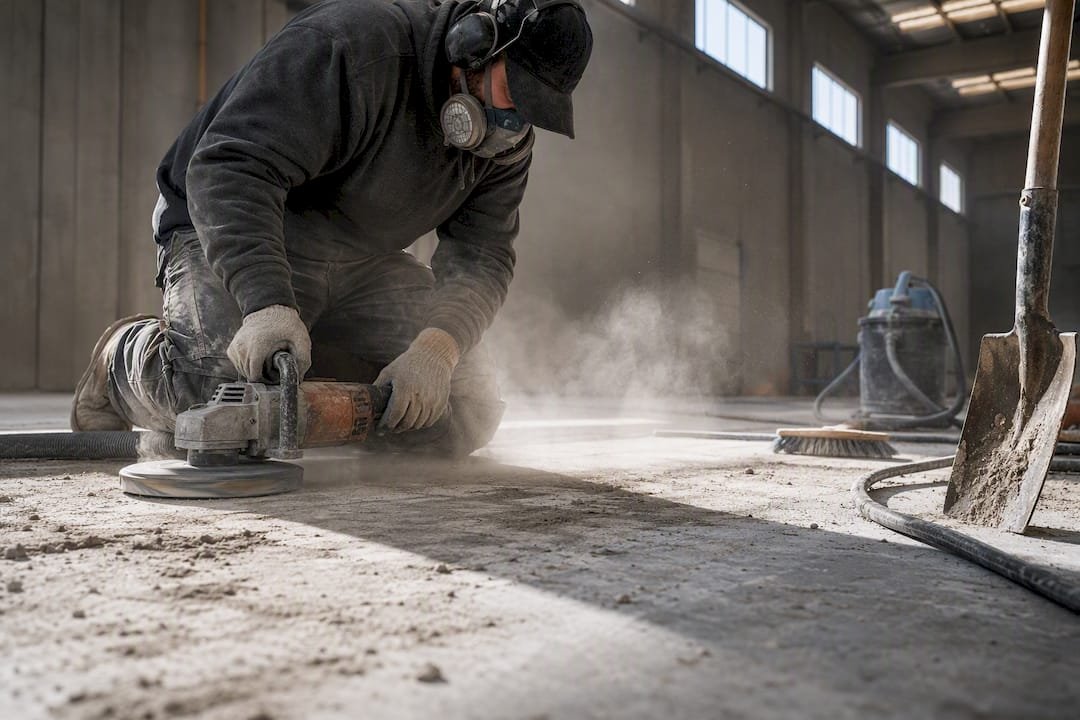
- Mechanical grinding or shot-blasting. This opens the concrete pore structure so the epoxy actually bonds instead of sitting on top and peeling later. Expect grinding to add roughly A$8 to A$20 per square meter depending on slab hardness and whether old coatings need to come off first.
- Moisture testing and mitigation. Concrete slab moisture is the number one cause of epoxy delamination in Melbourne’s older industrial buildings, especially slabs poured directly on ground with no vapor barrier. In-situ relative humidity or calcium chloride testing is standard before quoting, and if moisture is high, a vapor mitigation coat can add roughly A$12 to A$25 per square meter.
- Crack and spall repair. Installers usually price these per defect for isolated damage, or as a lump-sum allowance if the slab has widespread cracking. A slab riddled with joints and spalling from years of forklift traffic needs more repair time than one that’s simply dusty.
- Access, staging, and traffic management. Operating floors, tight loading bays, or jobs that require after-hours or weekend work to avoid shutting down a business add labor cost that a simple per-square-meter rate won’t reflect.
- Compliance items. Slip rating requirements under AS 4586 and required line marking for pedestrian routes, forklift lanes, or safety zones are often quoted as separate scope items that can add thousands on a larger commercial floor.
Pro Tip: Ask any installer specifically whether their per-square-meter quote already includes grinding and moisture testing, or whether those are separate line items. A quote that looks 20% cheaper than the next one is often just missing prep costs that show up later as a variation.
Worked Examples: What Real Melbourne Jobs Cost
Numbers land differently once you attach them to a space you can picture. Here’s how the bands translate into actual budgets for common areas, based on typical Melbourne installer pricing.
- Double garage (~36 m² / 388 sq ft): Low-prep coat runs roughly A$1,600 to A$2,000. A full high-build system with flake and PU topcoat runs several thousand Australian dollars. The cheap coat may need recoating within a few years under vehicle traffic; the high-build system commonly lasts 10 to 15 years or more in a garage setting.
- 12×12 foot room (~13.4 m² / 144 sq ft): Small jobs carry higher overhead per square meter because setup time doesn’t shrink with the area. Expect roughly A$700 to A$1,000 for basic coating, or A$1,400 to A$2,000 for a premium system.
- 20×20 foot space (~37.2 m² / 400 sq ft): Similar footprint to the double garage example, roughly A$1,650 to A$2,100 low-prep, or A$3,300 to A$5,600 for a full industrial-grade build.
- 1,000 sq ft warehouse bay (~92.9 m²): Low-prep coating sits around a few thousand Australian dollars. A proper 100% solids system with moisture mitigation and line marking can run several thousand Australian dollars or more, depending on how much repair the slab needs going in.
The gap between low-prep and heavy-prep totals on the same footprint often looks steep on paper, but it’s rarely just markup. It reflects real hours of grinding, testing, and material thickness that determine whether you’re recoating in three years or not touching the floor again for over a decade.
Choosing the Right System for Your Facility
Price should follow function, not the other way around. Specifying the cheapest coating that “looks like epoxy” on a floor that sees daily forklift traffic is one of the most common expensive mistakes facility managers make, and it’s avoidable once you understand what each system category is actually built for.
- Light-duty epoxy suits low-traffic storage areas, small offices attached to a warehouse, or display floors that see foot traffic only. It’s the cheapest option and the least forgiving of heavy use.
- 100% solids high-build epoxy is the standard choice for forklift traffic and general warehouse operations. It builds real film thickness, resists abrasion, and handles point loads from racking and pallet jacks far better than thin epoxy coats.
- Polyurethane (PU) systems come into play where hygiene matters most, food processing, cool rooms, healthcare, or anywhere with regular steam cleaning or chemical washdown. PU handles thermal shock and chemical exposure better than standard epoxy.
- Polyaspartic coatings cure fast, often within a day, which matters when a business can’t afford extended downtime.
- Decorative flake systems add slip resistance and hide minor surface imperfections, useful in showrooms, retail-adjacent warehouse space, or anywhere appearance matters alongside durability.
Coving, where the floor coating curves up the wall base instead of meeting it at a hard edge, adds cost but is often required in food handling or wash-down areas for hygiene compliance. Higher slip ratings under AS 4586 add cost through additional aggregate broadcast, and chemical-resistant topcoats cost more than standard PU because the resin chemistry is more specialized.
The lifespan gap is the real number that matters here. Professionally installed, high-build industrial coatings typically last 10 to 20-plus years, while budget installs commonly fail within just 3 to 5 years. Once you factor in the cost of stripping a failed coating and starting over, a A$60/m² professional system frequently ends up cheaper over a 15-year window than three rounds of a A$35/m² coating that keeps failing.
How to Get a Quote You Can Actually Trust
A good quote starts with someone actually looking at your floor, not a price given over the phone based on square footage alone. Here’s what to insist on before you sign anything.
What a proper site inspection covers:
- A moisture test on the slab, either relative humidity probes or calcium chloride testing, particularly if the building is older or ground-level.
- Photos and notes documenting existing cracks, spalling, or previous coating condition.
- A recommended prep method, grinding or shot-blasting, based on what that specific slab needs.
- Confirmation of expected foot and vehicle traffic so the system spec matches actual use.
Questions worth asking every installer you compare:
- What’s the solids content of the epoxy system, and is it 100% solids or a diluted formulation?
- What warranty is offered, and does it cover delamination as well as surface wear?
- How long until the floor can take light foot traffic, and how long until full vehicle or forklift use?
- What’s explicitly included and excluded, grinding, moisture mitigation, coving, line marking?
- Are there any traffic restrictions during cure, and does that affect your operating schedule?
A trustworthy quote is itemized: materials and prep should appear as separate line items so you can see exactly what you’re paying for. Watch for red flags like a blanket per-square-meter price with no site visit, no mention of prep at all, or a number that seems too good to be true against three other quotes, which almost always means moisture testing or grinding got left out and will show up later as a variation.
Pro Tip: If a quote doesn’t mention moisture testing at all, ask why. Skipping it is the single most common reason epoxy floors bubble or peel within the first year, and it’s cheap insurance against a much bigger repair bill later.
Why Trust This Guidance
VW Concreting has worked on Melbourne concrete and outdoor construction projects since 2001, completing more than 145 projects across driveways, slabs, and garage epoxy installations. Our approach to epoxy work is grounded in the same principle running through this whole guide: the slab underneath decides how the job performs.
Melbourne slabs, particularly older ones in the western and northern suburbs, commonly show up with rising damp, hairline cracking from ground movement, or previous coatings that were never properly keyed into the concrete. We grind these back and moisture-test before we ever touch a roller. .
Maintenance and Lifecycle Costs of Industrial Epoxy Flooring
A properly installed epoxy floor is close to maintenance-free day to day, sweep and occasional mop, but lifecycle cost still depends on how it’s treated over the years. Sharp metal debris, dragged pallets, and harsh solvent spills all shorten the working life of even a high-build system.
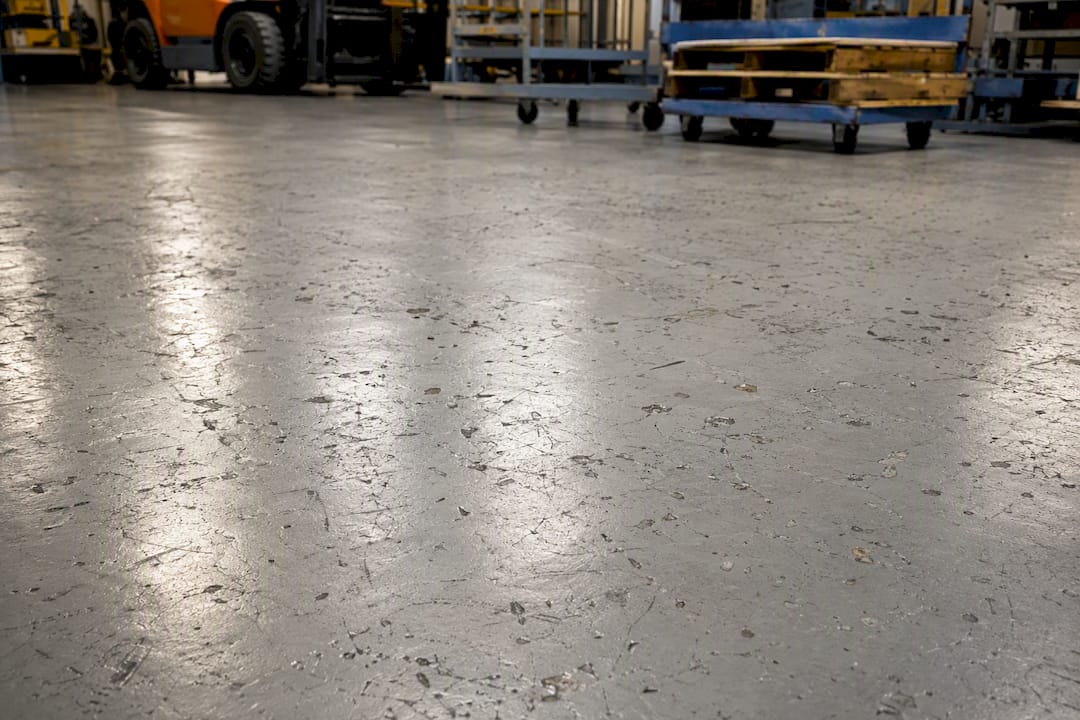
Recoating a topcoat, rather than the full system, every 5 to 8 years in the highest-traffic lanes (forklift paths, loading dock aprons) keeps the underlying epoxy protected without the cost of a full strip and reinstall. Budget a modest annual allowance for spot repairs rather than waiting for a large failure. Facilities that skip this and let minor chips or gouges sit tend to see moisture and grit work into the substrate, which turns a A$200 spot repair into a A$4,000 section replacement down the track.
The real lifecycle math favors spending more upfront. A high-build system at the top of the price band, maintained with light annual attention, commonly outlasts two or three cycles of a cheap coating, each of which requires full removal before recoating. Removal alone, grinding out failed epoxy, often costs nearly as much as the original low-budget install.
Cost Differences for Various Melbourne Suppliers and Contractors
Price spreads between Melbourne epoxy contractors usually come down to three things: the system they specify by default, how thorough their prep process is, and whether they carry proper insurance and warranty backing.
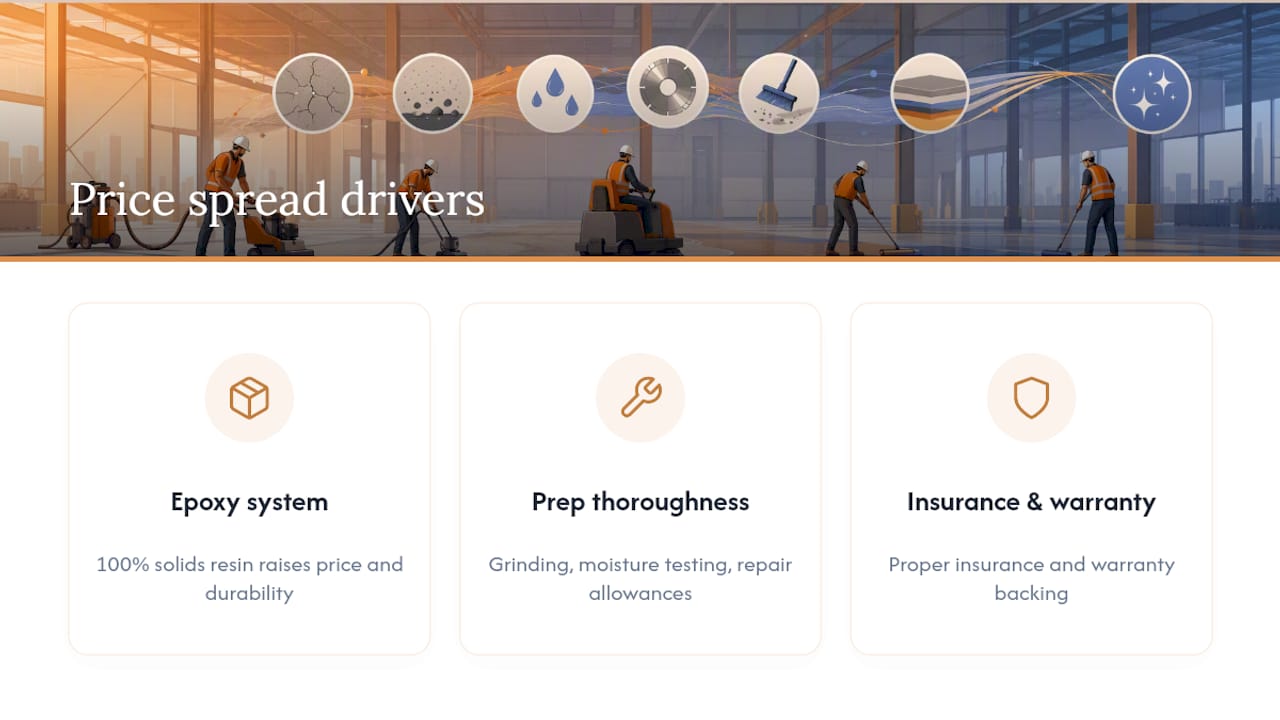
Some contractors default to a thinner, cheaper epoxy system regardless of the space’s actual use, which produces quotes at the bottom of the market range but a floor that underperforms for forklift or heavy equipment traffic. Others build their pricing around a proper prep process, grinding, moisture testing, repair allowances, as standard, which puts their base quote higher but avoids expensive surprises mid-job.
Suppliers who source 100% solids resin systems from established manufacturers tend to sit in the mid-to-upper price bands, but that reflects genuine material cost, solids content directly affects both price and durability. A supplier quoting well under the mid-band for a stated 100% solids system is worth questioning closely.
Local experience matters more in this trade than it gets credit for. A contractor who’s worked on dozens of Melbourne slabs knows which suburbs commonly have moisture issues, which building eras used slab designs prone to cracking, and how to price for that reality upfront rather than discovering it mid-install and issuing a variation.
Common Warranties or Guarantees Affecting Cost
Warranty terms vary more than most buyers expect, and they’re a legitimate reason two quotes at similar price points can represent very different value.
A basic warranty might cover material defects only, typically one to two years, and exclude any failure related to substrate moisture or movement. A stronger warranty from an established installer often extends coverage to workmanship and can run five years or longer on the topcoat, sometimes longer on the structural epoxy build coat itself.
The gap in warranty terms usually tracks the gap in preparation quality. An installer confident enough in their grinding and moisture testing process to offer a longer warranty has typically priced that prep work into the quote from the start. A rock-bottom quote with a short or vague warranty is often a sign that prep corners got cut, and the risk of early failure has simply been shifted onto you.
Always get warranty terms in writing before the job starts, not as a verbal assurance. Ask specifically whether the warranty covers delamination (the coating lifting from the slab), which is the most common and most expensive failure mode, rather than just surface wear or discoloration.
Impact of Melbourne’s Climate on Epoxy Cost and Performance
Melbourne’s weather swings, hot dry summers followed by wet winters, affect both installation cost and how a floor performs over its life. Epoxy needs a stable temperature and low humidity to cure properly, which means installers often plan around weather windows, particularly for jobs on unenclosed or semi-outdoor industrial spaces like loading docks.
Humidity is the bigger issue for existing slabs. Melbourne’s clay-heavy soils in many suburbs hold and release moisture seasonally, which is exactly why moisture testing before installation matters so much locally, a slab that tests dry in February can behave very differently after a wet winter if there’s no vapor barrier underneath. This is part of why moisture mitigation coatings are such a common line item in Melbourne quotes compared to drier inland regions.
Temperature swings between day and night can also stress a coating over years, particularly in uninsulated warehouse buildings with metal roofing that amplifies heat. Systems with better flexibility and adhesion, generally the higher-build 100% solids and PU options, tolerate this expansion and contraction better than thin, budget epoxy coats, which is one more reason the cheapest system on paper isn’t always the cheapest option over a decade.
The Real Lesson Buried in the Numbers
The conventional advice on epoxy flooring cost treats it like a shopping decision: get three quotes, pick the middle one, done. That approach breaks down here because the price spread isn’t really about markup or negotiation room, it’s about how much of the actual work is hiding in the number.
What gets underestimated constantly is how much moisture and substrate condition dictate everything else. Two identical warehouse floors, one with a dry slab and one with a slow moisture problem, can need completely different systems and completely different budgets, and you can’t tell which one you have without testing.
If there’s one thing worth prioritizing above all else, it’s insisting on a genuine site inspection with moisture testing before you compare a single dollar figure. A quote without that step isn’t really a quote. It’s a guess wearing a price tag, and guesses are exactly what turn a A$60/m² floor into a A$60/m² floor you’re redoing in three years.
— Vic
Get an Accurate Epoxy Quote from a Melbourne Concreting Team
Com is the practical alternative to guessing your way through epoxy pricing, we’re a Melbourne concreting and outdoor construction team that’s spent over two decades reading slabs before we quote them. Since 2001, we’ve completed more than 145 local projects, and garage epoxy flooring is one of the services we handle regularly, alongside driveways, slabs, and the concrete work that so often needs attention before a coating goes down.
If your slab has cracks, old coating, or you’re just not sure what condition it’s really in, that’s exactly the kind of groundwork we sort out first, the same site preparation principles that apply to driveways and slabs apply directly to a floor going under epoxy. Explore our garage epoxy flooring service or browse recent project work around Melbourne, then get in touch for a proper site inspection and an itemized quote that actually reflects what your floor needs.
Sources
- Epoxy Flooring Installation Cost: A Melbourne Guide 2026 – Newline Painting
- Epoxy Flooring Services Melbourne Cost | Epoxy Flooring Price
- How to choose the right epoxy flooring for industrial facilities – Alpine Painting
- Industrial floor coatings: factors to consider before installation – Jaydee Inc.
Leave A Comment