

A concrete specification is the technical document that tells everyone on a project exactly what materials to use, how to mix and place the concrete, what curing protocols to follow, and how to test the finished work. Think of it as the project’s rulebook for concrete. Without one, “good concrete” means something different to every subcontractor on site.
Two fundamental types govern most US projects:
- Prescriptive specifications spell out exact materials, mix proportions, and methods. The owner controls the process but also carries more responsibility if the approach underperforms.
- Performance-based specifications define measurable end results, such as a minimum compressive strength at 28 days, and let the contractor choose how to get there. More contractor flexibility, but it demands a solid testing regime to verify compliance.
Specifications are legally distinct from drawings. Drawings show geometry and location; specifications govern materials, processes, and performance criteria. When the two conflict, specifications typically take precedence in contract disputes.
Most US concrete specifications follow the Construction Specifications Institute (CSI) MasterFormat, organized primarily under Division 03 for concrete-related work.

What standards govern concrete specifications in the United States?
Three organizations set the framework that virtually every US concrete specification references. Understanding how they interrelate saves time and reduces liability.
- American Concrete Institute (ACI): ACI publishes the standards most structural engineers cite by default. ACI SPEC-301 covers new concrete construction, while ACI 562 addresses repair and rehabilitation. ACI Committee 563 developed performance-based repair specifications specifically to support the ACI 562 Repair Code, published in 2013. Technical committees own the definitions, which keeps the language consistent across documents.
- ASTM International: ASTM standards govern material testing and product conformance. Bonding agents, for example, must conform to ASTM C881. Aggregate gradation follows ASTM C33/C33M. Compressive strength cylinders are tested per ASTM C39/C39M at 28 days. These test methods are the measurement backbone of any specification.
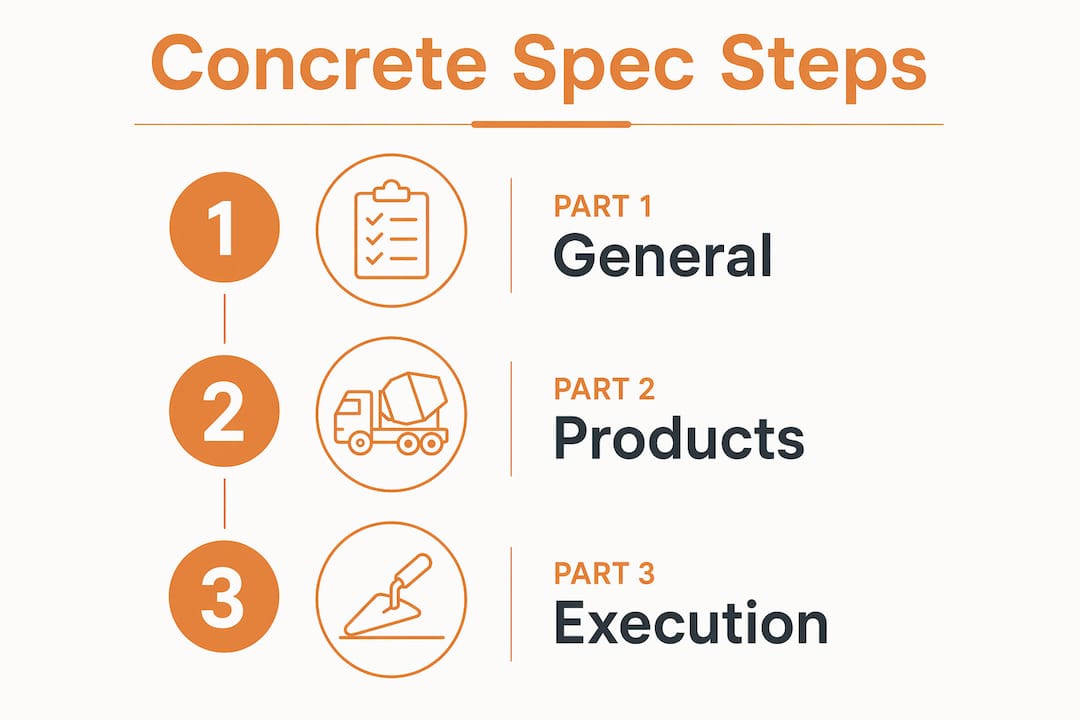
- Construction Specifications Institute (CSI) MasterFormat: CSI MasterFormat Division 03 organizes concrete work into subcategories, including section 03 01 30 for maintenance of concrete and 03 93 00 for concrete rehabilitation. Most project manuals follow this three-part format: Part 1 General, Part 2 Products, Part 3 Execution.
- ICRI (International Concrete Repair Institute): ICRI Committee 110 developed guide specifications for structural concrete repairs, first published in 2016. ICRI also defines Concrete Surface Profile (CSP) levels used to specify surface preparation requirements before repair or overlay work.
- NRMCA (National Ready Mixed Concrete Association): The NRMCA publishes guidance for design professionals writing ready-mixed concrete specifications, incorporating provisions from ACI CODE-318-25 and ACI SPEC-301-20.
These bodies do not operate in isolation. A single project specification might reference ACI 301 for mix design, ASTM C39 for strength testing, and CSI Division 03 for document organization, all at once.
Key components and types of concrete specifications
A well-structured concrete specification follows the CSI three-part format, and each part carries specific technical weight.
Part 1: General requirements covers scope, referenced standards, submittals, and quality assurance procedures. This is where the specification states which ACI or ASTM documents govern and what submittals the contractor must provide before work begins, including mix design documentation and source information for cementitious materials, aggregates, and admixtures.
Part 2: Products defines the concrete materials specification in detail. For packaged cementitious repair materials, for instance, a specified minimum compressive strength commonly used in industry guidance at 28 days is a commonly cited threshold. Aggregate must comply with ASTM C33/C33M. Bonding agents must meet ASTM C881. Every material gets a named standard or a measurable criterion.
Part 3: Execution covers surface preparation, placement, finishing, curing, and acceptance. ICRI CSP levels define how rough the substrate must be before an overlay or repair material is applied. Curing duration and method are stated explicitly, not left to the contractor’s discretion.
The distinction between prescriptive and performance approaches plays out most visibly in Part 2 and Part 3. A prescriptive specification might mandate a specific water-to-cementitious-materials ratio. A performance specification instead sets the required average compressive strength and lets the supplier document compliance through field test records, which under ACI 301 must span at least 45 days and cannot be more than 24 months old.
Pro Tip: When writing a repair specification, use the Division 03 subcategory structure from CSI MasterFormat to keep maintenance work (03 01 30) and rehabilitation work (03 93 00) in separate sections. Mixing them creates scope ambiguity that leads to change orders.
How concrete specifications support construction quality and risk management
The core function of a concrete specification is converting subjective expectations into objective, measurable standards. “Good bond strength” is an argument waiting to happen. A bond strength minimums defined as a measurable acceptance threshold for an overlay is a pass/fail criterion that both parties agreed to before work started.
ACI and ICRI guidelines treat the specification as the primary risk-management instrument on a project. A poorly written spec creates gaps that contractors fill with their own judgment, which may not align with the owner’s expectations. Gaps in curing requirements, for example, are a common source of surface cracking disputes that could have been avoided with a single sentence.
The choice between prescriptive and performance specifications is genuinely strategic. Prescriptive specs give owners tighter control over the process but shift more technical responsibility to the design team. Performance specs give contractors flexibility to propose cost-effective mixes, but the owner needs a robust testing and inspection program to verify results. Neither approach is universally better; the right choice depends on the owner’s risk tolerance and confidence in the contractor’s technical capacity.
Referencing established standards rather than rewriting requirements from scratch also reduces liability. ACI 563 for repair of concrete in buildings, for example, covers shoring, concrete removal, material compatibility, and acceptance criteria within a vetted legal framework. Citing it by reference is faster than drafting equivalent language and carries the authority of ACI’s technical committee process.
Consistent, plain language aligned with national standards is not a stylistic preference. Inconsistent terminology across a project manual creates compliance gaps and, in disputes, gives contractors room to argue that requirements were ambiguous.
Common challenges and best practices in writing concrete specifications
Writing a concrete specification that actually works in the field is harder than it looks. Here are the problems that come up most often, and what experienced specifiers do about them.
Copying old specs without updating references. Outdated ASTM or ACI edition numbers are one of the most common errors. Standards get revised; a specification that references a superseded version may require materials or test methods that no longer exist. Always verify that every cited standard is the current edition at the time of bid.
Mixing prescriptive and performance language inconsistently. Specifying both a maximum water-to-cementitious-materials ratio and a minimum compressive strength in the same section can create conflicts if the two requirements are not compatible for the proposed mix. Decide on your approach for each section and stay consistent.
Vague surface preparation requirements. Repair specifications that say “clean and prepare the substrate” without referencing ICRI CSP levels leave too much to interpretation. A parking garage repair and a bridge deck overlay need very different surface profiles. Name the required CSP level explicitly.
Omitting acceptance criteria. A specification that defines materials and methods but never states how the finished work will be evaluated is incomplete. Every execution section should include a measurable acceptance standard, whether that is a compressive strength result, a bond test value, or a visual standard referenced to a mockup.
Ignoring the contractor’s perspective. Specifications written without considering constructability create problems during bidding and construction. If a requirement is technically correct but physically difficult to achieve on a specific project, contractors will either price in a large contingency or submit RFIs that delay the schedule. Reviewing specs with an experienced contractor before bid release catches these issues early. For projects involving concrete removal as part of rehabilitation, vetting demolition contractors against the specification requirements before award is worth the time.
Pro Tip: Use the residential driveway specification guide as a practical reference when drafting specifications for smaller residential projects. It translates the same ACI and ASTM principles into plain language that homeowners and contractors can both follow.
Key Takeaways
A concrete specification is the binding technical document that converts quality expectations into measurable, enforceable standards for every concrete element on a project.
| Point | Details |
|---|---|
| Two core spec types | Prescriptive specs control the process; performance specs define measurable outcomes like compressive strength. |
| Governing US standards | ACI, ASTM, and CSI MasterFormat Division 03 form the interlocking framework most US specs reference. |
| Specifications outrank drawings | When drawings and specs conflict, specifications take legal precedence in contract disputes. |
| Measurable thresholds prevent disputes | Bond strength minimums for overlays replace subjective language with objective acceptance criteria. |
| Plain, consistent language reduces risk | Referencing ACI 563 or similar vetted standards lowers liability and cuts administrative overhead on repair projects. |
Leave A Comment