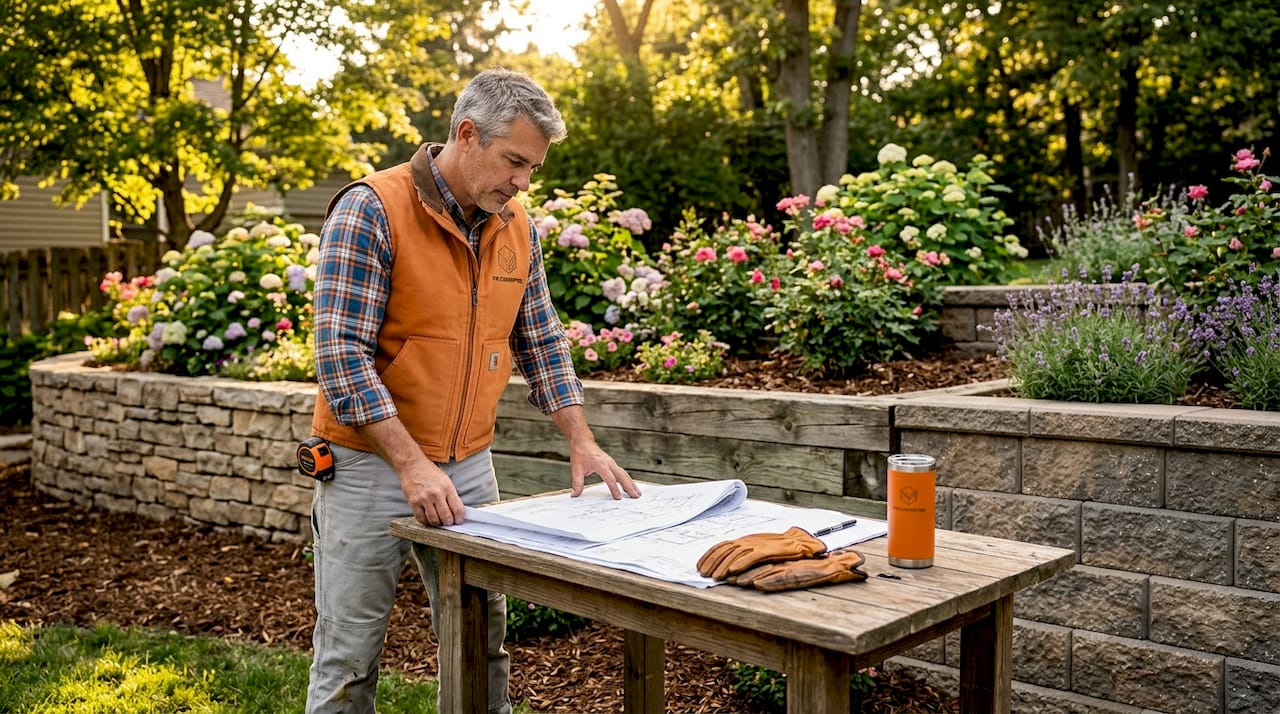
Choosing the right retaining wall is one of those decisions where getting it wrong costs you twice. The structure fails, you rebuild it, and you pay again. The four main types of retaining walls used in residential settings each resist lateral soil pressure differently, and the types of retaining walls residential homeowners actually need depend on far more than looks. Height, soil conditions, load requirements, and budget all drive the decision. This guide walks you through every major option so you can match the right wall to your site.
Table of Contents
- Key takeaways
- 1. Gravity retaining walls
- 2. Cantilever retaining walls
- 3. Mechanically stabilized earth (MSE) walls
- 4. Anchored retaining walls
- 5. Soldier pile, soil nail, and sheet pile walls
- 6. Comparing retaining wall types side by side
- My honest take after years of watching these walls go in
- Ready to build your retaining wall the right way?
- FAQ
Key takeaways
| Point | Details |
|---|---|
| Match type to site conditions | Height, soil type, and loading requirements should drive your wall selection, not aesthetics alone. |
| Gravity walls suit low slopes | For walls under 4 feet, gravity block or stone walls are cost-effective and DIY-friendly. |
| Cantilever walls handle mid-range height | Reinforced concrete cantilever walls are the standard choice for residential walls from 4 to 20 feet. |
| MSE walls scale taller and cheaper | Mechanically stabilized earth walls can reach 50+ feet and often cost less per square foot than cantilever for tall applications. |
| Drainage prevents failure | Omitting proper drainage is the single most common cause of retaining wall failure across all wall types. |
1. Gravity retaining walls
Gravity walls are the simplest type in residential wall designs and the most common choice for low slopes and garden terracing. They resist soil pressure purely through their own mass. No steel reinforcement, no engineered footing. The wall just needs to be heavy enough to stay put.
Materials include concrete masonry blocks, natural stone, gabion baskets (wire cages filled with rock), and timber sleepers. Each brings a different visual and a different price point. Gabion walls have a raw, industrial look that works well in contemporary landscapes. Dry-stacked stone reads as traditional and natural. Timber sleepers are popular for informal garden beds and are among the most budget-friendly options.
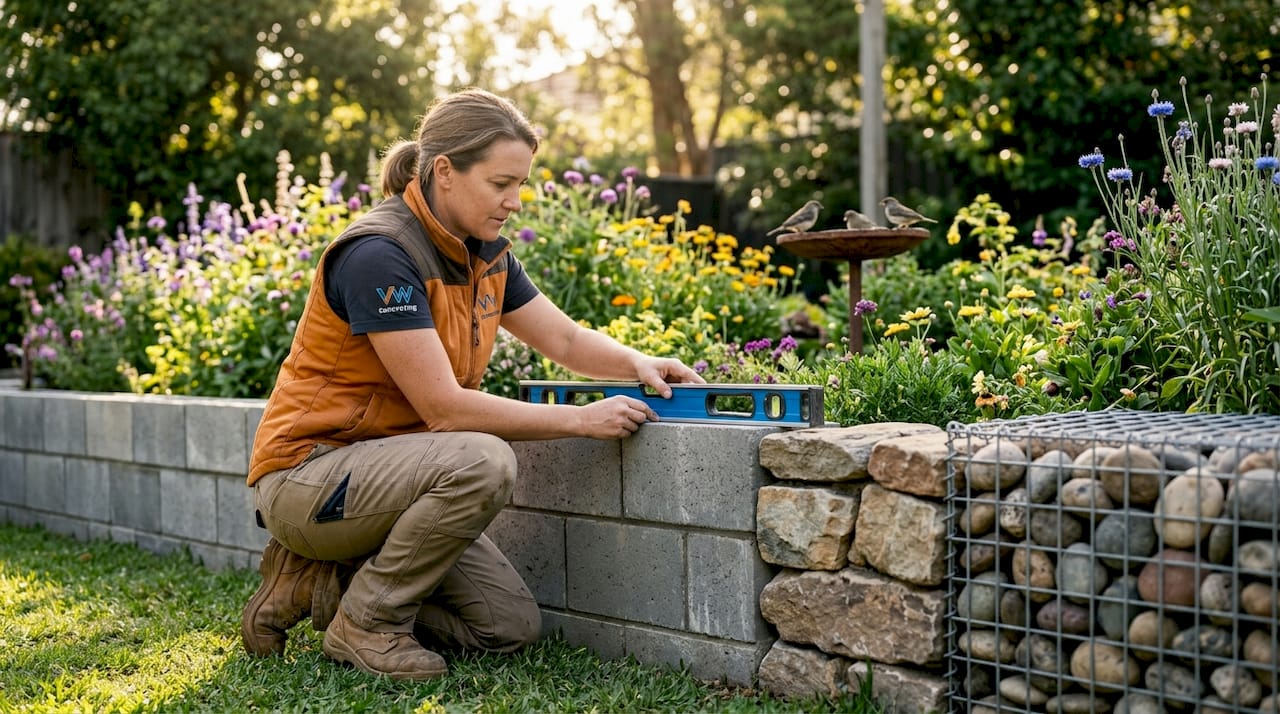
Height and cost: Gravity block walls typically suit heights between 0 and 4 feet and cost approximately $20 to $40 per square foot of face. For most backyard terracing projects, that range covers the job.
The main limits of gravity walls are height and base width. As the wall gets taller, the base needs to widen to maintain stability, which eats into usable yard space. For anything approaching 4 feet, you should check local council requirements. Many jurisdictions require engineering approval above that threshold.
- Works well for garden terraces, low retaining borders, and pathway edging
- Natural stone and gabion options offer strong aesthetic flexibility
- Timber sleepers are cost-effective but degrade over time, especially in wet soil
- Concrete block systems are durable and straightforward to install
Pro Tip: Always slope gravity walls slightly back into the retained soil (a “batter”) rather than building them perfectly vertical. Even a 1-in-10 batter significantly improves long-term stability without affecting the visual result.
2. Cantilever retaining walls
Cantilever walls are what engineers call the workhorse of site civil retaining wall design. They work through a structural stem connected to a base footing. The weight of the retained soil sitting on the footing heel provides the stabilizing force. That counterbalance is what lets cantilever walls hold back far more soil than a gravity wall could at comparable thickness.
Cast-in-place reinforced concrete is the standard material for cantilever walls in residential construction. Precast masonry and concrete block systems are also used for mid-range heights. For residential projects requiring structural design confidence, cantilever walls often come with engineer-certified drawings, especially for walls over 1.2 meters.
Height and cost: Cantilever walls range from 4 to 20 feet in height and cost approximately $40 to $80 per square foot. That higher cost reflects the engineering, formwork, and reinforcement required.
- Common applications include home foundations, below-garage retaining, parking areas, and boundary walls
- Delivers precise, vertical face geometry where space is constrained
- Requires excavation and formed footing work, making DIY installation challenging above modest heights
- Higher upfront cost but low maintenance over the wall’s lifespan
Pro Tip: On residential sites with clay-heavy soils, increase the drainage spec behind your cantilever wall. Clay retains water and amplifies lateral pressure. A proper drainage system behind the wall is not optional — it is structural.
Where you have a tight right-of-way or a hard boundary constraint, cantilever walls earn their price. A gravity wall at that same height would need a base width that may not exist on your property.
3. Mechanically stabilized earth (MSE) walls
Mechanically stabilized earth walls, commonly called MSE walls or reinforced soil walls, look like segmental block walls from the outside. Inside, they are a different system entirely. MSE walls use geogrids and geosynthetics layered into the retained soil, connecting to the segmental facing units. The reinforced soil mass becomes the structure.
Segmental retaining walls are mortarless, interlocking concrete systems suitable for residential heights ranging from 8 inches up to 20 feet or more. At low heights, the unit weight does most of the work. For taller applications, the geogrids kick in and extend stability deep into the soil bank behind the wall. That transition is what makes MSE walls so versatile.
Height and cost: MSE walls cover a height range from 4 feet to 50+ feet and cost approximately $25 to $55 per square foot, which often undercuts cantilever walls for tall residential applications with significant fill.
| Feature | MSE Wall | Cantilever Wall | Gravity Wall |
|---|---|---|---|
| Height range | 4 ft to 50+ ft | 4 ft to 20 ft | 0 to 4 ft |
| Cost per sq ft | $25 to $55 | $40 to $80 | $20 to $40 |
| Requires engineer | Yes (tall walls) | Yes | Generally no |
| DIY-friendly | Moderate | No | Yes (low heights) |
| Aesthetic flexibility | High | Moderate | High |
- Geogrids eliminate the need for large mass or deep footing, reducing excavation
- Segmental units interlock without mortar, making installation faster and equipment requirements lower
- Design accommodates curved alignments and terraced layouts
- Strong option for large fill conditions or sloped residential blocks requiring tall retention
One thing worth understanding: you cannot simply scale up a low gravity block wall design and expect it to work at 15 feet. Taller segmental walls require full reengineering with geogrid reinforcement. The physics change fundamentally once gravity alone cannot hold the load.
4. Anchored retaining walls
Anchored walls solve a specific problem: how do you hold back soil when you have neither the space for a wide gravity wall nor the budget for a thick cantilever wall? Anchored retaining walls use cables or rods drilled and grouted into stable soil or rock behind the wall face, transferring tension forces away from the wall itself.
In residential settings, anchored walls appear where site constraints are severe. Think of a cut slope along a driveway on a steep block, or a boundary wall adjacent to a neighboring structure. They are also used to stabilize an existing wall that has begun to move.
- Cables or rods anchor into stable substrate behind the active soil zone
- Allows thinner, taller wall faces where excavation space is limited
- Commonly combined with soldier pile systems (vertical steel H-piles with horizontal timber or concrete lagging)
- Higher installation cost due to drilling and grouting requirements
The installation process requires specialist equipment and geotechnical input. These are not DIY walls. But for the right site, they are often the only practical structural solution.
5. Soldier pile, soil nail, and sheet pile walls
These three wall types are less common in standard residential landscaping but show up regularly in specific scenarios where standard solutions do not fit.
Soldier pile walls use vertical steel H-piles driven at regular intervals, with horizontal timber or precast lagging placed between them as the wall face is excavated down. They work well in cut conditions on constrained urban sites and are common in Melbourne’s inner suburbs where tight lot boundaries leave no room for a conventional footing.
Soil nail walls take a different approach. Rather than building a wall and retaining behind it, soil nailing reinforces the existing slope itself by drilling bars into the ground at a slight downward angle and grouting them in place. A shotcrete face is then applied to the slope. For stabilizing existing embankments and cuts on residential properties with rocky or stiff soil, soil nailing is often the most cost-effective method.
Sheet pile walls use interlocking steel, vinyl, or timber sheets driven directly into the ground. They form a continuous barrier and are particularly useful in waterfront residential construction, along creek boundaries, and for temporary excavation retention. Long-term corrosion is a concern for steel sheet pile in wet conditions.
- Soldier pile: best for constrained urban cuts and basement excavation support
- Soil nail: effective for reinforcing existing slopes and embankments
- Sheet pile: suited to waterfront properties, soft ground, and temporary works
All three require professional design and installation. They are specialist landscape retaining wall options for genuinely difficult sites, not first choices for routine backyard projects.
6. Comparing retaining wall types side by side
Selecting the right type comes down to matching your specific site conditions to the wall’s resistance mechanism. Height bands plus retained conditions are the framework. Choosing based purely on how the wall looks is how projects end up overbuilt or, worse, unsafe.
| Wall type | Height range | Est. cost/sq ft | Best application | DIY suitability |
|---|---|---|---|---|
| Gravity | 0 to 4 ft | $20 to $40 | Garden terracing, low slopes | High |
| Cantilever | 4 to 20 ft | $40 to $80 | Basements, parking, vertical boundaries | Low |
| MSE/Reinforced | 4 to 50+ ft | $25 to $55 | Large fill, tall walls, flexible design | Moderate |
| Anchored | Varies | High | Constrained sites, existing wall repair | None |
| Soldier/Sheet pile | Varies | High | Urban cuts, waterfront, temporary | None |
Material choices across all these types affect appearance significantly. Materials range from budget landscape blocks (around $1 each) through natural stone, timber, and weathering steel like Corten. If you want the wall to be a visual feature, MSE segmental block and natural stone give you the most flexibility. If the wall needs to disappear into the landscape, board-formed concrete or treated timber can work beautifully.
Pro Tip: Whatever wall type you choose, drainage is non-negotiable. Clogged weep holes and absent ag pipe are the leading causes of retaining wall failure. Budget for drainage from the start, not as an afterthought.
For walls over 1 meter in height or on sites with unstable soil, surcharge loading (driveways, buildings, pools nearby), or poor drainage, bring in a structural engineer before you pour a single concrete pad. The fee is small compared to a failed wall.
My honest take after years of watching these walls go in
I’ve seen homeowners spend weeks agonizing over which block color to choose and ten minutes on soil conditions. That’s backwards. The aesthetics matter, but the resistance mechanism is what determines whether the wall is still standing in ten years.
The most common mistake I see on residential sites is underestimating soil pressure. People treat retaining walls like garden borders. A 1.2-meter wall holding back wet clay on a sloped block is under enormous force. That’s an engineering problem, not a landscaping problem. The wall needs to be designed for those loads, not just for the look.
The second most common mistake is skipping drainage. I’ve watched structurally sound walls fail within three years simply because no one installed drainage behind them. Water pressure is invisible until the wall cracks or leans. By then you’re rebuilding from scratch.
My advice: start with the site assessment, not the product catalog. Know your height, your soil type, whether there’s a driveway or building load nearby, and what your drainage situation is. Those four factors will narrow your real options down fast. Then you choose materials and aesthetics from within those options.
Taller walls also need more than a scaled-up version of a small wall design. That’s a fundamental reengineering requirement, and cutting corners there is genuinely dangerous. For anything above about 1 meter in challenging conditions, get professional eyes on the design. The retaining walls in landscaping context shifts the whole project when done properly, turning a structural necessity into a real asset for your property.
— Vic
Ready to build your retaining wall the right way?
VW Concreting has been designing and installing retaining walls across Melbourne since 2001, with over 145 completed projects across gravity, cantilever, and MSE wall types. Whether you have a straightforward garden terrace or a complex sloped block requiring serious structural work, the team brings the experience to match the right solution to your site.
From material selection through to drainage planning and final installation, VW Concreting handles the details that protect your investment long-term. Explore completed retaining wall projects to see the quality firsthand, or check out the full range of retaining wall services in Melbourne to start your project with the right team behind you.
FAQ
What are the main types of residential retaining walls?
The four main types used in residential projects are gravity, cantilever, mechanically stabilized earth (MSE), and anchored walls. Each resists lateral soil pressure through a different mechanism: mass, structural footing, geosynthetic reinforcement, or tie-back anchors.
How tall can a retaining wall be before needing an engineer?
Most local councils require engineering approval for walls above 1 meter (approximately 3.3 feet), though this varies by location. Any wall near a surcharge load like a driveway, pool, or building should be engineered regardless of height.
What is the most cost-effective retaining wall type?
For walls under 4 feet, gravity block walls at $20 to $40 per square foot are the most economical option. For taller walls with significant fill, MSE walls at $25 to $55 per square foot often undercut cantilever alternatives.
Why do retaining walls fail?
Poor drainage is the most common cause of retaining wall failure across all wall types. Water builds up behind the wall, increases lateral pressure dramatically, and causes cracking, leaning, or collapse. Weep holes and ag pipe drainage are critical installations.
Can I build a retaining wall myself?
Low gravity walls under 3 to 4 feet using concrete block or natural stone are genuinely DIY-friendly. Segmental block systems are also manageable at modest heights. Anything taller, in difficult soil, or near a load source requires professional design and installation.
Leave A Comment