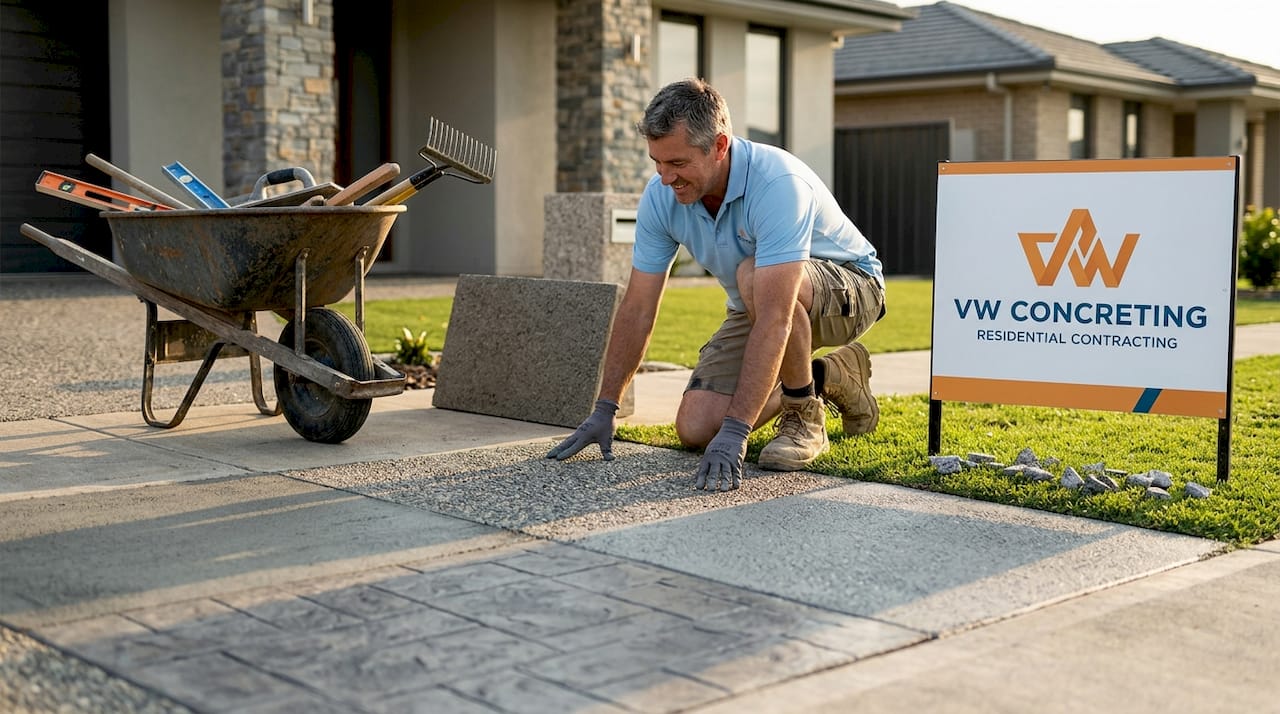
Choosing the right surface treatment for your driveway means balancing aesthetics, safety, budget, and long-term upkeep. The examples of concrete driveway finishes available today go well beyond plain gray slabs. Whether you want something that looks like natural stone, resists wet-weather slipping, or simply stays low maintenance, the finish you choose shapes how your property looks and performs for decades. This guide walks you through the most popular options in residential and commercial surface finishing, with real performance data and practical advice to help you decide.
Table of Contents
- Key takeaways
- 1. Examples of concrete driveway finishes: broom finish
- 2. Exposed aggregate finish
- 3. Stamped concrete finish
- 4. Colored and stained concrete finishes
- 5. Salt finish
- 6. Polished concrete driveway
- 7. Comparison of driveway concrete finishes
- My take on choosing the right driveway finish
- VW Concreting: Melbourne’s driveway finishing specialists
- FAQ
Key takeaways
| Point | Details |
|---|---|
| Slip resistance varies widely | Each finish type delivers different PTV ratings; match the finish to your safety needs, especially in wet areas. |
| Sealer choice is critical | Decorative sealers can reduce wet slip resistance significantly, so always verify anti-slip additive performance. |
| Timing affects quality | Applying texture too early or too late ruins the result; skilled workmanship is non-negotiable. |
| Cost and maintenance differ | Broom and salt finishes are affordable; stamped and exposed aggregate carry higher upfront and sealing costs. |
| Climate matters | Your local weather should influence your finish choice, particularly for finishes prone to moisture retention. |
1. Examples of concrete driveway finishes: broom finish
The broom finish is the most widely used surface treatment for residential driveways in Australia and North America alike. In the industry, you will also hear it called a brushed finish. The technique is straightforward: a stiff-bristle broom is dragged across freshly floated concrete, creating parallel ridges that provide slip resistance with a wet PTV of 45 to 55.
That PTV range is meaningful. A PTV above 36 is considered slip resistant under standard safety guidelines, so a broom finish comfortably clears that bar even in wet Melbourne winters.
Why homeowners keep choosing it:
- Costs less than decorative alternatives because it requires no special tools or pigments
- Repairs and resurfacing are simple and inexpensive
- Works equally well on wide residential driveways and commercial parking areas
- The textured ridges channel water away from the surface, reducing pooling
Broom finish applications typically take two to four hours and require 24 to 48 hours of curing before foot or vehicle traffic. That tight window makes timing the most important variable.
Pro Tip: Wait until the bleed water on the surface has fully evaporated before dragging the broom. Too early and the ridges collapse; too late and the concrete resists the texture. Watch the surface sheen, not the clock.
2. Exposed aggregate finish
Exposed aggregate is the most popular decorative concrete finish for driveways across Melbourne. The process involves removing surface cement paste to reveal decorative aggregate beneath, either by water-washing shortly after placement or by acid etching once cured.
The visual result depends entirely on the aggregate you choose. Granite chips create a speckled, earthy look. River gravel gives a rounder, more natural feel. Recycled glass adds color and a modern edge. Each material produces a completely different appearance from the same basic technique, which is why exposed aggregate appears so frequently in concrete driveway design ideas.
Beyond aesthetics, the numbers are compelling. Exposed aggregate reaches PTV levels of 55 to 70, making it one of the safest surfaces available for pool surrounds, barefoot areas, and driveways that see heavy rain.
What to know before you commit:
- Resealing every three to five years keeps the surface protected and color-rich
- Acid washing cleans up efflorescence and maintains the exposed texture over time
- Cost sits in the mid-range, higher than broom finish but lower than stamped concrete
- Not all aggregates perform the same under traffic; confirm with your contractor that the chosen stone meets load requirements
For a closer look at how this finish performs on real projects, VW Concreting’s exposed aggregate driveway work shows the range of materials and outcomes possible.
Pro Tip: Ask your contractor to lay a small sample panel on-site before committing to an aggregate type. Colors and textures look very different wet versus dry, and you want to see both.
3. Stamped concrete finish
Stamped concrete is where function meets full creative control. After pouring, concrete is pressed with large rubber stamps while still workable, imprinting patterns that replicate cobblestone, brick, timber planks, slate tiles, and more. Color is added either as an integral pigment mixed through the slab or as a surface hardener broadcast before stamping.
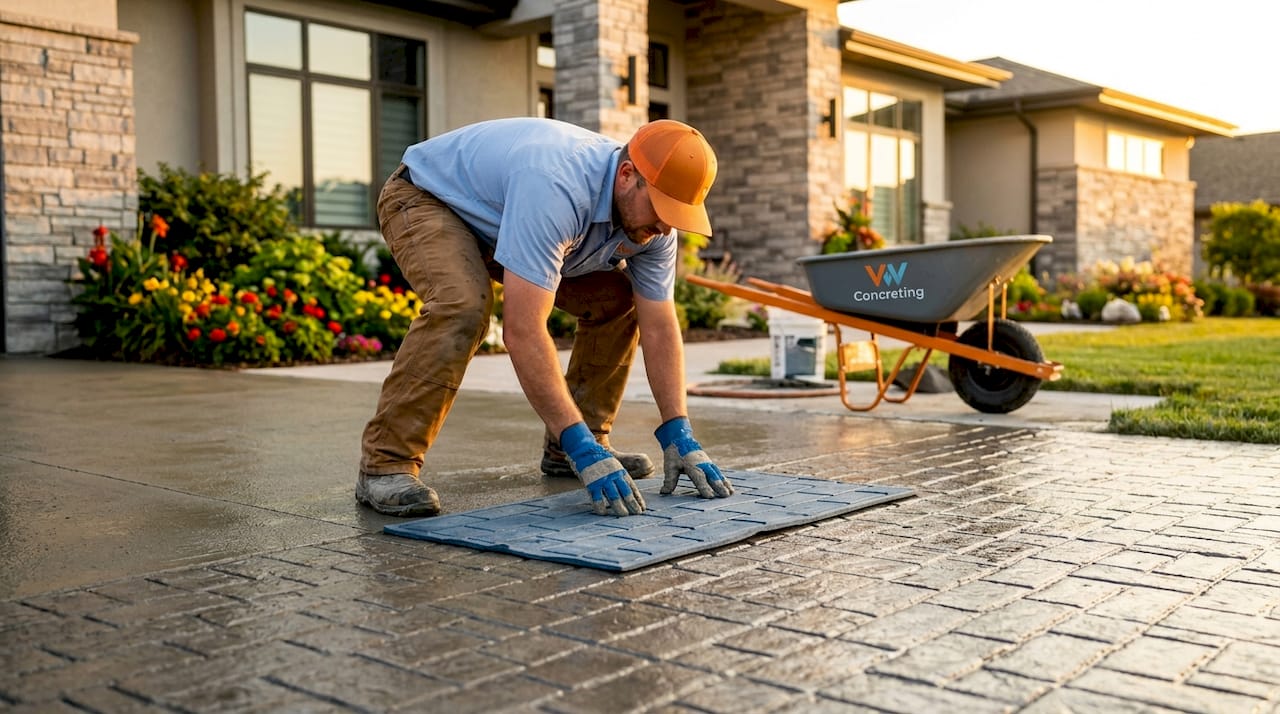
The result can genuinely be mistaken for expensive natural materials at a fraction of the installation cost. That makes it one of the most sought-after decorative concrete driveways for homeowners focused on curb appeal.
Common patterns and their applications:
- Cobblestone: suits heritage homes and formal entrances
- Ashlar slate: clean and contemporary, pairs well with modern architecture
- Random stone: natural, organic appearance for garden-adjacent driveways
- Wood plank: striking on pathways and entertainment areas, less common on driveways
The trade-off is slip resistance. Decorative sealers on stamped concrete can drop wet PTV to between 15 and 25, well below the safe threshold. This is not a reason to avoid stamped concrete. It is a reason to be extremely careful about sealer selection.
Pro Tip: Never assume your sealer is slip safe. Ask your contractor for documented PTV test data for the specific sealer system they plan to use, including any anti-slip additives. This single step prevents the most common and costly mistake in decorative driveways.
Resealing stamped surfaces every two to three years is standard practice. Without it, the color fades and the surface becomes porous.
4. Colored and stained concrete finishes
Color transforms a plain gray slab into something that actually complements your home’s exterior. There are two distinct approaches: integral color and surface staining.
Integral color is mixed directly into the concrete before pouring. The pigment runs throughout the slab, so chips and scratches do not reveal gray underneath. Earth tones like terracotta, sandstone, and charcoal are the most popular choices for driveways because they hide dirt well and age naturally.
Surface staining is applied to cured concrete and falls into two categories. Acid stains react chemically with the concrete to produce mottled, variegated effects that look genuinely unique because no two slabs react identically. Water-based stains offer more predictable color results and a wider palette, including vibrant blues, greens, and reds.
For Melbourne properties, VW Concreting’s colored concrete applications show how pigments and stains work across different surface conditions and project scales.
Key considerations:
- Integral color costs more upfront but holds color longer than surface stains
- Stained surfaces require sealing to prevent fading and moisture penetration
- UV exposure is the main enemy; lighter colors can fade noticeably in full sun without UV-resistant sealers
- Both options work well for driveways, patios, and commercial entries where visual branding matters
Color does not significantly change slip resistance on its own. The finish beneath the color (broom, trowel, or exposed aggregate) determines the texture.
5. Salt finish
The salt finish is a textured driveway finishing technique that creates a softly pitted surface. Rock salt crystals are pressed into freshly placed concrete, then washed out once the slab cures, leaving small, irregular depressions across the surface.
The result simulates a natural stone appearance and provides moderate slip resistance. Salt finishes are especially popular around pool surrounds, garden paths, and residential patios where a softer, more tactile surface is preferred.
Other textured finish options to consider:
- Troweled finish: A smooth, polished surface created with a steel trowel. Best for interior slabs or covered areas since it becomes slippery when wet outdoors.
- Swirl float finish: A circular hand-textured pattern using a magnesium float. Provides light texture and a distinctive appearance for pathways and patios.
The limitation of salt finish is moisture retention. Those small pits trap water in high-rainfall climates, which can accelerate surface wear and, in frost-prone regions, cause spalling as water freezes and expands. In Melbourne’s moderate climate it performs reliably, but it is not the best pick for shaded, slow-drying driveways.
| Finish type | Slip resistance (PTV) | Best use |
|---|---|---|
| Broom finish | 45–55 | Driveways, commercial areas |
| Exposed aggregate | 55–70 | Pool surrounds, wet areas |
| Stamped (sealed) | 15–25 | Decorative driveways (with anti-slip sealer) |
| Salt finish | 35–45 | Patios, pool paths |
| Troweled finish | 10–20 | Covered/interior slabs only |
6. Polished concrete driveway
A polished concrete driveway is created through a process of mechanical grinding with progressively finer diamond-tipped tooling, followed by a chemical densifier that hardens the surface and a final high-sheen polish. The industry term is “mechanically polished concrete” and the result looks closer to terrazzo or stone than a typical outdoor slab.
Polished finishes are far more common indoors, but a growing number of commercial entries, covered driveways, and under-cover parking areas now use them outdoors. The reflective surface amplifies natural light and creates an unmistakably premium look.
The performance trade-off is real. A high-gloss polished surface is extremely slippery when wet. For any outdoor or exposed application, a matte or satin grind level (rather than a full mirror polish) is strongly recommended, combined with a sealer that carries verified anti-slip additives. This is one finish where the gap between a beautiful result and a dangerous one comes down entirely to the finish level and sealer system chosen.
7. Comparison of driveway concrete finishes
Choosing among these options is easier when you see the key performance variables side by side.
| Finish | Relative cost | Maintenance | Aesthetics | Safety in wet conditions |
|---|---|---|---|---|
| Broom finish | Low | Minimal | Functional, clean | Excellent |
| Exposed aggregate | Medium | Seal every 3–5 years | Natural stone look | Excellent |
| Stamped concrete | Medium-high | Seal every 2–3 years | High-end decorative | Poor without anti-slip sealer |
| Colored/stained | Medium | Seal regularly | Versatile, vibrant | Depends on base finish |
| Salt finish | Low-medium | Low | Natural, textured | Moderate |
| Polished concrete | High | Low (indoors) | Premium, reflective | Poor outdoors unless modified |
For eco-conscious projects, pervious concrete is worth a mention. With 15 to 25% void content, it allows water infiltration rates that dramatically reduce surface runoff, making it genuinely useful in areas with drainage concerns. It is not a decorative finish in the traditional sense, but it is an option worth discussing with your contractor if sustainability is a priority.
My take on choosing the right driveway finish
I’ve seen a lot of driveways over the years, and the single most consistent mistake homeowners make is choosing a finish based on photos alone. A sample image of stamped cobblestone looks stunning. What the photo does not show is whether the sealer applied on that job carried validated anti-slip additives or whether the surface will become dangerously slippery after the first Melbourne rain.
My honest view is this: slip resistance is a non-negotiable starting point, not an afterthought. You can add color, texture, and pattern after you have confirmed the finish system is safe. You cannot retrofit safety once a driveway is down and someone has fallen on it.
The second thing I have learned is that timing during finishing makes or breaks the result more than any product choice. A broom finish applied at exactly the right moment in the curing sequence will outperform an expensive decorative overlay that was rushed or delayed. Skill and experience matter more than budget at that stage.
Finally, think seriously about your specific driveway conditions. A north-facing driveway in full sun will fade stained concrete faster than one under shade. A steep gradient needs a higher PTV finish than a flat entry. Match the finish to how you actually use the space, not just how it looks in a catalog.
— Vic
VW Concreting: Melbourne’s driveway finishing specialists
If you are working through your options and want to see real project outcomes before committing, VW Concreting has completed over 145 concreting and outdoor construction projects across Melbourne since 2001. The team works with every finish type covered in this article, from practical broom finishes through to custom stamped and exposed aggregate installations.
Browse the driveway and slab portfolio to see finish examples across different property styles and budgets. For properties that need a more comprehensive outdoor solution, the full project portfolio covers landscaping, fencing, and decking alongside concreting work. You can also read through VW Concreting’s service selection guide for practical advice on what to ask before signing a contract. Get in touch for a consultation or quote tailored to your Melbourne property.
FAQ
What is the most slip-resistant concrete driveway finish?
Exposed aggregate offers the highest slip resistance, with wet PTV ratings between 55 and 70, making it the safest choice for driveways, pool surrounds, and wet-climate conditions.
How often does stamped concrete need to be resealed?
Stamped concrete driveways typically need resealing every two to three years to maintain color, protect the surface, and preserve any anti-slip additive performance in the sealer.
Does coloring concrete change its slip resistance?
No. Adding integral pigment or surface stain does not significantly change slip resistance on its own. The texture of the underlying finish (broom, aggregate, or trowel) determines how safe the surface is when wet.
Which concrete driveway finish is the most affordable?
Broom finish is the lowest-cost option. It requires no special tools, pigments, or sealing schedules, and its combination of affordability and solid slip resistance makes it the default choice for standard residential driveways.
Is a polished concrete finish suitable for an outdoor driveway?
A full mirror-gloss polish is not suitable for exposed outdoor driveways due to very low wet slip resistance. A satin or matte grind level with a verified anti-slip sealer system can work in covered or partially protected applications.
Leave A Comment