TL;DR:
- Galvanised fasteners protect steel by forming a durable zinc barrier and sacrificial anode, extending outdoor service life.
- Choosing hot-dip galvanised fasteners with sufficient coating thickness is essential for durability, especially near coastal areas or when using treated timber.
Most builders and keen DIYers assume any steel nail or screw will hold a structure together for years. That assumption is costing people money they cannot see leaving. Understanding why galvanised fasteners matter is not an academic exercise. It is the difference between a deck that looks sharp and holds strong after a decade of Melbourne summers and rain, and one that bleeds rust down the timber within two seasons. This article explains how galvanised coatings work, how to choose the right type for your project, and why the upfront cost difference is far smaller than the replacement bill waiting on the other side.
Table of Contents
- Key takeaways
- Why galvanised fasteners matter: the science of corrosion protection
- Galvanised vs non-galvanised fasteners: what the comparisons actually show
- Matching specifications to Australian environments
- The practical benefits of galvanised fasteners
- Best practices for selecting and using galvanised fasteners on site
- My experience with fastener specification errors
- Build with confidence: how VW Concreting approaches quality
- FAQ
Key takeaways
| Point | Details |
|---|---|
| Zinc coating sacrifices itself | Galvanised fasteners protect steel even when the coating is scratched, a property standard steel lacks entirely. |
| Coating process determines lifespan | Hot-dip galvanised fasteners last decades; electro-galvanised versions typically fail within 2 to 5 years outdoors. |
| Environment dictates specification | Coastal projects within 5 km of saltwater require a minimum 85 micron zinc coating for 30-plus years of service. |
| Treated timber demands attention | Chemical preservatives in pressure-treated timber accelerate corrosion; sherardised or stainless fasteners are often the better choice here. |
| Lifecycle cost favours galvanised | Despite a higher purchase price, galvanised fasteners deliver a 4 to 8 times return by preventing replacement labour and material costs. |
Why galvanised fasteners matter: the science of corrosion protection
Steel wants to rust. Left outdoors without any protective coating, uncoated carbon steel begins oxidising within 24 to 48 hours of moisture exposure, with visible rust forming in as few as seven days. That is not a worst-case scenario. That is normal outdoor Australian weather doing exactly what it does to unprotected metal.
Galvanised fasteners work through two mechanisms working together, not just one. The zinc coating forms a physical barrier between the steel and the environment. More critically, zinc acts as a sacrificial anode, corroding first when moisture is present and actively drawing electrochemical attack away from the steel beneath. This galvanic protection means that even if the coating gets scratched during installation, the zinc surrounding the damaged area keeps corroding preferentially, shielding the exposed steel. Standard coated paints or platings do not offer this. Once scratched, they leave the steel completely exposed.
Over time, zinc reacts with atmospheric carbon dioxide to form zinc carbonate, a stable grey patina that significantly slows further zinc consumption. This self-healing chemistry is what gives properly galvanised fasteners their extraordinary service life in outdoor conditions.
How coating processes differ
Not all galvanised fasteners are produced the same way, and the difference matters enormously for coating thickness and longevity.
Hot-dip galvanising involves submerging cleaned steel fasteners in molten zinc at around 450 degrees Celsius. The zinc metallurgically bonds to the steel surface, producing a coating typically 45 to 85 microns thick. Standards like ASTM A153 and ISO 1461 set minimum thickness requirements, giving buyers a reliable quality baseline.
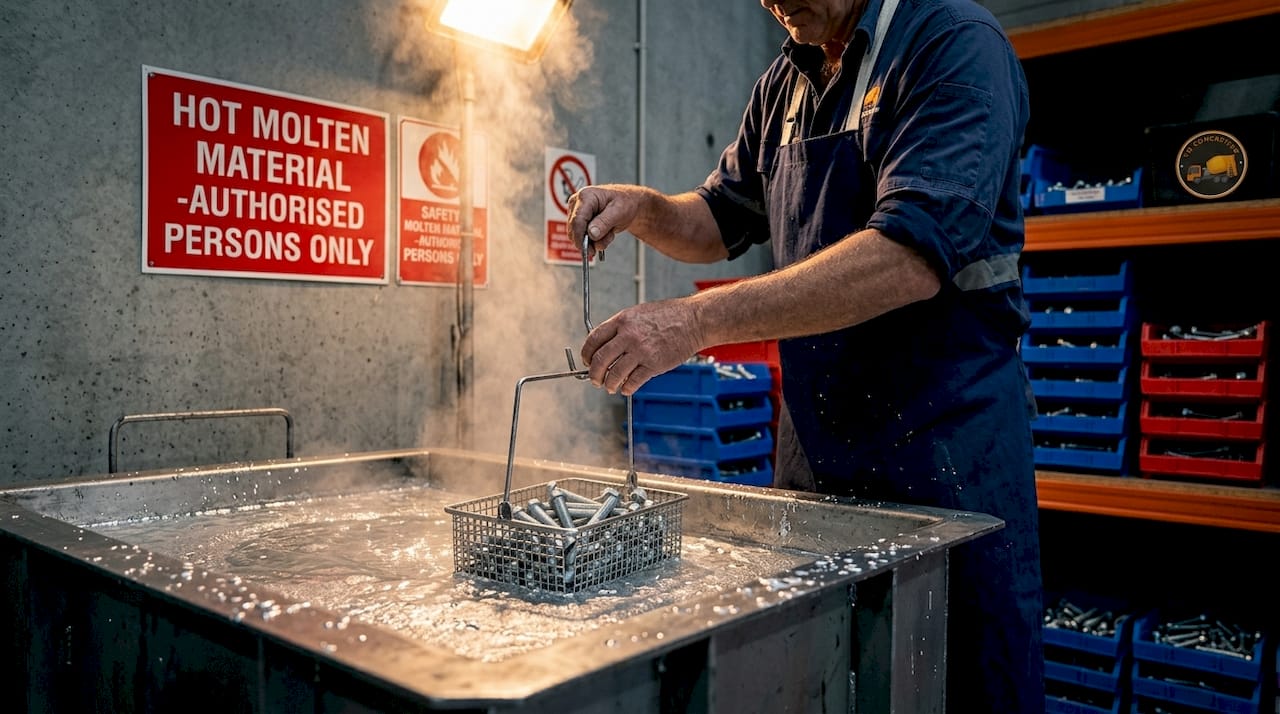
Electro-galvanising uses an electrochemical bath to deposit zinc onto the surface. The result is a thin, uniform coating of around 5 to 15 microns. It looks clean and bright, but it offers a fraction of the protection.
Pro Tip: When buying galvanised fasteners, look for the product to reference ASTM A153 or ISO 1461. If the product listing only says “zinc plated” or “electro-galvanised,” assume the coating is thin and treat it accordingly when choosing where to use it.
- Hot-dip galvanised (HDG): 45 to 85 microns, metallurgical bond, decades of outdoor service life
- Electro-galvanised: 5 to 15 microns, electrochemical deposit, suitable for indoor or light-duty use only
- Sherardised: zinc powder diffused into the steel surface, good dimensional accuracy, well suited to treated timber
- Stainless steel: not galvanised but worth understanding as an alternative in specific conditions
Galvanised vs non-galvanised fasteners: what the comparisons actually show
The choice between fastener types is rarely obvious from a product shelf, so understanding real-world performance differences is worth the time.
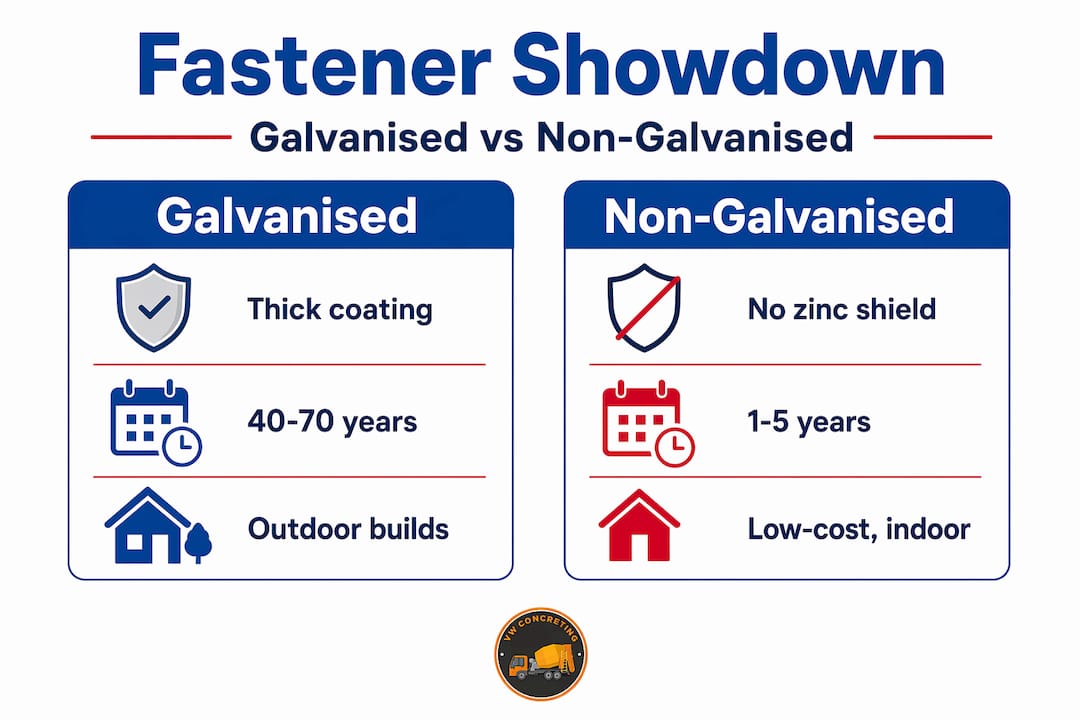
| Fastener type | Coating thickness | Expected outdoor life | Best suited to | Relative cost |
|---|---|---|---|---|
| Bare carbon steel | None | Days to weeks | Dry indoor only | Lowest |
| Electro-galvanised | 5 to 15 microns | 2 to 5 years | Light indoor/sheltered | Low |
| Hot-dip galvanised | 45 to 85 microns | 40 to 70 years inland | Outdoor structural | Moderate |
| Sherardised | 15 to 35 microns | 10 to 25 years | Treated timber | Moderate |
| Stainless steel (grade 316) | N/A (alloy) | 50-plus years | Coastal, marine | High |
Hot-dip galvanised fasteners cost 35 to 45 per cent more than uncoated equivalents but prevent the costly cycle of replacement. Electro-galvanised fasteners look similar at point of purchase, which is where the confusion starts. Builders who specify electro-galvanised for outdoor decking or fencing because it was cheaper find themselves replacing joinery within a few years. That is not a saving.
Stainless steel offers superior corrosion resistance but typically lacks the mechanical strength of hot-dip galvanised carbon steel fasteners. For high-load structural connections, HDG carbon steel is usually the correct professional choice. Stainless is reserved for visible hardware in coastal environments where aesthetics and corrosion exposure both demand it.
Pro Tip: If you are working with pressure-treated pine, check the preservative type before choosing fasteners. ACQ and other chemical treatments are aggressive to standard zinc coatings. Sherardised or hot-dip galvanised with heavier coating thickness, or stainless steel, should be specified instead.
Matching specifications to Australian environments
Australia’s coastal exposure, heat, and humidity make fastener selection a genuine engineering consideration rather than an afterthought. ISO 9223 classifies environments by corrosivity from C1 (very low, dry indoor) through to C5 (very high, industrial coastal). Most outdoor residential and commercial construction in coastal Australian cities sits firmly in the C3 to C4 range, and coastal properties frequently hit C5.
Here is how to think about coating specification by project location:
- Inland, low humidity (C2 to C3): Standard hot-dip galvanised per ASTM A153 Class C (minimum 50 microns) provides adequate protection for structural use over 40-plus years.
- Urban coastal, within 10 km of the ocean (C4): Increase to 75 microns minimum. Verify coating thickness rather than taking packaging claims at face value.
- Direct coastal, within 5 km of saltwater (C5): A minimum of 85 microns zinc coating is the threshold for 30-plus years of service. Consider stainless steel for exposed visible hardware.
- Pressure-treated timber structures: Chemical preservatives like ACQ create an aggressive environment that attacks standard zinc coatings through galvanic acceleration. Use sherardised or stainless fasteners.
- Industrial or marine environments: These consistently reach C5 classification. Stainless grade 316 or specialty coated fasteners are the minimum standard.
Verifying what you are actually buying
This is where many projects go wrong. Visual inspection cannot reliably determine coating thickness or quality. A fastener can look correctly galvanised and be dramatically undercoated.
Practical verification steps:
- Request a Material Test Certificate (MTC) from the supplier for any structural fastener purchase. The MTC confirms the zinc coating thickness has been independently measured.
- Use a magnetic thickness gauge on site for spot-checking deliveries, particularly for larger projects.
- Confirm the relevant standard (ASTM A153 or ISO 1461) is referenced in the product specification, not just the label.
The practical benefits of galvanised fasteners
The case for galvanised fasteners comes down to three things that matter to every project: how long it lasts, what it costs over time, and how it looks.
Lifespan is the headline advantage. While uncoated steel fails salt spray tests in under 24 hours, HDG fasteners regularly exceed 1,000 hours in equivalent testing. In real-world outdoor use, that translates to 40 to 70 years for inland projects compared to a few seasons for bare steel.
- Structural integrity is maintained as fasteners hold their grip and load-bearing capacity without the cross-section loss that rust causes
- Rust bleed is eliminated, keeping timber surfaces clean and aesthetically sound without the brown staining that ruins the look of new decking and fencing
- Replacement cycles are dramatically reduced, avoiding the labour cost of pulling out corroded fixings and re-driving new ones through potentially damaged timber
Lifecycle cost is where the numbers speak clearly. Galvanised fasteners provide a 4 to 8 times return on investment by preventing replacement and labour costs. When you factor in that typical replacement labour runs 5 to 20 times the original fastener cost, paying a moderate premium upfront is straightforward arithmetic.
Incorrect fastener coating leads to rust weakening the structural cross-section in ways that are not visible until a joint fails. In a deck, pergola, or fenced structure, that failure is not just an expensive inconvenience. It is a safety risk.
Best practices for selecting and using galvanised fasteners on site
Knowing why galvanised fasteners matter is one thing. Getting the selection and installation right is where it translates to actual project outcomes. Here is how to approach it systematically:
- Identify the exposure class first. Before ordering fasteners, classify your project location using the ISO 9223 corrosivity categories above. Your coating specification follows from that, not from what is convenient to buy locally.
- Match fastener grade to the mechanical load. Mechanical load class affects structural performance independently of corrosion resistance. A correctly coated but undersized fastener is still a failure waiting to happen.
- Distinguish HDG from electro-galvanised visually and by documentation. HDG fasteners typically have a rougher, matte grey finish due to the hot-dip process. Electro-galvanised fasteners are shinier and more uniform. When in doubt, ask for the MTC.
- Avoid damaging the coating during installation. Overdriving fasteners strips coating from the head. Use appropriate setting tools and avoid excessive torque on coated screws. For nails, do not rely on a pneumatic nailer set too high.
- Consider sherardised or stainless steel for treated timber early. Do not treat this as a fallback decision after problems appear. The right fastening approach for secure builds starts at the specification stage, not the problem-solving stage.
Pro Tip: Always cross-reference the timber treatment type and fastener manufacturer’s compatibility chart before purchasing. Some modern timber treatments are significantly more aggressive than traditional CCA, and what worked ten years ago on-site may not be appropriate today.
My experience with fastener specification errors
I have seen the same specification mistake made on residential and commercial projects repeatedly across Melbourne. Someone chooses electro-galvanised fasteners because they look the part and cost less, then wonders why a relatively new deck has rust streaks and loose boards within three years. The fix costs far more than the original saving.
What I have found is that the confusion almost always comes from not distinguishing between galvanised and zinc plated at point of purchase. They are not the same product. Zinc plated is electro-galvanised. Coating thickness is the deciding variable, and it cannot be verified by eye.
The other consistent mistake is underestimating treated timber’s impact on standard HDG fasteners. I have pulled out fasteners from two-year-old treated pine structures that looked like they had been underwater. The preservative chemistry accelerates corrosion faster than outdoor exposure alone. Once you know this, the decision to spend a little more on sherardised or stainless fasteners for treated timber becomes automatic.
Genuinely hot-dip galvanised fasteners from a supplier who can provide an MTC pay for themselves. Not eventually. Usually within the life of the first replacement cycle that never has to happen.
— VW
Build with confidence: how VW Concreting approaches quality
Whether you are planning a new deck, a fenced garden, a concrete path or a full outdoor renovation, the fasteners holding it all together are as important as any visible material. That principle is at the core of how we work at VW Concreting.
With over 145 completed projects across Melbourne, we understand that durable outdoor construction depends on getting every detail right. From specifying correctly coated fasteners for our fencing and decking projects to matching structural fixings to concrete and timber applications, quality materials are non-negotiable. If you are planning a project and want guidance from a team that builds to last, reach out to us at VW Concreting for a consultation.
FAQ
What is the difference between galvanised and zinc-plated fasteners?
Galvanised fasteners, particularly hot-dip galvanised, have a zinc coating of 45 to 85 microns applied through immersion in molten zinc. Zinc-plated (electro-galvanised) fasteners use an electrochemical process producing a much thinner coating of 5 to 15 microns, making them unsuitable for outdoor structural use.
How long do galvanised fasteners last outdoors in Australia?
Hot-dip galvanised fasteners last 40 to 70 years in inland environments and significantly less near the coast without heavy coating specification. Electro-galvanised fasteners typically fail within 2 to 5 years under similar outdoor conditions.
Can I use standard galvanised nails in pressure-treated timber?
Standard hot-dip galvanised fasteners can corrode prematurely in pressure-treated timber because chemical preservatives like ACQ accelerate zinc corrosion. Sherardised fasteners or stainless steel grade 316 are the recommended options for treated timber applications.
How do I verify a fastener is genuinely hot-dip galvanised?
Request a Material Test Certificate from your supplier confirming zinc coating thickness per ASTM A153 or ISO 1461. On site, a magnetic thickness gauge can spot-check coating depth. Visual inspection alone is not a reliable method.
Why choose galvanised nails over stainless steel for most structural projects?
Hot-dip galvanised carbon steel fasteners offer higher mechanical strength than stainless steel at a lower cost, making them the practical choice for structural connections. Stainless steel is reserved for coastal or marine environments where corrosion exposure and aesthetics both justify the premium.
Recommended
- Understand fastener durability: Build stronger Australian projects – Aussie Nails and Fasteners Warehouse
- Fastener grades explained: A practical guide for Aussie builds – Aussie Nails and Fasteners Warehouse
- Essential fastener types for Australian construction: 8 key picks – Aussie Nails and Fasteners Warehouse
- How fastener coatings boost durability and prevent failure – Aussie Nails and Fasteners Warehouse
Leave A Comment