
TL;DR:
- Choosing the appropriate nails for Melbourne outdoor projects requires considering load, weather resistance, timber type, and aesthetics. Ring shank nails with galvanised or stainless coating offer superior holding power and corrosion resistance, especially for decks and fences exposed to the elements. Using wrong-coated nails, such as electro-galvanised steel, often leads to rust and premature failure despite correct nail type selection.
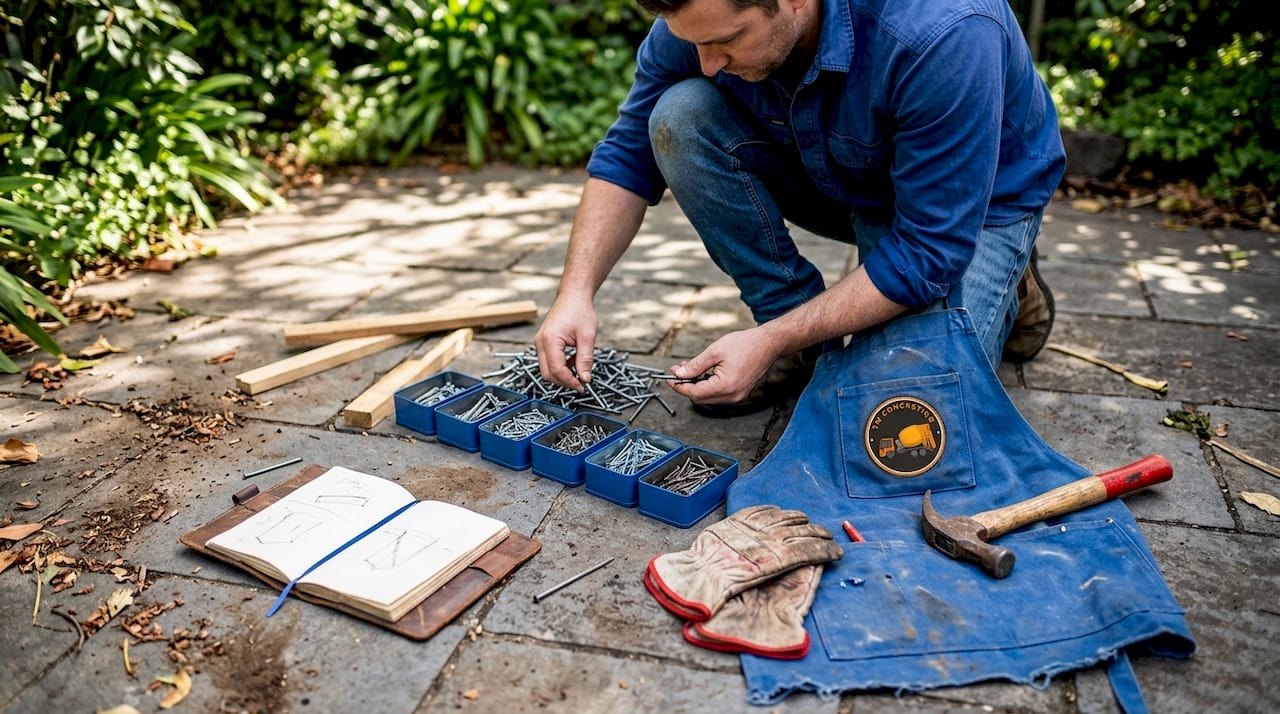
Standing in the fasteners aisle at Bunnings, staring at row after row of nails in every length, gauge, and coating imaginable, can make even a seasoned DIYer’s head spin. The wrong choice can mean a fence that rusts within two seasons, a deck that pops and squeaks underfoot, or trim work riddled with unsightly hammer marks. This guide cuts through the confusion by walking you through every major nail type, what makes each one suited to specific jobs, and how Melbourne’s climate shapes the choices you should be making for long-lasting results.
Table of Contents
- How to choose nails: key criteria for DIY and landscaping
- Main types of nails: features and best uses
- Ring shank vs smooth nails: which holds better?
- Matching nails to your Melbourne project: quick recommendations
- The crucial nail mistake even experienced DIYers make
- Get professional results for your outdoor projects
- Frequently asked questions
Key Takeaways
| Point | Details |
|---|---|
| Choose nails by project | Select nails based on load, weather, timber, and removability to make builds last longer. |
| Galvanised or stainless for outdoors | These coatings prevent rust in Melbourne’s climate, making them ideal for decks, fences, and landscaping. |
| Ring shank holds best | Ring shank nails offer superior grip over smooth shank, especially in dynamic or outdoor structures. |
| Use the right nail for masonry | Only hardened masonry nails should be used for concrete or brick to ensure strong and reliable attachment. |
How to choose nails: key criteria for DIY and landscaping
With the challenge identified, let’s start by examining the most important criteria for nail choice in Melbourne projects. Choosing nails isn’t just about picking the right size. Several overlapping factors determine whether your build will stand up for years or start failing before the paint dries.
The key criteria to weigh up:
- Load requirements: Structural framing calls for thick, large-headed nails that can carry serious shear forces. Lightweight trim or moulding needs something far finer.
- Weather exposure: Melbourne’s combination of summer heat, cool winters, and unpredictable rain means any nail used outdoors must resist corrosion. Bare steel simply won’t last.
- Timber type: Dense hardwoods like spotted gum or ironbark used in Australian decking resist splitting better with thinner, ring-shanked nails. Treated pine is more forgiving but still benefits from the right gauge.
- Aesthetics: Visible nail heads matter in cabinetry, interior panelling, or feature timber walls. Finishing nails and brads are purpose-built to disappear.
- Removability: If you ever plan to pull a structure apart or adjust it, smooth-shank nails come out far more easily than ring-shank versions.
For outdoor builds in particular, choosing right nail types is one of the most critical decisions you’ll make before starting any project. Melbourne’s coastal-adjacent air and seasonal moisture mean that hot-dip galvanised or stainless nails are the minimum standard for any build exposed to the elements.
Pro Tip: When shopping at your local Bunnings, check the packaging for “hot-dip galvanised” rather than just “galvanised.” Electro-galvanised nails look similar but have a thinner zinc coating that degrades faster outdoors, especially near garden beds where soil moisture and fertiliser can accelerate corrosion.
Main types of nails: features and best uses
Now that you know what matters, let’s dive into each major nail type to see how they fit with your criteria.
Framing nails
These are the workhorses of structural construction. Framing nails feature large flat heads and are sized using the traditional “d” (penny) system, with 16d nails measuring 3.5 inches being the standard for load-bearing timber frames. They’re driven by nail guns or hammers into wall studs, roof trusses, and floor joists. You won’t see them when the build is finished, so appearance is irrelevant. Strength is everything.
Common nails
Similar to framing nails but with an even thicker shank, common nails have wide flat heads designed for high shear strength in framing and structural assemblies. They’re slightly harder to drive by hand than framing nails but provide excellent holding power in rough carpentry, packing crates, and formwork.
Finishing nails
When looks matter, finishing nails are your go-to. Finish nails have small barrel heads designed for countersinking below the timber surface in trim, moulding, and cabinetry. Once set with a nail punch and filled, they become virtually invisible. These are a staple for interior work where the surface will be painted or stained. See finish nails advantages for a deeper look at why they’re so popular in Australian interior work.
Brad nails
Even finer than finishing nails, brad nails are thin 18-gauge fasteners ideal for delicate trim, lightweight mouldings, and attaching thin material like beading or edging strips. They leave minimal holes and are almost always driven with a pneumatic brad nailer. Perfect for DIY furniture assembly and feature wall panelling.
Roofing nails
Purpose-built for overhead work, roofing nails have large heads, often fitted with rubber or neoprene washers, and are galvanised to resist corrosion from weather exposure. They’re used to fix shingles, roofing felt, and sarking. Never substitute a general-purpose nail here. The oversized head prevents the roofing material from tearing away in wind, which is especially important during Melbourne’s spring storm season.
Decking nails
Specifically engineered for outdoor timber boards, decking nails are galvanised or stainless with dome or checkered heads that grip the surface and resist movement. Many feature a ring shank for added withdrawal resistance. If you’re building or repairing a deck in Melbourne, this is non-negotiable territory.
Masonry nails
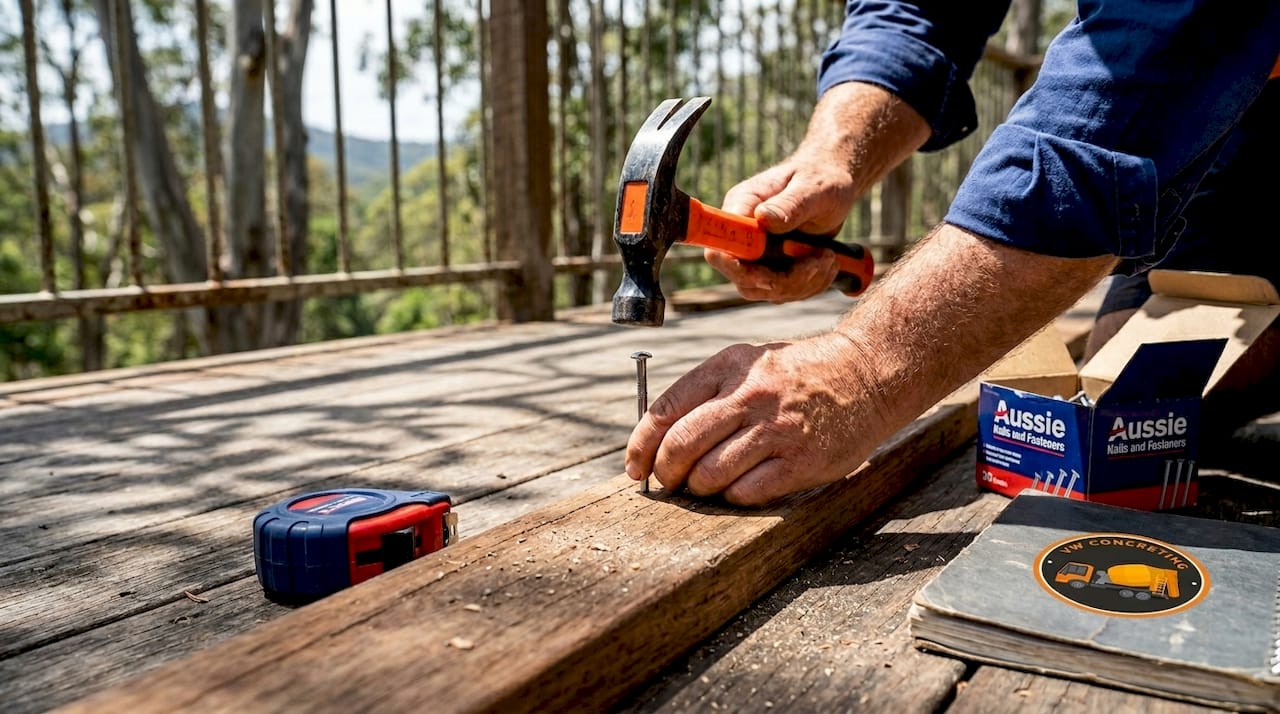
Working with concrete, brick, or block? Masonry nails are hardened steel with a fluted shank that grips masonry material without requiring pre-drilling. They’re driven with a heavy hammer and are useful for fixing timber plates to concrete slabs or attaching furring strips to brick walls. Attempting this with a regular nail will simply bend it on contact.
Ring shank nails
Ring shank nails have annular rings that dig into surrounding wood fibres as the nail is driven, creating a mechanical lock that dramatically increases pull-out resistance. We’ll cover this type in more detail in the next section. For now, know that they’re the preferred choice for any application where timber movement or uplift forces are a concern.
| Nail type | Shank style | Head type | Best use | Outdoor suitable? |
|---|---|---|---|---|
| Framing | Smooth or ring | Flat | Structural frames | Yes (galvanised) |
| Common | Smooth | Wide flat | Rough carpentry, formwork | Yes (galvanised) |
| Finishing | Smooth | Small barrel | Trim, cabinetry | Indoor primarily |
| Brad | Smooth | Near-headless | Light trim, beading | Indoor primarily |
| Roofing | Smooth or ring | Large/washer | Roofing materials | Yes |
| Decking | Ring or smooth | Dome/checkered | Timber decking | Yes (required) |
| Masonry | Fluted | Flat | Concrete, brick | Yes |
| Ring shank | Annular rings | Varies | Decking, fencing, flooring | Yes (galvanised) |
For a full rundown on Australian-specific applications, the construction nail types guide covers project scenarios in more depth. You can also explore nail types for Australian builds for guidance on matching species-specific timber to the right fastener.
Ring shank vs smooth nails: which holds better?
With the basics in hand, many projects boil down to a choice between ring-shank and smooth-shank nails. Let’s settle which is best for key situations.
This is one of the most practical decisions in outdoor construction. On the surface, both look similar. The difference lies in what happens after the nail goes in and time, weather, and movement start working against your build.
Ring shank nails increase withdrawal resistance by up to 2x over smooth shank nails by mechanically interlocking with wood fibres through their annular ring pattern. In an outdoor environment where timber swells and contracts with seasonal moisture changes, this grip is the difference between a solid deck and one that starts popping boards within a few years.
“Ring shank nails create a mechanical interlock with wood fibres that resists withdrawal forces significantly better than smooth shanks, making them the preferred option wherever timber movement, wind uplift, or vibration loads apply.” — Fastener USA ring shank analysis
| Property | Ring shank | Smooth shank |
|---|---|---|
| Pull-out resistance | High (up to 2x greater) | Standard |
| Ease of driving | Slightly harder | Easier |
| Removability | Very difficult | Relatively easy |
| Best application | Decks, fences, flooring | Framing, formwork, interior |
| Cost | Slightly higher | Lower |
| Noise/squeak prevention | Excellent | Fair |
For Melbourne fence builds exposed to northerly and westerly winds, ring shank is the safer call. The nail strength comparison guide breaks this down further for specific timber species and fence heights.
Pro Tip: If you’re building a deck near the bay or anywhere with salt-laden air, combine ring shank with hot-dip galvanised coating. You get both the grip of the ring shank and the corrosion protection of a heavy zinc coat. It costs a little more up front but saves you a full deck re-nail within five years.
There are situations where smooth shank is actually preferable. Formwork is a good example. You want to remove those nails after the concrete sets, so a smooth shank makes your life easier. Similarly, interior framing that won’t face moisture or movement loads doesn’t need the added holding power of ring shank.
Matching nails to your Melbourne project: quick recommendations
You’ve now got the specifics, so let’s make nail selection a breeze with some fast, scenario-based picks tailored for local jobs.
- Timber deck: Use galvanised or stainless ring shank decking nails, 50mm to 65mm depending on board thickness. For hardwood species like merbau or spotted gum, pre-drill slightly to avoid splitting.
- Structural wall frame: 75mm or 90mm hot-dip galvanised framing nails. Use a nail gun where possible for consistent depth. Smooth shank is fine here since the frame isn’t exposed to uplift forces.
- Timber fence panels and palings: Ring shank galvanised nails, minimum 50mm. Melbourne’s wind conditions demand the extra holding power, particularly for fences over 1.5 metres.
- Interior cabinetry and trim: 45mm to 50mm finishing nails, or 18-gauge brads for lightweight moulding. No galvanising needed indoors.
- Fixing to concrete or brick: Hardened masonry nails, 50mm to 75mm. Alternatively, consider a combination of masonry anchors and screws for anything load-bearing.
- Pergola or shade structure: Hot-dip galvanised ring shank or structural screws. A pergola takes wind uplift and lateral loads, so withdrawal resistance is critical.
Seasonal note: Melbourne summers can push hardwood decking to contract significantly in the drier months. Nails with a slightly oversized dome head give the board a little room to move without lifting at the edges. This small detail extends the life of your deck’s surface considerably.
For guidance on nails that deliver long-term results outdoors, nail types for durability is a useful resource to bookmark. And when your project involves mixing fastener types across concrete and timber elements, check out fastener selection tips for Victorian-specific advice.
As with outdoor nails at Bunnings, always buy more than you think you need.
Pro Tip: Add at least 10% to your nail count estimate before heading to the hardware store. Misdriven nails, splitting in tricky timber, and the inevitable “I’ll redo that one” moments all eat into your supply. Running out mid-job and making a second trip wastes an afternoon.
The crucial nail mistake even experienced DIYers make
Here’s an opinion that might sting a little: most DIY build failures we’ve seen in Melbourne aren’t caused by using the wrong type of nail. They’re caused by using the right type with the wrong coating.
We’ve inspected decks built with thick, long ring-shank nails that were falling apart within three to four years. The boards weren’t split. The timber was solid. But brown streaks ran down every board face from rusting nail heads, and when you pushed on the surface, the nails had corroded so badly they’d lost their grip entirely. The culprit every time: electro-galvanised nails used outdoors, or worse, bright steel nails that came in a bulk pack because they were cheap.
Electro-galvanised nails look shiny and well-finished. The zinc coating is even and attractive. But that coating is typically only 5 to 7 microns thick, compared to the 45 to 85 microns on a hot-dip galvanised nail. In Melbourne’s climate, with its soil moisture, morning dew, and occasional salt air, electro-galvanised nails in exposed conditions can start showing surface rust within 12 to 18 months.
Choosing durable nails means looking past the label and understanding what the coating actually delivers. For marine environments or coastal suburbs like Brighton or Williamstown, stainless steel is worth every extra cent. For general outdoor use further inland, hot-dip galvanised is the practical minimum.
The uncomfortable truth is that shiny, bright nails in the bargain bin are almost never appropriate for outdoor use, even if the shank style and size are exactly right. A properly coated nail that costs two or three cents more each is a far better investment than having to pull apart and re-nail a fence or deck two years after you built it. In our experience, spending an extra $15 to $30 on the right nails for a weekend project protects a $2,000 to $5,000 build. That maths is simple.
Get professional results for your outdoor projects
Sometimes a project grows beyond what a trip to Bunnings can solve. Whether you’re planning a new deck, a concrete path, a retaining wall, or a full garden transformation, having experienced local tradespeople involved from the start saves time, money, and headaches down the track.
At VW Concreting, we’ve been delivering high-quality outdoor construction across Melbourne since 2001, with over 145 completed projects covering everything from driveways and slabs to fencing, decking, and landscaping. Our team understands the specific demands of Melbourne’s climate and uses only properly specified materials, including the right nails and fasteners for every application. If you’re ready to take your outdoor project to the next level, explore how to choose the right concreting services for your needs, or browse our completed driveway and slab projects to see the quality we deliver.
Frequently asked questions
What type of nail is best for decking in Melbourne?
Galvanised or stainless decking nails are ideal for Melbourne decks, as their corrosion-resistant coating handles outdoor exposure and seasonal moisture without staining or weakening the timber.
Do smooth or ring shank nails hold better in outdoor construction?
Ring shank nails hold significantly better outdoors, delivering up to double the pull-out resistance of smooth shank nails by gripping wood fibres through their annular ring pattern.
Can I use regular nails for masonry or concrete?
No. Only hardened steel masonry nails are suitable for driving into concrete or brick, as regular nails will bend, shatter, or fail completely on contact with hard masonry.
What’s a quick checklist for buying nails at Bunnings for outdoor projects?
Look specifically for hot-dip galvanised or stainless options, confirm the head style suits your application (dome for decking, flat for framing), and consider picking up a small pack first to test fit and drivability in your specific timber.
Recommended
- Choosing the right nail types for durable Australian builds – Aussie Nails and Fasteners Warehouse
- Construction nail types and their uses for Australian projects – Aussie Nails and Fasteners Warehouse
- Landscaping and concreting services in Melbourne
- How to choose fasteners and screws for Victorian projects
Leave A Comment